


Departing the BVI for open waters.
“Anchors aweigh” is a nautical phrase meaning a ship’s anchor is clear of the seabed and therefore the ship is no longer tethered to land and is ready to depart for the open sea.
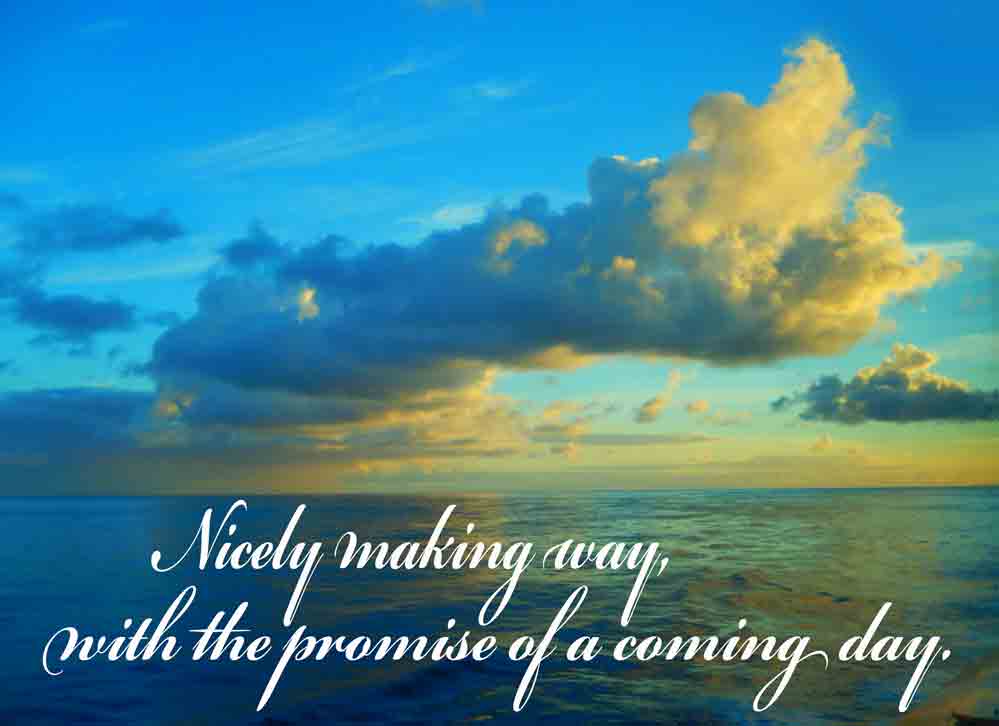
I first went to sea in 1965 and still, even today as we cruise, I feel that promise of adventure as the ship departs port…

The Norwegian Sun departs from Key West before sunset.
Going cruising? Here’s a quick lesson in speaking sailor – nautical terms 101
Aft: Toward the stern of the boat.
Ahead: The world in a forward direction.
Astern: The opposite of ahead, in the back of the boat.
Bow: The forward part of a boat. Usually the pointy end of a boat.
Bridge: A space for controlling the boat that usually houses steering, engine command, and communications.
Bulkhead: The nautical term for a wall.
Deck: The nautical term for a floor.
Galley: The ships kitchen.
Head: A bathroom on a working boat.
Helm: The wheel or tiller controlling the rudder which steers the boat. Oddly modern ships may not have a ships wheel.
Hull: The main body of a vessel designed to allow it to float.
Keel: the main element under the bottom of a boat that forms the foundation upon which the rest of the boat is built.
Leeward: The direction away from the wind. The opposite of windward..
Lines: The nautical term for rope.
Nautical Mile: One minute of latitude; approximately 6076 feet, about 1/8 longer than the statute mile of 5280 feet.
Port: The left side of a boat looking forward. Historically the side of the ship tied to a pier (port) Remember that port and left both have four letters.
Rudder: A vertical plate or board for steering a boat.
Square Knot: A knot used to join two lines of similar size. Also called a reef knot.
Starboard: The right side of a boat when looking forward. The names comes from historically the side of a ship where the stearing board was located.
Stern: The after part of the boat in nautical terms. The stern of a boat is the rounded or flat end of the vessel.
Windward: The side of the boat closest to the wind. When heeling over, this will always be the high side.
Nautically Terminology
“making way” means a vessel is actively moving through the water.
At a loose end: Nautically, loose ends are unattached things that are not doing their job. “Tying up loose ends” is used to mean finalizing details of a matter as a sailor makes fast the loose ends to ensure the boat is shipshape.
Batten down the hatches: Battening down the hatches was secure for bad weather.
Get underway: The “under” is likely to have meant “on the” and the “way” is the forward progress of the ship through the water, so it means going to sea.
Give a wide berth: Originally, a berth was a place where there was room to moor a boat. The meaning of “berth” was probably “bearing off”. Sailors were warned to keep a wide distance between moving boats. It could also refer to anchoring a boat far enough away from another to ensure they wouldn’t hit each other when swinging around the anchor from the wind or the tide.
Dead in the water: A negative term suggesting a ship wasn’t moving ahead like it should. Come from no wind in the sails or no working engine..

Planning A Cruise? Start By Checking Out The Intentional Travelers Port Guides
Looking for specific information?


Recent Posts From The Intentional Travelers You Might Find Interesting:






Still haven’t joined us?
You can unsubscribe anytime with an easy link right in our emails and we promise not to sell or share your contact information with anyone.
Isn’t it time you subscribed?

 The Intentional Travelers