Airline Frequent Flyer Programs

It’s been forty years since I earned my first airline “mile”. These industry programs became almost universal over a few years and were pretty simple to understand. Fly a mile and earn a mile and after accumulating a specific number of miles get a free ticket. There were a number of subtle variations like if you didn’t earn any miles over two years your mileage would be forfeit. Some allowed you to use small amounts to upgrade to first class on a paid ticket and many started programs with affiliated airlines.

Some added shopping and restaurant programs to encourage you to accumulate more miles and most started awarding bonus miles for getting and using their branded credit cards. Years ago business travelers like me benefitted the most because we were logging constant miles and while our employers paid for the tickets we got to use the free ticket awards.

Well things always change. Our first realization came about six years ago when a roundtrip flight to Australia only earned 5,000 miles instead of the 20,000 that we flew. It seemed we had bought a discount ticket and the seat code had a Z in it (American Airlines).

Isn’t it surprising how one company makes a change and all the rest follow. Between one and two years ago miles stopped being miles traveled but became a calculation based on the price of the ticket (that partial award based on the seat code also can still apply, please refer to the fine print).

Today we find it very difficult to calculate the actual miles we will be awarded with the award being fare based with additional reductions at times based on the ticket class or the writing agency.

Because most of these frequent flyer programs have evolved into complex constructs bringing together a number of businesses, the airlines have to be very specific regarding the rules of their award programs. Now the fine print covering the earning of miles looks more like an insurance policy than a marketing promotion.

Still if we are going to fly and regardless if you’re a frequent flier or even a not-so-frequent flier, not signing up for airline award programs is like leaving money on the tray table.

To provide information on some of these programs the following descriptions have been copied from the program web sites of each airline:

Delta

For Delta-marketed (flight numbers that include the “DL” airline code) or Delta-ticketed (featuring a ticket number beginning with “006”) flights, SkyMiles Members will earn miles based on ticket price, at the rate of 5 miles per U.S. Dollar (USD) spent, including base fare and carrier-imposed surcharges, but excluding government-imposed taxes and fees.

Earn miles in the air with 20+ partner airlines including Virgin Atlantic, Air France, KLM and Aeromexico. Earn miles on the ground with hotel, accommodation, car, ride sharing, shopping and dining partners.

With the Delta SkyMiles Credit Card from American Express, you earn miles on every eligible purchase on the Card. 

United

MileagePlus is much more than a frequent flyer program — you can earn miles with your daily activities and use them on trips, experiences, dining and more. Even better? Now those miles you earned will never expire. Download United MileagePlus X our new app that allows you to earn miles on the go. After you log in with your MileagePlus account. Your account information, including any payment cards stored in your profile, will sync up and be ready to go for purchases to get you on your way to earning more award miles.

United MileagePlus members will earn MileagePlus award miles based on the fare at 5 miles per dollar value. Flights operated by United and United Express, and Flights operated by a Star AllianceTM or MileagePlus partner airline for tickets issued by United (ticket number starting with “016”)

Tickets containing Basic Economy (N) fares are eligible to receive award miles based on fare at 5 miles per fare dollar and MileagePlus status, but will not receive any Premier qualifying credit.

American

As a member of the AAdvantage® program, you’ll earn miles when you fly on American, oneworld® and other participating airlines, as well as our partners. There are over 1,000 ways to earn miles with our partners – from car rentals and hotel stays, to dining out and using credit cards. Then, you can use your miles for:

  • Flights to nearly 1,000 destinations worldwide
  • Upgrades
  • Vacations, car rentals and hotels
  • Other retail products

American Award miles are awarded based on ticket price (includes base fare plus carrier-imposed fees, but excludes government-imposed taxes and fees). The more you spend, and the higher your elite status level, the more you earn.

  • AAdvantage® member – 5 miles/U.S. dollar
  • Gold member – 7 miles/U.S. dollar (40% bonus)
  • Platinum member – 8 miles/U.S. dollar (60% bonus)
  • Platinum Pro member – 9 miles/U.S. dollar (80% bonus)
  • Executive Platinum member – 11 miles/U.S. dollar (120% bonus)

Southwest

As a Rapid Rewards® Member, you earn points by flying or spending with our partners and can use them how and when you want. Plus, if you’re short on points, you can always purchase more to get that reward you’ve been eyeing. Booking a vacation without worrying about blackout dates. That’s Transfarency.®

Southwest Earn When You Fly The amount and type of fare you choose determines how many points you earn. Now you have another reason to go for that Business Select® Fare.

  • Business Select® 12 Points Earned per dollar
  • Anytime 10 Pts Per Dollar
  • Wanna Get Away® 6 Pts Per Dollar

JetBlue

JetBlue TrueBlue Program. No blackout dates on JetBlue operated flights. Use points for any seat, any time. Earn at least 6 points per eligible dollar when you book on jetblue.com. Points don’t expire. Earn and share points together with Family Pooling.

There was a time we made choices to stay with the major airlines based on what the points were worth to us and what we would save in dollars flying with a discount airline. Because now they’ve heavily discounted the number of award points we get, we find we are flying discount airlines much more often. Cash in pocket beats points almost every the time

Still we keep up with our memberships in those frequent flyer programs because there is no reason to not earn points when our only option is to fly those majors.


It’s been forty years since I earned my first airline “mile”. These industry programs became almost universal over a few years and were pretty simple to understand. Fly a mile and earn a mile and after accumulating a spefic number of miles get a free ticket. There were a number of subtle variations like if you didn’t earn any miles over two years your mileage would be forfeit. Some allowed you to use small amounts to upgrade to first class on a paid ticket and many started programs with affiliated airlines.

Some added shopping and restaurant programs to encourage you to accumulate more miles and most started awarding bonus miles for getting and using their branded credit cards. Years ago business travelers like me benefitted the most because we were logging constant miles and while our employers paid for the tickets we got to use the free ticket awards.

Well things always change. Our first realization came about six years ago when a roundtrip flight to Australia only earned 5,000 miles instead of the 20,000 that we flew. It seemed we had bought a discount ticket and the seat code had a Z in it (American Airlines).

Isn’t it surprising how one company makes a change and all the rest follow. Between one and two years ago miles stopped being miles traveled but became a calculation based on the price of the ticket (that partial award based on the seat code also can still apply, please refer to the fine print).

Today we find it very difficult to calculate the actual miles we will be awarded with the award being fare based with additional reductions at times based on the ticket class or the writing agency.

Because most of these frequent flyer programs have evolved into complex constructs bringing together a number of businesses, the airlines have to be very specific regarding the rules of their award programs. Now the fine print covering the earning of miles looks more like an insurance policy than a marketing promotion.

Still if we are going to fly and regardless if you’re a frequent flier or even a not-so-frequent flier, not signing up for airline award programs is like leaving money on the tray table.

To provide information on some of these programs the following descriptions have been copied from the program web sites of each airline:

Delta For Delta-marketed (flight numbers that include the “DL” airline code) or Delta-ticketed (featuring a ticket number beginning with “006”) flights, SkyMiles Members will earn miles based on ticket price, at the rate of 5 miles per U.S. Dollar (USD) spent, including base fare and carrier-imposed surcharges, but excluding government-imposed taxes and fees.

Earn miles in the air with 20+ partner airlines including Virgin Atlantic, Air France, KLM and Aeromexico. Earn miles on the ground with hotel, accommodation, car, ride sharing, shopping and dining partners. With the Delta SkyMiles Credit Card from American Express, you earn miles on every eligible purchase on the Card. Miles you can use to go see the world. With each Card, you enjoy distinct benefits.

United MileagePlus is much more than a frequent flyer program — you can earn miles with your daily activities and use them on trips, experiences, dining and more. Even better? Now those miles you earned will never expire. Download United MileagePlus X our new app that allows you to earn miles on the go. After you log in with your MileagePlus account. Your account information, including any payment cards stored in your profile, will sync up and be ready to go for purchases to get you on your way to earning more award miles. United MileagePlus members will earn MileagePlus award miles based on the fare at 5 miles per dollar value and MileagePlus status for the following flights, with some exclusions as listed at the bottom of this page. Flights operated by United and United Express, and Flights operated by a Star AllianceTM or MileagePlus partner airline for tickets issued by United (ticket number starting with “016”). Tickets containing Basic Economy (N) fares are eligible to receive award miles based on fare at 5 miles per fare dollar and MileagePlus status, but will not receive any Premier qualifying credit

American As a member of the AAdvantage® program, you’ll earn miles when you fly on American, oneworld® and other participating airlines, as well as our partners. There are over 1,000 ways to earn miles with our partners – from car rentals and hotel stays, to dining out and using credit cards. Then, you can use your miles for

American Award miles are awarded based on ticket price (includes base fare plus carrier-imposed fees, but excludes government-imposed taxes and fees). The more you spend, and the higher your elite status level, the more you earn.

Southwest As a Rapid Rewards® Member, you earn points by flying or spending with our partners and can use them how and when you want. Plus, if you’re short on points, you can always purchase more to get that reward you’ve been eyeing. Booking a vacation without worrying about blackout dates. That’s Transfarency.® Southwest Earn When You Fly. The amount and type of fare you choose determines how many points you earn. Now you have another reason to go for that Business Select® Fare.

JetBlue JetBlue TrueBlue Program. No blackout dates on JetBlue operated flights. Use points for any seat, any time. Earn at least 6 points per eligible dollar when you book on jetblue.com. Points don’t expire. Earn and share points together with Family Pooling.
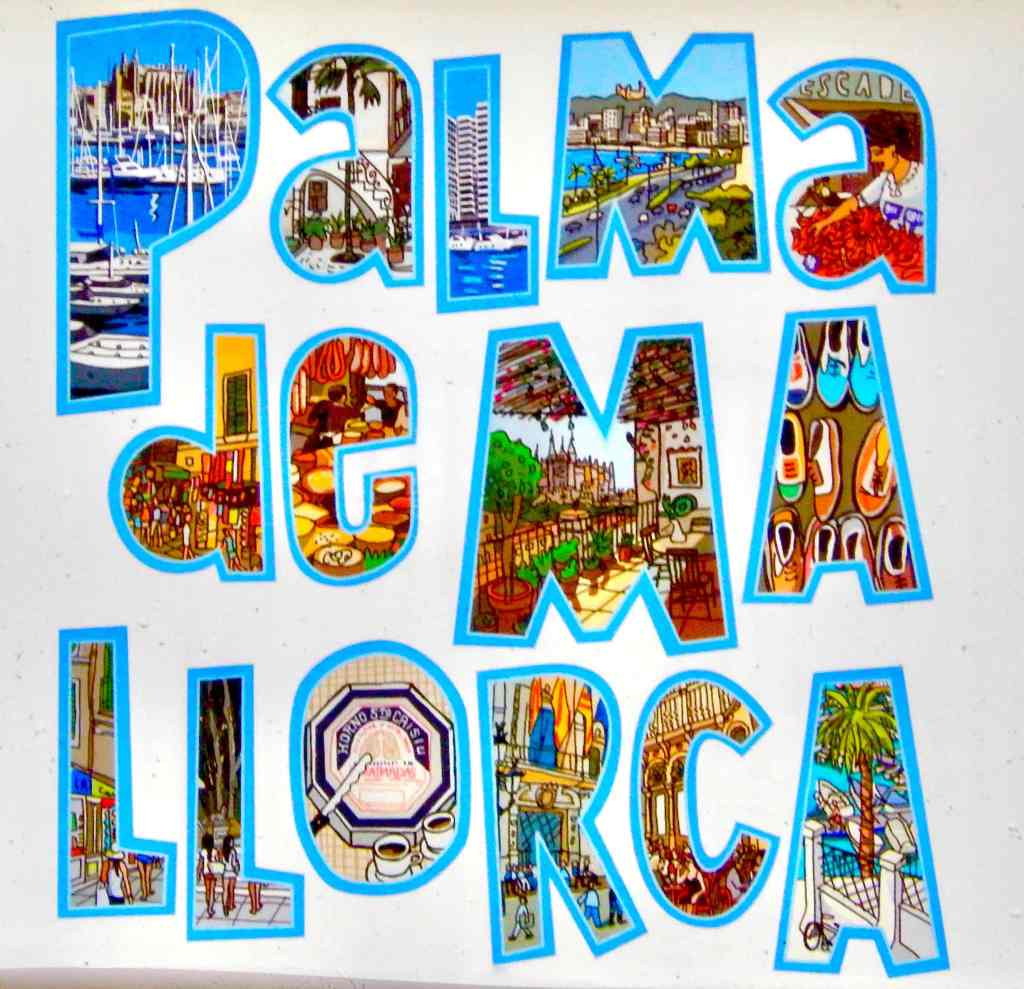
Port of Call Palma de Mallorca

Mallorca is the largest of Spains Balearic Islands and a major vacation destination for many western and northern Europeans attracted to its beautiful beaches, sunny climate and crystal clear waters.

Cathedral of St. Mary

Palma is an ancient port with architecture showing the influence of both Christians and Moors in its castles, fortifications, cathedrals and in the winding streets of the old town. If you like to walk this is a great place to spend time exploring. The city is also famous for its many excellent tapas bars and restaurants.

Where Your Ship Dock – Palma de Mallorca has two areas where cruise ships dock. Most cruise ships will dock at Estacio Maritime which has a modern terminal and is about four miles from the old historic district. If that port is full your ship will dock in the industrial area at Porto Pi which is six miles from the old city. While the Porto pi facility doesn’t have the modern terminal it does have a major shopping mall just a short walk outside the port entrance. Both ports will allow passengers to walk out but in either case it is a good hike into town.

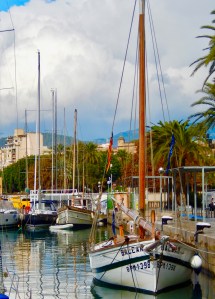
Palma Marina and waterfront

Transportation – Most ships provide shuttle service into the town center averaging about $15 round trip.

Public transportation – provided by a number of private bus lines that cover the island. Information about schedules and routes can be found at the TIB website . One popular destination is the beach resort area of Palmanova with regular bus service provided from the port areas on bus numbers 105 and 106 for about three Euros each way.

Taxis – In the city and around the port taxis are readily available. A taxi out to Palmanova or the airport would cost about twenty five Euros.

Money – The Euro is the local currency and credit cards are generally accepted and there are ATM machines available.

Attractions

Castell de Bellver is a fourteenth century circular castle set on a wooded hilltop overlooking Palma, it is home to the city’s history museum.

Cathedral of St. Mary of Palma is a Gothic cathedral overlooking the sea. It features a vast rose window and a wrought-iron canopy by Gaudí. It was built on the site of a Moorish Mosque and was begun by King James I of Aragon in 1229 and is one of the tallest cathedrals in Europe.

Castell de Bellver

Miro Museum and Workshops where Miro painted and sculpted from the 1950s to the 1980s and houses a number of permanent and visiting exhibits.

The Royal Palace of La Almudaina is the fortified palace of Palma where the Spanish Royal Family often stays in Summer and at Easter.

Beaches – Cala des Grells, Dic de l’Oest is a beach within a 30 min walk from the center of town and 5 minutes walking from Porto Pi port and shopping center and its neighbour. It’s possible to get there by bus (line 1) and by car (maximum 15 min from everywhere). There is a free parking for cars. However, the beach doesn’t have more than 50 people in summer and the water is clean. Excellent open sea views.

Beach Resort Area – Six to eight miles down the coast from the port are the beach resorts of Palmanova. The resorts are located around three beautiful bays, Playa Son Matias, Playa de Palmanova and Playa Es Carregador.

Athens Metro • Piraeus To The Acropolis

Visiting the Acropolis from the port of Piraeus Greece

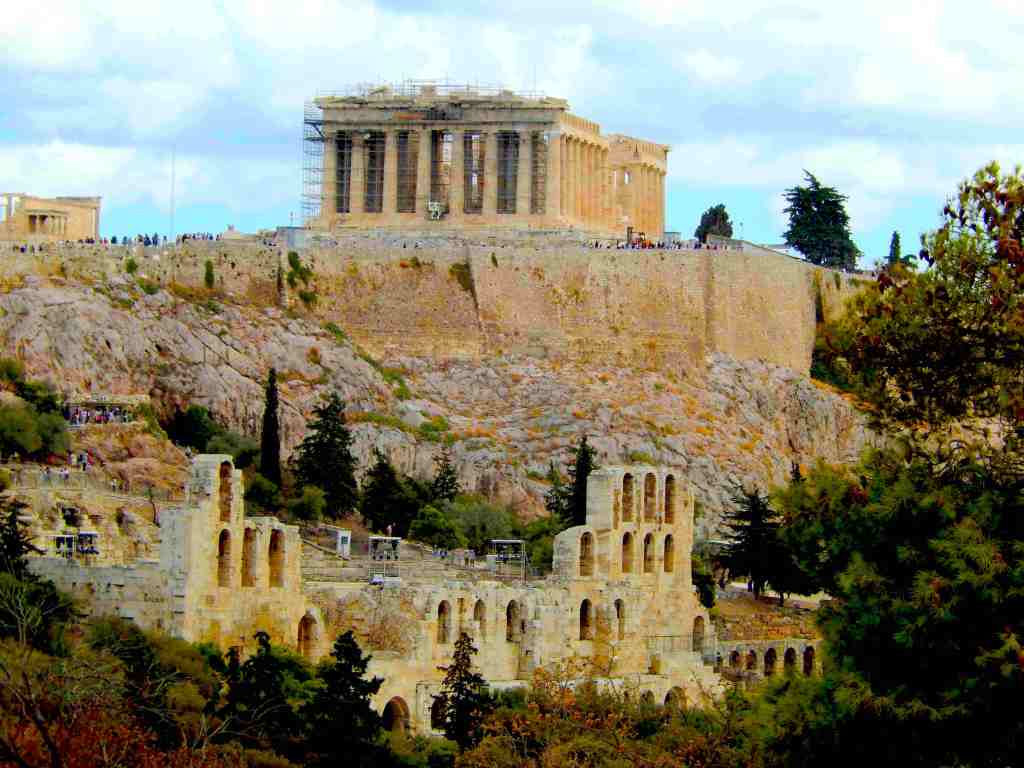
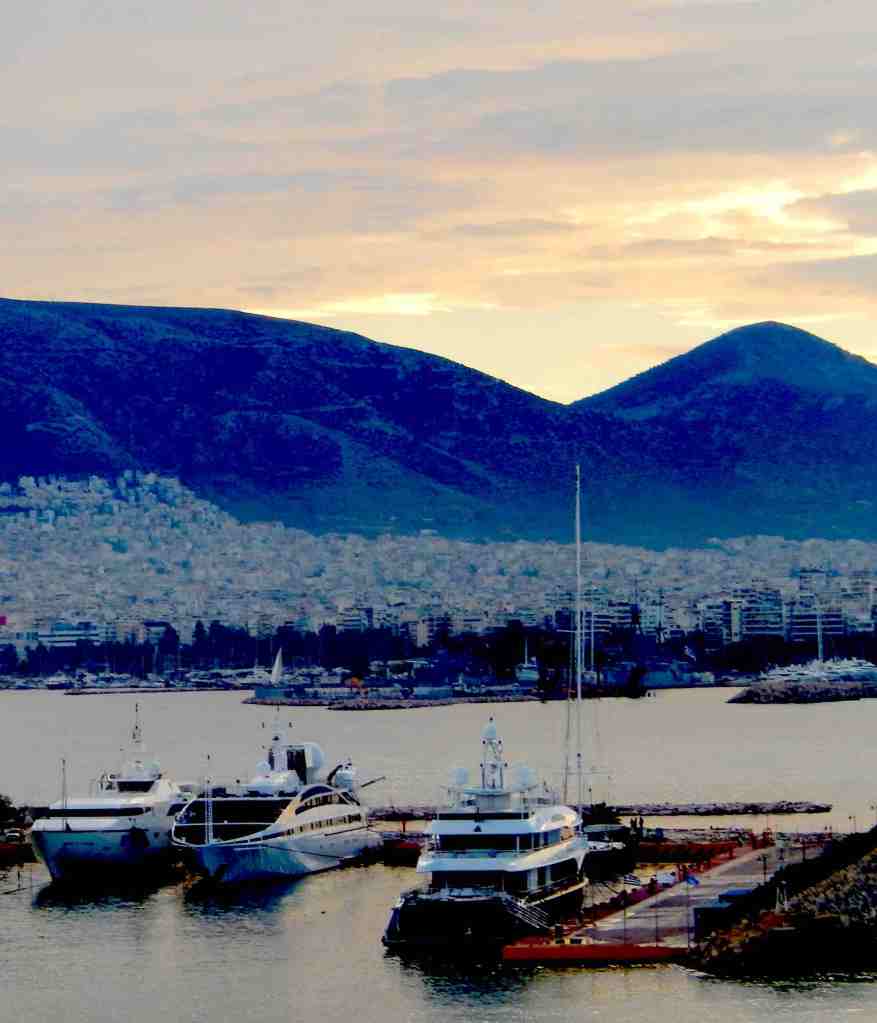
The View From The Filopappou Hill

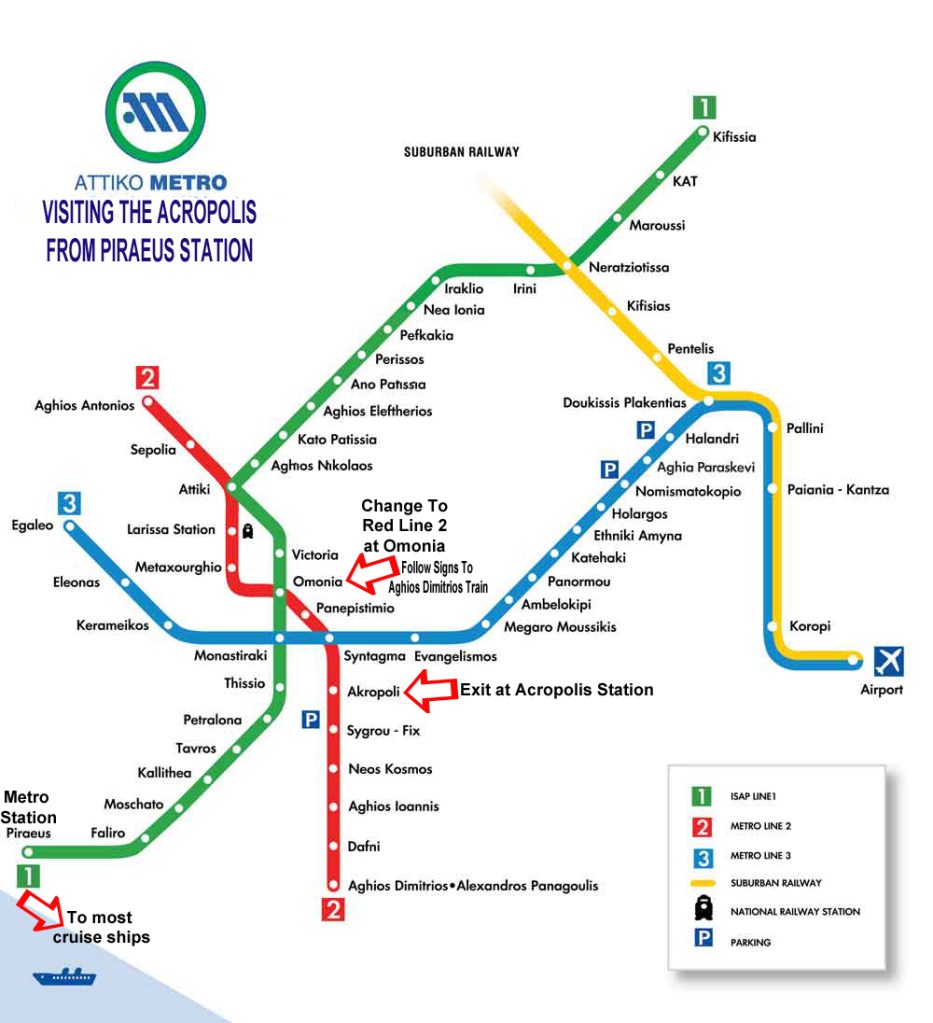
An easy trip from the port of Piraeus into Athens for a visit to the Acropolis is inexpensive and takes about forty minutes each way. The main Piraeus Metro station is located at the back of the port itself and is a fifteen to twenty minute walk from where most cruise ships dock. If you are walking from the pier there is a sky walk over traffic at the subway station location. The Metro (subway) system in Athens offers various kinds of electronic tickets but for a single day trip the best option for a trip into Athens and back is the 90-minute ticket at € 1.90 each way.

There are also:

A 24-hour ticket at € 4.50 that allows 24 hours to travel any number of times in and out of the various public transportation systems. It does not however include the airport as a destination)

A 3-day ticket at € 22 (Includes transport to the airport)

5-day tourist ticket at € 10 (It does not include the airport destination)

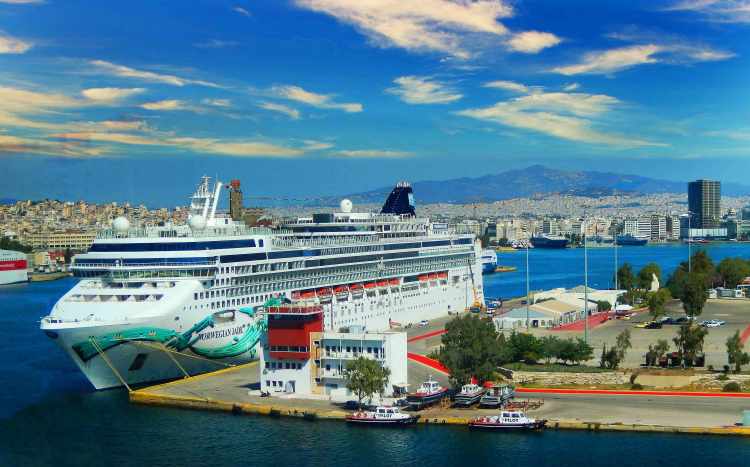
Piraeus Harbor

There are easy to use vending machines at all stations that accept credit cards and provide instruction in a number of languages. You can also purchase any number of tickets at one time and use them as needed. A discount of 25% is also available for seniors over 65, teenagers under 18 years old and university students under 25. Children under seven ride free. In order to get the discount you will need to purchase tickets from a ticket window.

To enter the metro system tap your ticket at the entry post. From that point the ticket is valid for 90 minutes (with the 90 minute ticket) in the system or until you leave by taping out to exit.

Getting on the train going in the right direction is easy. Each platform is named for the last station on the route. So in order to get the train back to Piraeus follow the arrows showing Piraeus which is the last station on the green line.

CLICK THIS MAP TO DOWNLOAD A PRINTABLE PDF COPY

Note – If you are flying in or out of Athens there’s an airport metro stop. The Athens airport subway offers reliable and fast transportation services from and to Athens airport. The Blue Line connects Athens International Airport to Syntagma Square in the center of the city, in only 40 minutes. A one-way Metro ticket from Athens airport to Syntagma Square costs € 10 for adult passengers and € 5 for children, students and elders. The price for a round trip ticket is € 18. Cruising out of the Port of Piraeus? Take the Blue Line to Monastiraki station, switch to the Green Metro Line to get to Piraeus. Furthermore, the subway Blue Line also serves many other areas of Athens. A 3-day tourist ticket includes a return ticket to Athens airport and costs € 22.

A Walking Tour Of The Acropolis Area

The Acropolis Museum

The Acropolis Museum

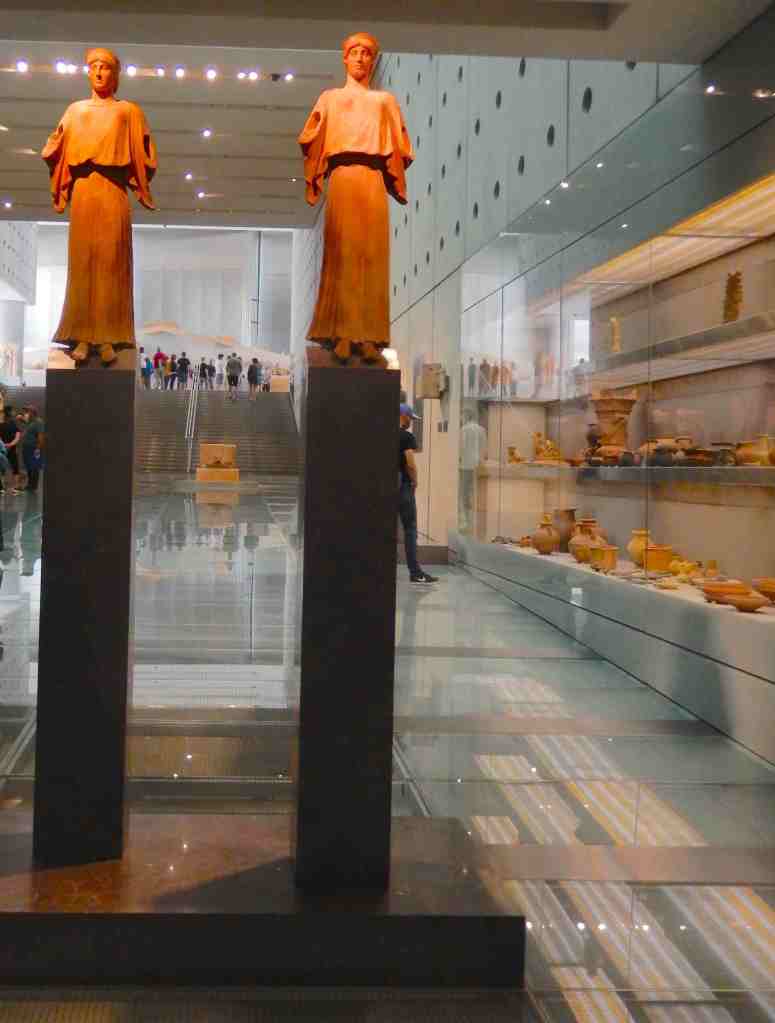
For a much more in-depth understanding of the history of Athen’s Acropolis a visit to the museum is strongly recommended (admission € 20). Inside are a number of artifacts from excavations along with many of the damaged statuary saved from the Parthenon itself.

The Agora and Roman Forum ruins of the Forum with remains of the agora built by the Romans from 19-11 B.C. include columns & an octagonal tower.

Roman Ruins walking around the base of the Acropolis are a number of archeological sites to explore that include Roman houses and the ancient cisterns.

Areopagus Hill (Λόφος Αρείου Πάγου) Historic site sitting high up on another hill it once served as the high court of appeal for judicial cases in ancient Greece.

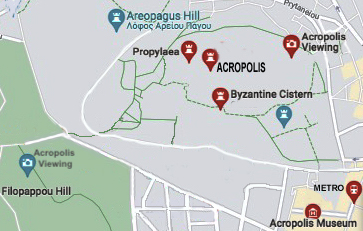
While the highlight of the trip is ascending the Acropolis itself there is much to see around the area. One recommendation is to walk through the Filopappou Hill Park. Admission is free and there are a number of archeological sites to explore. Walking to the top of the hill offers one of the best views of the Acropolis itself.


Planning A Cruise? Start By Checking Out The Intentional Travelers Port Guides

Looking for specific information?

Thanks For Visiting

The Port Of Call Malta

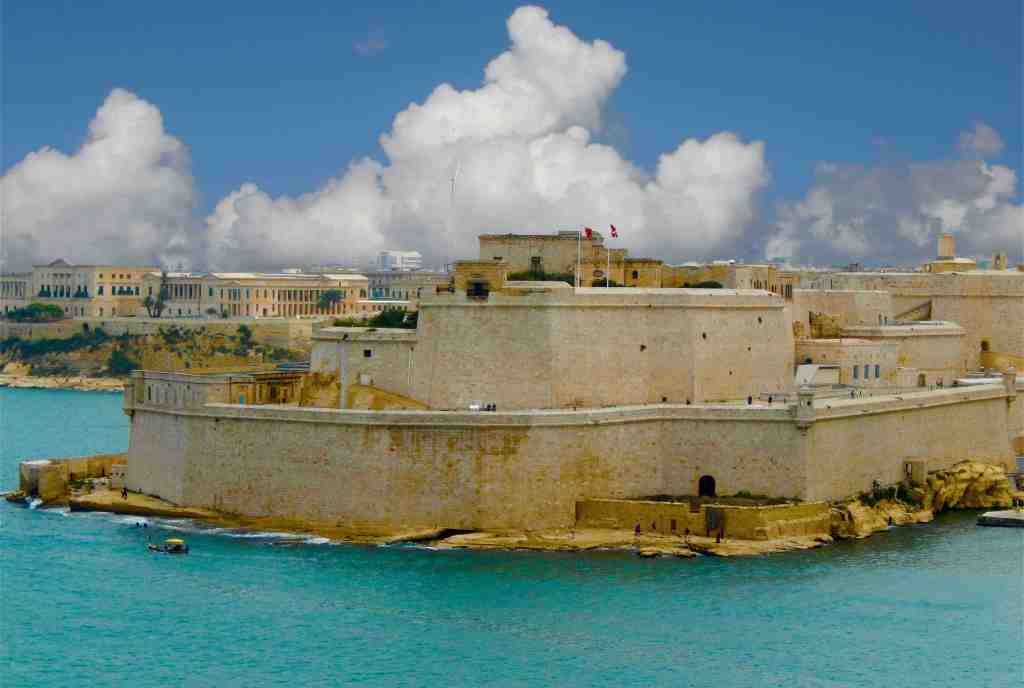
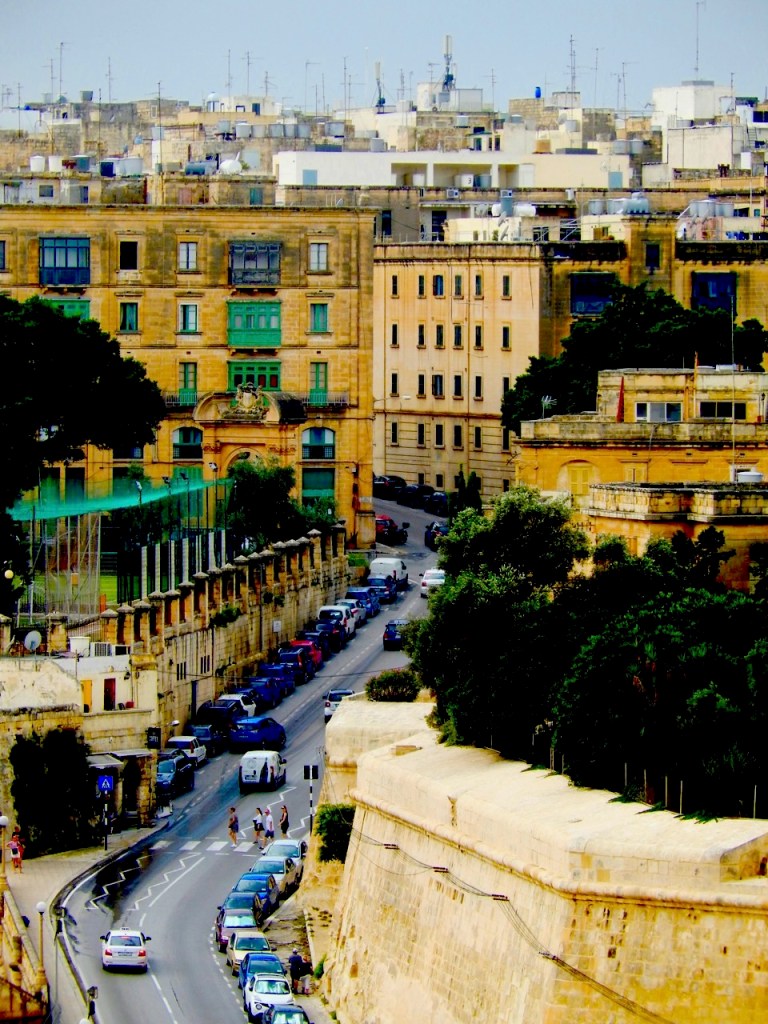
Malta sits in the middle of the crossroads of the Mediterranean being mid-way between Sicily and North Africa. It has played host to numerous civilizations which gives this island a unique culture. It is a blend of Arab, Byzantine and European cultures even with its own unique language. The island is blessed with the one of the Mediterranean’s largest natural harbors in the capital city of Valletta. The port is ringed by a number of massive fortifications with some dating back to the eleventh century.

Where Your Ship Docks – There are almost a dozen docking areas around Valletta harbor with several cruise ship docking areas being miles apart. Generally there aren’t anything you would call a cruise terminal but inside the security area at the docks there often are shops and public facilities. All docking areas allow walking out.

Transportation – Driving in the city is problematic, especially when it comes to negotiating tight corners and one-way streets and horrific rush hours. Parking is also limited, because in addition to the resident population, many Maltese drive into the city for business.

Buses are frequent with extensive routes. Fare is 2€ per trip but there is a “12 Single Day Journey” card for 15€ that can be shared by several people. While there is an unlimited tourist pass, unfortunately the shortest length is 7 days. There is also a circular bus route around the central city and harbor that serves all the docks. Look for buses with Kalkara Progress – Valletta markings. Tickets can be purchased from the Bus Driver on all these Buses. These Cash Tickets are Single Journey tickets that can be used to get to any destination within two hours, including interchanging. Rates vary between Summer and Winter months. Multi-day cards can be purchased at Sales and Information Offices and other leading outlets, and can be used immediately.
Currency – Malta uses the Euro and generally other currencies are not accepted. Most major credit cards are accepted and there are numerous ATM machines.

History – Malta has been occupied for about 5,000 years but became a pawn of numerous empires in the the Middle Ages when it became a crossroads in the Byzantine-Arab Wars. Invaded by the Arabs, who introduced new agricultural methods to the island. The Arabs also introduced the Siculo-Arabic language. The language is the basis of current-day Maltese.

The Normans took control of Malta around 1091, and were welcomed by the Christian population. At that time the Maltese islands became part of the Kingdom of Sicily, which encompassed half of Italy.

In 1530 the Order of Knights of St John or the Knights of Malta expanded to the island and ruled until 1798, building the present-day capital city Valletta.

The Sovereign Military Order of Malta, commonly referred to as the Knights of Malta, is a Catholic religious order, known for their military, chivalric and noble creed.

The Knights changed the face of the island building hospitals, increasing trade and erected massive fortifications. During the period of the Knights they defended Malta and held out for months during terrible fighting and huge assaults by the Ottoman army, in what is known as The Great Siege of 1565.

In 1798 Napoleon conquered the island, removing the Knights from power. In the six days after the victory a civil code was created for Malta. Slavery was abolished,Turkish slaves were freed and Napoleon himself created a primary and secondary education system.

The British Throne took over Malta after Napoleon and ruled the islands for the next 160 years.

Attractions – The Museum of Archaeology in Valletta houses an exceptional collection of prehistoric artifacts. The War Museum at Fort St. Elmo is home to a Sunday military parade in period costumes and the capital is home to the impressive Knights of Malta Grand Master’s Palace and St. John’s Co-cathedral.

With 7,000 years of history, there is much to see from megalithic sites, underground catacombs, churches and forts. Interactive walkthrough and multimedia attractions offer an overview of Malta’s history in under an hour. They’re interesting and a great way to learn the significance of what visitors will later be looking at.

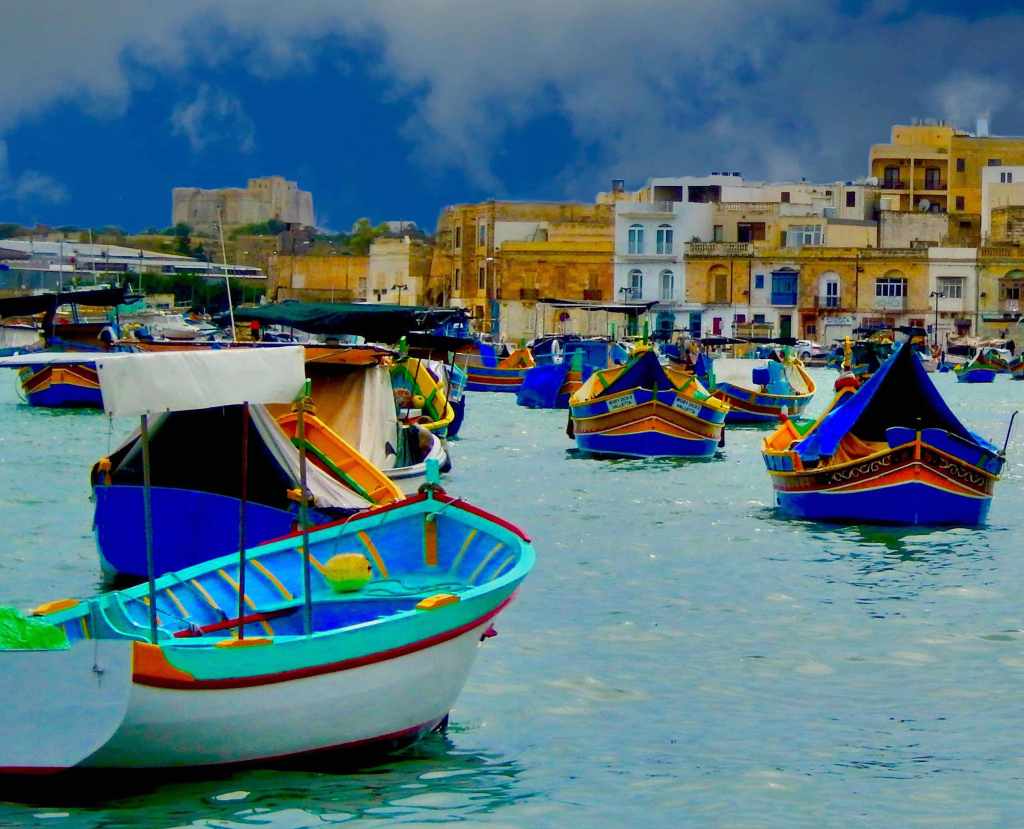
The picturesque southern fishing village of Marsaxlokk and neighboring resort town of Marsascala are also worthy of a visit.

The island of Malta is blessed with the one of the Mediterranean’s largest natural harbors in the capital city of Valletta. The port is ringed by a number of massive fortifications with some dating back to the eleventh century

Paris Metro – An Updated Tourists Guide

Seeing Paris On The Cheap

Fast approaching is another travel season and hopefully this Summer will be better than last. Of the world’s great destinations Paris is a true stand out and for good reason. If Paris is on your list here is a way to see the city and save some time and money in the process.

Seeing the sites in Paris can be a costly adventure especially if time is at a premium. First, the city itself is very large. On our recent trip we walked from Notre Dame to the Louvre, up to Sacre Coeur and back to Notre Dame and clocked fourteen miles. While there are a couple of hop-on, hop-off bus services like Big Bus Tours you can expect to pay between 40€ to 60€ per person. Add in a Seine boat excursion and it climbs to 75€ to 85€.

While Paris boasts one of the worlds oldest and largest subway systems (Metro) that includes 14 city lines, 2 Tramways and 6 RER express lines, it strikes most visitors as just overwhelming especially with the language issues.

To the left is the official system map and it does look imposing. The color coded, numbered lines are the city Metro routes. The lettered routes are the RER lines that feature express underground or subway trains in Paris city centre. Outside Paris the system becomes a ground level commuter trains that connect outlying suburbs. In addition, on the map there are 27 transfer stations along with connections to airport shuttles located around Paris.
Still our recommendation is to put your fears aside, focus on your goals and go underground.

We created our own map to simplify the system and focus on routes that have the highest value to a new visitor. They include Metro routes 1, 2, 3, 4, 6, 8, 10 and 12 and includes orange asterisks that highlight major areas of specific interest to tourist and includes major Paris attraction:

Want our simplified high resolution pdf map?  CLICK HERE
  • Eiffel Tower
  • Arc de Triomphe
  • Notre Dame
  • Sacre Coeur
  • Louvre
  • Champs-Élysées
  • Montmartre
  • Bastille

To simplify the map even more we have also removed the RAR express train routes as the Metro will get you to almost all major visitor destinations with much less confusion.

By simplifying the system you can now focus on where you will be entering the system, where you want to go and what lines you need to use to get there. To make sure you are going in the right direction make a note of a lines end stations as they are usually used to identify a trains direction of travel (Like Poissonniers for the North end of the number 4 line). If you aren’t staying on a line for the whole trip simply locate your destination station on the general map and find the transfer point to get you onto the proper line.

*Example: If you get on the number 1 (Yellow) Line at the Louvre and want to go to the Arc de Triomphe at the Charle De Gaulle Etoile station, look for a train with the destination of La Defense Grand Arche to be sure you are going in the right direction. If you want to go to Pigalle switch to the number 12 (Green) Line at the Concorde Station and catch a train marked Marx Dormoy.

Tickets And System Cost

There are visitor passes available for one to five days on the Metro in Paris center:

  • 1 day: 12€ (kids : 5.80€)
  • 2 days: 19.50€ (kids : 9.75€)
  • 3 days: 26.65€ (kids : 13.30€)
  • 5 days: 38.35€ (kids: 19.15€)

In addition there is a card for travel outside of the city center called the Mobilis Card for unlimited travel for one day in Zone 1-5 for 7.00€.

For most visitors it is often cheaper to buy one-trip tickets. A single ticket costs €1.80. A single ticket is valid for 1½ hours within the metro system but if unvalidated, will last indefinitely. The best buy is a ‘CARNET’ which is a pack of 10 single tickets. You won’t have to mess around buying tickets each time you use the train and you can split the pack with your companion. It is also cheaper buying a carnet than a single ticket each time. A carnet of 10 single tickets costs €14.10. Therefore a saving of 3.90 euros. Paris is a city of attractions and each stop can take a few hours to see,so buying single tickets can be much cheaper than a full day or multi day pass depending on your plans for the day.

Each ticket allows travel from an entry station to any exit station regardless of distance. Insert your ticket into the slot, when it comes out pass thru the gate. Be sure and carry that ticket with you until you exit the Metro above ground as tickets are occasionally checked inside the Metro to confirm validity (there are fines if you cannot produce the ticket).

Buying Tickets

You can buy a single ticket, a Carnet of tickets or recharge Navigo Decouverte passes at a green colored machine in the Metro or at ticket counters, but ticket counters are not always staffed and not all of the staff speak English.

You can use Euros, coins or debit/credit cards if they have a chip. Some machines are used only for re-charging Navigo cards and most newer machines offer instructions in several languages. Most machines have touch screens but some have a large silver cylinder shaped scroll device below the screen. Gliding your fingers on this will scroll up and down the screen.

Using The System

Once you have your ticket, go to the turnstiles. Slip the ticket in the slot, move forward but wait for the ticket to pop out at the top, than move through the turnstile and hang on to your ticket and don’t discard it until you have left the system. If a red light appears, the card isn’t being accepted. If you know it is a new card, go to a ticket counter.

Be prepared to do some walking in Métro stations, especially if you transfer. Transfers are free and can be made wherever lines cross, provided you do so within 1.5 hours. When you are looking for the right platform, follow the signs by the color of the line, the line number and the line end destination. When you transfer, follow the colored line number and end-of-the-line stop to find your next train, or look for signs that lead to your next line. At the destination look for the blue-and-white sortie signs pointing you to the exit. After you exit the system, dispose of the used ticket.

Train Differences

The Paris Metro is a blend of a number of lines with different ages.There are three types of trains with three types of door mechanisms. The newer trains have automatic opening and closing doors. Another type has a green button when pressed opens the doors. The third has a handle, which you pull up and the door will open.

Changing Trains

Upon leaving a train look for signs for your next line and the direction you need to go on the platform, and look for the line color, the line number and the end destination of the line. Also look for your exit and note if it has a number. As you walk through the station it helps to follow the numbers, rather than names.

Leaving The System

If the station has only one exit simply follow the SORTIE signs. Otherwise follow the SORTIE, exit signs to the right exit. On leaving you will find steel doors, there are two types; automatic and manual. You either push the doors open or you stand on a sensor pad and the doors will automatically open. In the larger and newly renovated stations there are turnstiles where you simply walk through.

There is also an APP for the Paris Transit System (the android app is HERE) for Apple and Android but thus far they reviews aren’t good.

Click below to download your free pdf copy of our Paris Metro map:

Ports of Tahiti, Bora Bora and Moorea

Adventures in Paradise

Called the French Society Islands they are better known by the individual island names of Tahiti, Bora Bora and Moorea with Tahiti being the largest. The islands are due south of Hawaii on the other side of the equator.

Tahiti is part of a volcanic chain formed by the northwestward movement of the Pacific Plate over a fixed hotspot similar to the process that formed the Hawaiian Islands. Tahiti consists of two old volcanoes—the larger Tahiti-Nui in the northwest and Tahiti-Iti in the southeast connected by an isthmus. Tahiti-Nui was the first eruption that formed Tahiti as a volcanic shield cone between 1.4 million and 900,000 years ago. Tahiti-Iti probably formed about 250,000 years later.

Where Your Ship Docks – In Papeete, Tahiti there are piers capable of docking large cruise ships right in the center of Papeete’s waterfront. Within a couple of blocks there are public facilities an outdoor market building and numerous shops.

Visiting Bora Bora and Moorea ships anchor out and use tenders to take passengers ashore. While both of these islands are famous for their resorts they are still significantly rural without much of a central town. Near the tender docks on both islands there are some shops and facilities and usually craft stalls are set up nearby when cruise ships are visiting

.

Tahiti has a long and rich history. The islands were first settled by migrating Polynesians as early as 500 BC. They were later discovered by European explorers during the 16th century but there is controversy over who was the first. The islands were eventually colonized by France and remain French today. In August 1768, Captain James Cook set sail from England to visit Tahiti to observe the Transit of Venus across the Sun and mapped several island groups in the southern Pacific that had been previously discovered.

Jardin de l’Assemblée de la Polynésie Francé

Getting Around – Except for taking a ships tour, the best way to see these islands is to rent a car. There are several major rental companies and day rates are moderately priced.

Language – The islands language is French and few locals speak English so you may have issues being understood.

Money – The islands use the French Pacific Franc equal to about one US penny. Some places will accept Dollars but don’t count on it. Credit cards are welcome almost everywhere.

Attractions

Farerei Haga – Mid September, a cultural and tourist event takes place over a whole week with the contribution of the surrounding atolls. Fields days coconut husking, stone lifting, braiding. Evenings: traditional songs and dances. Tourists are encouraged, the event is free and located on the Papaputa land.

Pacific International Documentary Film Festival – Early February the FIFO is the audiovisual event that makes Tahiti the documentary film capital of Oceania. It brings a selection of documentary films before an international jury. A succession of film screenings, free workshops, conferences.

Moorea Marathon – In late October is the most important sports event on the island of Moorea. The Moorea Marathon since 1988 welcomes runners from all over the world and its course ranks it among the worlds most challenging.

The Tahiti Pearl Regatta – in mid May a sporting regatta that brings together between 40 and 50 sailing boats, or 250 to 300 crew members from around the world.

Papeete, Tahiti celebrates the Mutiny on the Bounty Festival each year in late October which usually offers an opportunity to hear lectures on history, buy T-Shirts, souvenirs and books. Papeete is the governmental center of The Society Islands with Jardin de l’Assemblée de la Polynésie Francé being the house of the assembly.

Notre Dame Cathedral

While Tahiti is short on historic sites there is the Notre Dame Cathedral, a historic building with a mix of Colonial and Gothic styles. It is a Catholic church opened in 1875 and is noted for housing three bells in its tower. The truth is that most people don’t visit these islands for history but for the beaches and clear azure waters and coral reefs. The islands are surrounded by coral reefs that act to protect these islands from storms and the diving is some of the best in the world. There are fewer resorts on Tahiti than the other islands with only three really highly rated hotels, the InterContinental Resort Tahiti being the top rated.

Bora Bora seems to offer the better selection of beaches with a dozen four star resort properties including the iconic Bora-Bora Pearl Beach Resort with its over water bungalows (in season rates start at US$600 a nite).

While Moorea is beautiful it’s Bora Bora that steals the show for scenery. It includes breathtaking towering peaks, natural lagoons and spectacular coral reefs circling the island. If you’d like to spend time in these islands this is the island to come back to.

Bora Bora