During a short visit to Copenhagen, Denmark a group of our friends went off to see the changing of the guard at Amalienborg Palace. We headed off on our own with plans to find the Little Mermaid statue and stroll the canal district.
After finding the Little Mermaid and having coffee on the canal at Nyhavn we headed into the shopping district. Sometime a little after eleven we were window shopping along Dronningens Tvaergade when flashing police lights caught our attention. As we came out on the sidewalk we could see a crowd down the street at the next intersection.
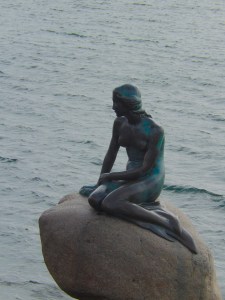
The Little Mermaid*
Walking down to the corner we were surprised to see the Danish Royal Guard marching down the center of the street led by a police car. Traffic was backed up behind them and crowds followed down the sidewalk. They came to our position just as the traffic light turned red and they halted. Once the light turned green their commander gave the command to march and they moved off on down the street in the direction of Amalienborg Palace.
Nyhavn
As it turns out the Danish Royal Guard march from Rosenborg Castle to Amalienborg Palace right through downtown Copenhagen for the Changing of the Guard ceremony at noon each day. The guard leaves Rosenborg Castle at 11:30 am to arrive at Amalienborg Palace for the ceremony a half hour latter. If the Queen is in residence at the palace the guard marching across the city is even more exciting as they are accompanied by the Royal Guards Marching Band.
*The Little Mermaid (Danish: Den lille Havfrue) is a famous bronze statue on a rock at the waterside by sculptor Edvard Eriksen, depicting a mermaid becoming human. The sculpture is displayed at the Langelinie promenade in Copenhagen.
Photography is my obsession and when traveling the world often images just present themselves. Most are random impressions with little context but some seem to suggest at a self contained story. Still others leave me wanting to find out more about what I stumbled upon. Here’s a glimpse of just why we travel…
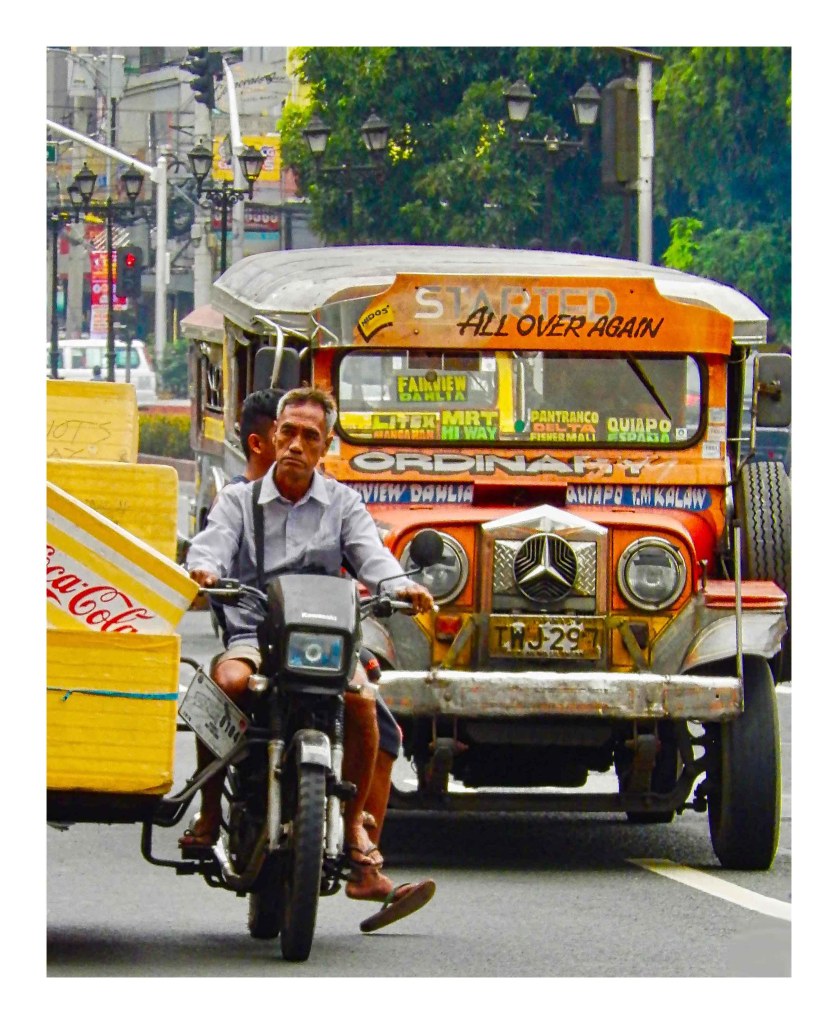
In Manila traffic you’re likely to see almost anything. Motor scooters with trailers, motorcycle delivery vehicles and the ubiquitous Jeepney. The origin of the Jeepney is found in U.S. Army jeeps left behind after WWII. Locals took the jeeps and turned them into minibus like public transportation. After the jeeps were used up Philippine shops started building the Jeepneys from the ground up. Today they are called just Jeeps and in most cities they serve as the most popular means of public transportation. They are known for crowded seating and outlandish decorations and are a symbol of Philippine culture and art. After taking this photo I was also fascinated by the sidecar delivery motor scooter and the passenger’s flip flop almost falling off…
Join us as we visit historic treasures, natural wonders and vibrant cities set against beautiful backdrops that are endlessly changing.
Join Us – We understand that the last thing you may want is more emails cluttering up your inbox, but we promise we’ll work hard to make this worth your while. Give us a try and if we don’t live up to our promise all you need do is click the unsubscribe link in our emails.
Featured above is St Colman Cathedral in Cobh, Ireland. The Cathedral of St Colman, usually referred to as Cobh Cathedral, or Queenstown Cathedral from the previous name of the town. It is a single-spire Roman Catholic cathedral built on Cathedral Place, and overlooks Cork harbor from a central position high above the town. It was completed in 1919, and is dedicated to Colmán of Cloyne, patron saint of the Diocese of Cloyne.
This picturesque Cork landmark attracts visitors and tourists from all over the world. St Colman’s Cathedral in Cobh is just a few minutes’ walk from the town centre. Perched on top of the hill and overlooking the town and the harbor, this neo-Gothic building is worthy of a visit and deserves its iconic status.
Join us as we visit historic treasures, natural wonders and vibrant cities set against backdrops that are endlessly changing and visually magnificent. Celebrate a world of travel experiences with these decorating accessories that are perfect for framing.
Join Us – We understand that the last thing you may want is more emails cluttering up your inbox, but we promise we’ll work hard to make this worth your while. Give us a try and if we don’t live up to our promise all you need do is click the unsubscribe link in our emails.
We have returned to Rome a number of times usually staying a few days with each visit. On a Mediterranean cruise a few years ago it was our sons first trip to Europe. The cruise originated and ended in Barcelona and the ship docked for one day in Civitavecchia the port servicing Rome. With the trip to Rome by bus takes an hour plus each way* that left about seven hours to actually see the city.
Rome is one of the world’s great cities. It is packed full of thousands of years of historic sites. It is home to one of the world’s major religions (yes, I know the Vatican is actually a different city/country). In addition Rome has some of the best food and shopping in Europe and then there are the concerts and opera…
So the challenge is what to do with eight hours in Rome? Since this day is focused on a first timer who probably isn’t real keen on shopping and the symphony and opera, that leaves historical highlights. Our eight hours in Rome started and finished at Vatican City where the cruise bus dropped us off.
Throwing coins in Trevi
The first time hurdle you will have to deal with in visiting the major sites in Rome, particularly in the summer, are the crowds. As hard as it is to believe, even the outdoor Fountain of Trevi in the summer, has huge crowds you need to navigate. Many other sites need tickets or hours waiting in line or both.
The Vatican Museum and Sistine Chapel – direct purchase tickets through the Vatican are 17 Euros and it will still require a fair amount of time in line to get in. You can get Skip-the-Line Tickets to the Vatican Museums & Sistine Chapel thru an agency for about 30 Euros but it requires doing this in advance. Without being aware of this the Vatican Museums & Sistine Chapel will use up too much time.
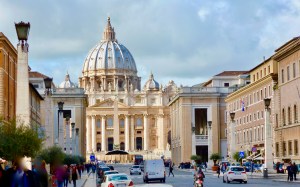
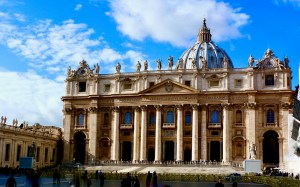
St. Peters Basilica
Getting into St. Peters is free but the lines usually will take up to an hour or more. Since the lines were already long we decided to try later when we returned to the Vatican.
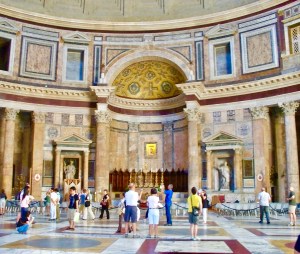
Interior of the Pantheon
From Vatican City we took a taxi over to the Pantheon, which is the oldest intact domed structure in the world and really deserves a look. Unfortunately even the Pantheon now requires admission tickets, instituted primarily to better control the crowds.
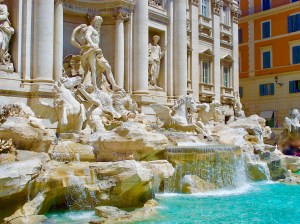
For the next stop it is important to have a really good sense of direction and a map or the use of the GPS on your smart phone because the next stop is only a modest walk away. Everyone has to put in an appearance at the Fountain of Trevi. Remember Anita Ekberg’s famous Trevi Fountain bathing scene from “La Dolce Vita,” and the tradition of throwing coins into the Trevi from “Three Coins in the Fountain”? Stand with your back to the fountain and throw a coin over your right shoulder and you will always return to Rome.
The Fountain of Trevi
The Spanish Steps
From Trevi still walking, head for the Spanish Steps another must do iconic site. While I’ve been there dozens of times I’ve never been sure what you’re supposed to do. Walk up and down? Sit and play an instrument (many do)? At least take a selfie that proves you were there.
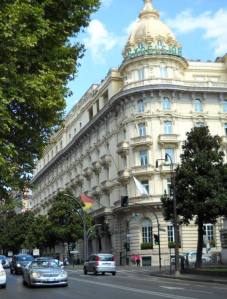
From the Steps another fifteen or twenty minutes walking will get you to the Via Veneto where, if you’re not into shopping at least sit at a café, have lunch or drink an espresso and watch the people passing by.
Via Veneto
Another option from the Steps is to head off in the opposite direction thru the Piazza Spagna, probably Rome’s favorite piazza. This is a great area for strolling and lunch or perhaps at least a cappuccino as you people watch and take in the sights around the piazza.
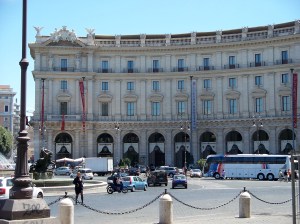
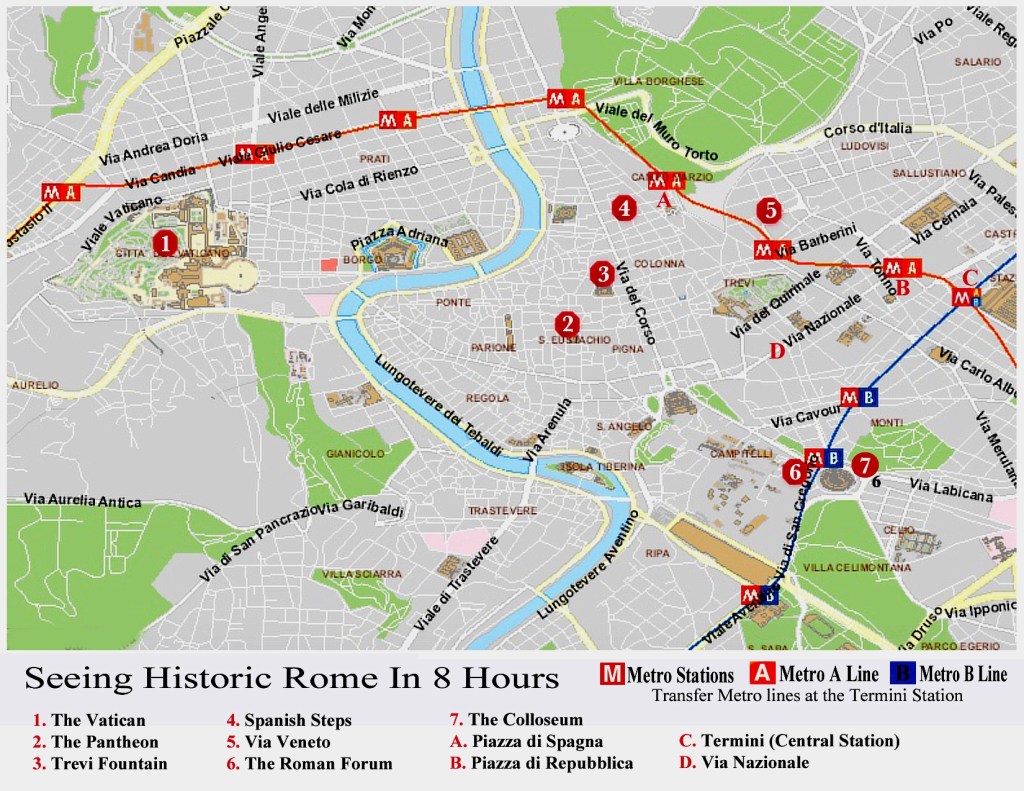
If you are on the Via Veneto and enjoy walking you can walk the dozen blocks over to the Piazza Republica and head down the Via Nazionale toward the Roman Forum. You can also catch the Metro at the nearby Barberini Metro Station and exit at the Piazza Republica.
Piazza Republica
If you are at the Piazza Spanga you can walk to the Roman Forum in about a half hour or catch a metro at the Spanga/Trevi station and take the A line and get off at the Piazza Republica station. From there you can walk or take a bus down the Via Nazionale to the area of the Roman Forum and the Coliseum.
Of course you can take taxis between the various locations. You should expect to pay 15 to 20 Euros per ride between these locations. A better option is rapid transit but in Rome it is somewhat fragmented between Metro and buses. With a little practice it is, by far, the best way of getting around Rome. The fare system is totally integrated, so you can pay and use the Metro trains and buses on the same ticket. A minimum fare is a BIT Standard ticket for one ride and costs about $2 per person. Our recommendation is a 24 hour pass for about $9. There are ticket machines at all Metro stations and they offer instructions in a number of languages and accept most major credit cards.
The Roman Forum
Once in the area of the Roman Forum you can walk thru the Forum, visit the Colisseum and Palitine Hill. The Colisseum requires admission tickets and you can expect the line to take up to an hour in Summer.
The Colosseum
Getting from the area of the Forum back to Vatican City by walking or by bus will take about an hour. A faster option is to pick up the Metro B Line at the Colosseo station, change to the A Line at the Termini stop and get off at Ottaviano – San Pietro station. The Metro trip should take 30 to 40 minutes so because of the time limit you might want to take a taxi (about 15 to 20 minutes for about $25).
Highlights:
St. Peters Basilica
Vatican Museum– A collection amassed by Popes throughout the centuries including some of the most renowned classical sculptures and most important masterpieces of Renaissance art.
Sistine Chapel – A large papal chapel built within the Vatican between 1477 and 1480 by Pope Sixtus IV, for whom the chapel is named. The ceiling along with a large fresco The Last Judgment on the sanctuary wall were painted by Michelangelo between 1508 and 1512.
St. Peters Basilica – Is an Italian Renaissance church in Vatican City, the papal enclave within the city of Rome. It was designed principally by Donato Bramante, Michelangelo, Carlo Maderno and Gian Lorenzo Bernini, St. Peter’s is the most renowned work of Renaissance architecture and the largest Christian church in the world.
Pantheon Exterior
Pantheon – meaning “[temple] of every god”) is a former Roman temple, now a church, on a site of an earlier temple commissioned by Marcus Agrippa during the reign of Augustus (27 BC – 14 AD). The present building was completed by the emperor Hadrian in 126 AD. Almost two thousand years after it was built, the Pantheon’s dome is still the world’s largest unreinforced concrete dome and one of the worlds oldest complete structures.
Fountain of Trevi – Is a fountain in the Trevi district. Commisioned in 1629 by Pope Urban VIII. Designed by Italian architect Nicola Salvi and completed by Pietro Bracci. It is the largest Baroque fountain in the city and one of the most famous fountains in the world.
Spanish Steps – This monumental staircase of 135 steps was built with 20,000 scudi bequeathed by French diplomat Étienne Gueffier’s in 1723–1725, linking the Bourbon Spanish Embassy, and the Trinità dei Monti church that was under the patronage of the Bourbon kings of France to the Holy See in Palazzo Monaldeschi.
Piazza Spanga – Is one of the most famous squares in Rome. It owes its name to the Palazzo di Spagna, seat of the Embassy of Spain to the Holy See. Nearby is the famed Column of the Immaculate Conception of the Blessed Virgin Mary.
Via Veneto – Is one of the most famous, elegant, and expensive shopping streets in Rome.
The Arch of Titus c. AD 82 near The Forum
The Roman Forum – A rectangular plaza containing the ruins of several important ancient Roman government buildings. Originally a marketplace, the Forum became the center of the Roman Republics government and was the heart of ancient Rome.
Colosseum – Originally known as the Flavian Amphitheater it is an oval amphitheater in the centre of the city. Built of travertine and brick-faced concrete, it is the largest amphitheater ever built. commissioned in A.D. 71 by Emperor Vespasian as a gift to the Roman people. In A.D. 80, Vespasian’s son Titus officially opened the Colosseum
Click map to download a pdf printable copy
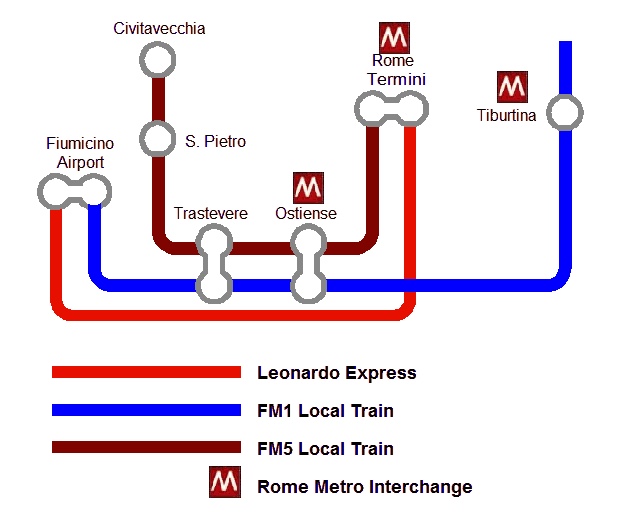
*If you have come to Rome on a cruise you’ll be docked in Civitavecchia and almost all cruise tours use tour buses to get into the city. St. Peters is usually the primary Rome drop-off point. That’s a minimum ride of an hour and a quarter. Our recommendation is to take the free shuttle bus from the port to the Civitavecchia train station and catch a train. Trains run every 20 to 40 minutes, cost only 9€, and the express trains take just 50 mins. Recently Civitavecchia Port has added an express train specifically for cruise passengers going to Rome (MORE HERE). The main train lines and stations are diagramed :
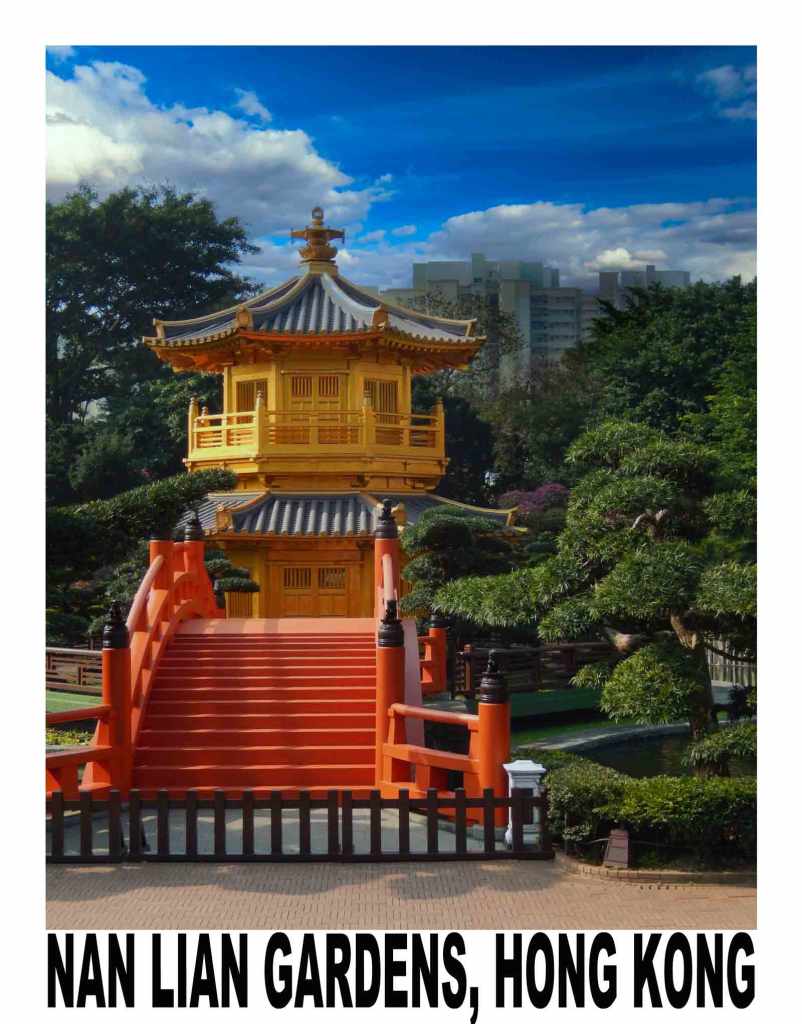
Nan Lian Gardens is a traditional Chinese garden situated in the heart of Hong Kong. This garden is an oasis circled by Hong Kong’s high rise towers and is open to the public with no admission charge. The garden features koi ponds, classic architecture, interesting historic exhibits, beautiful plantings and pleasant walking paths. A great place to spend a couple of peaceful hours away from the hectic city life in Hong Kong…
Join us as we visit historic treasures, natural wonders and vibrant cities set against backdrops that are endlessly changing and visually magnificent. Celebrate a world of travel experiences with these decorating accessories that are perfect for framing.
Join Us – We understand that the last thing you may want is more emails cluttering up your inbox, but we promise we’ll work hard to make this worth your while. Give us a try and if we don’t live up to our promise all you need do is click the unsubscribe link in our emails.
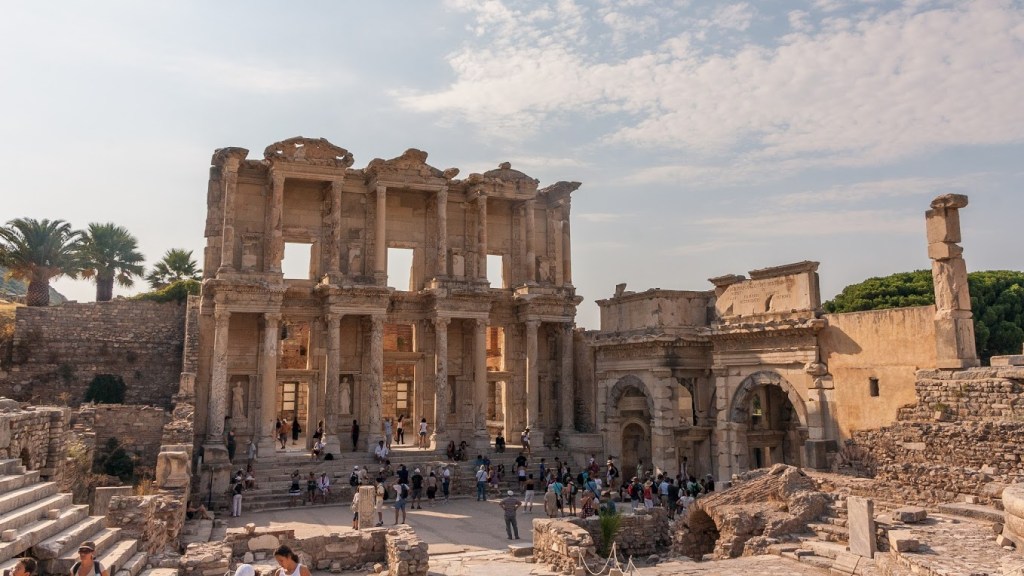
After Istanbul, Ephesus is one of the most popular tourist destinations in Turkey and it probably has been for over two thousand years. Today it is the site of an ancient port city with well-preserved archaeological areas. Two thousand five hundred years ago this city was considered the greatest of the Greek cities and the largest trading port in all the Mediterranean. Throughout history Ephesus has survived numerous attacks, changed hands many times and been the focus of many pilgrimages. It was also the center of early Christianity and remains one of the most important archaeological sites in the Middle East.
Visiting Ephesus
Mediterranean cruises will often make port calls on Kusadasi were tours to the ancient city are available. From Istanbul it is about 340 miles by car and a train or bus will cost about US$40 each way and take about eight hours. There are a number of beach resorts and good hotels in the area. Ephesus is located thirty five miles northeast of the Turkish coastal city of Kusadasi and sixty miles south of Izmir, Turkey. While it was once a major ancient port on the Aegean Sea at the River Kaystros, over centuries the river deposited silt into its estuary leaving Ephesus today some thirty miles inland.
Early History
According to legends there are two stories about the founding of the city. One is about an Ionian prince named Androclos who founded Ephesus in the eleventh century B.C. That legend claims that as Androclos searched for a location for a new Greek settlement, he turned to the Oracle of Delphi for guidance. The oracle instructed him to look for a boar and a fish that would show him the right location. Later Androclos was cooking fish over a fire. He dropped the fish and it landed in a bush. The bush caught fire and a boar ran out. Androclos built his new settlement where that bush stood and named it Ephesus.
The other legend says Ephesus was founded several hundred years earlier by the Amazon tribe of female warriors, and that the city was named after the Amazon queen, Ephesia.
Temple of Artemis
Much of Ephesus’s history is unrecorded and lost in time. We do know that in the seventh century B.C., Ephesus was ruled by Lydian Kings and was a major metropolis where men and women enjoyed equal opportunity and was the birthplace of the philosopher Heraclitus. The Lydian King Croesus, who ruled from 560 B.C. to 547 B.C., funded the building of a major temple for Artemis in Ephesus. Artemis was the goddess of the hunt, chastity, childbirth, wild animals and the wilderness and was one of the most worshipped Greek deities. Archeological excavations show that three smaller Artemis temples preceded the Croesus temple. In about 356 B.C., a fanatic named Herostratus burned down the Temple of Artemis. The Ephesians soon rebuilt the temple but made it bigger. It is estimated it was four times larger than the Parthenon and is known as one of the Seven Wonders of the World.
Today you can explore the ancient site including the library building, the Roman amphitheater, the forum and market street.
Christian History
Christian also believe that the Virgin Mary, mother of Jesus Christ, came to Ephesus with St. John after the Crucifixion of Jesus and the two lived the rest of their lives near the city. Today there’s a shrine, the House of the Virgin Mary based on a discovery in 1812 by following the instructions by the visions of Blessed Anne Catherine Emmericha a bedridden German nun showing stigmata wounds.
Later on the Apostle Paul’s third missionary journey starting in the summer of 53 A.D. he arrived in Ephesus. Like his stays in Syrian Antioch and Corinth, he lived in the city for probably three years. In the Bible the Letter To The Ephesians, the tenth book of the New Testament is credited as letters address by Paul to Christians in Ephesus.














 The Intentional Travelers