
Cruise Port Santorini Greece

Officially the Greek island of Thera But Popularly Referred To As Santorini
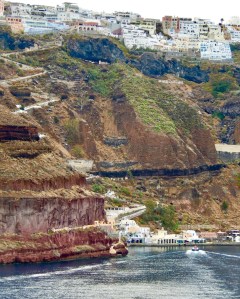
Looking up at Fira from the caldera at Old Port
Old Port below Fira

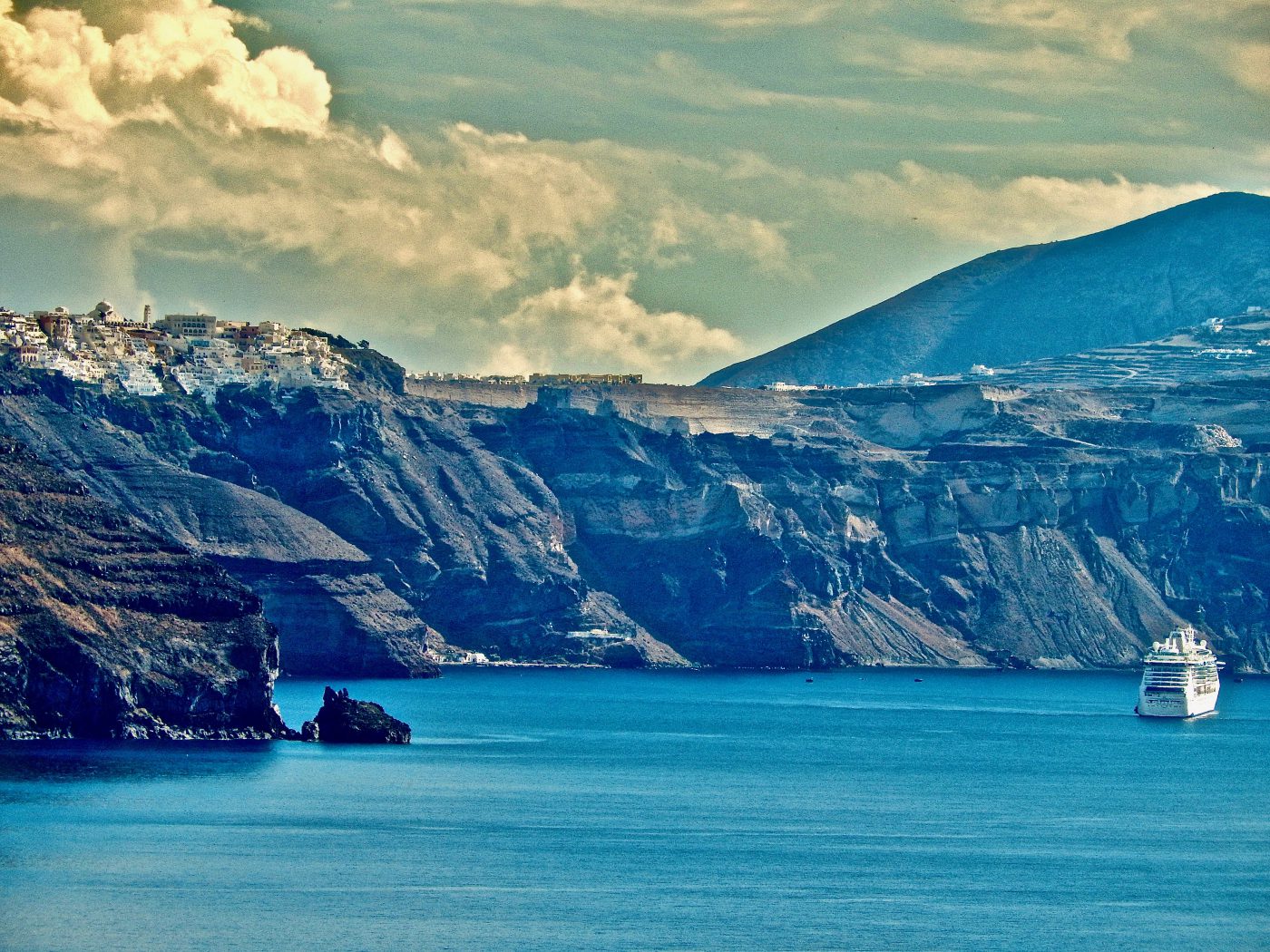
Cruise ships visiting Santorini will usually anchor out and tender in to the Old Port area. The anchorage is actually the caldera of an ancient volcano and the steep cliffs ringing the lagoon are what remains of the island after the massive explosion.
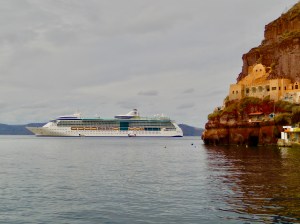
Cruise ship anchored off Old Port of Santorini
At anchor off Old Port

About 3,500 years ago in the Eastern Mediterranean a great Minoan civilization flourished. It was centered in Crete with towns and cities established on a number of nearby islands. From a number of archeological excavations we know that they built multi-story houses that were decorated with incredible frescoes and had advanced plumbing systems some with hot and cold running water. One of the richest cities was Akrotiri (not its ancient name because there is no known written record) located in the middle of trade routes connecting Crete, Cyprus, Greece and Egypt. On a day around 1625 BC it all came to an end as one of the largest volcanic eruptions of the last 5,000 years destroyed most of the island under Akrotiri. Shortly after that tsunamis from the eruption swept across Crete and dozens of other Minoan islands. Over a short period of time much of the Minoan civilization simply vanished.
Welcome to Santorini, Greece! Santorini was named in the thirteenth century after Saint Irene. The old name Thera was revived a century ago as the official name of the island but Santorini is still used.

Where You’re Ship Stops – There are only cruise ship piers on Santorini for smaller ships. Docking space is at a premium and most facilities are used by ferries and cargo ships. Most Cruise ships anchor out and use tenders to take passengers to the Old Port. Since the island is noted for its shear 900 foot cliffs that rise out of the sea, the first challenge you’ll face is getting from the limited sea level space up on top of the island.

Transportation – From the Old Port you will find four options to get up to the top of the island and the town of Fira. A mule ride (€8/$8.70), or a serious hike up 580 steps and on the same path used the mules (don’t wear shoes you don’t want ruined). There’s a modern cable car which costs €6 each way and takes 3 to 6 minutes unless there’s a long line which usually happens early in the day or within an hour or two of cruise ships departing. The island has a good bus service and reasonably priced taxis.
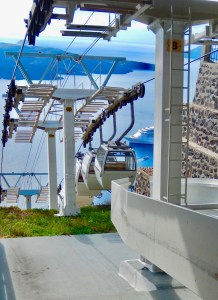
cable cars down to Old Port and cruise ship at anchor
Cabble cars down to Old Port

While Santorini has good bus service and a bus route does go to the Old Port area, it would probably be more efficient to take the cable car up to the town. If you want to see more of the island catch a bus in Fira or take a taxi. The island towns are very walkable with their unique white-washed stucco buildings and bright colored doors and trim being the picturesque hallmark of Santorini.

Bus Service – The island bus service is KTEL with the average fare being under €2. You find the fare schedule HERE and a system map HERE . Taxis – Taxis are available but catching one at the Old Port early in the day can at times be difficult. An average trip between towns will cost around €10 to €15. You can also have a taxi take you on a tour around the island but be sure and firm up a price before starting out.

Money – Like most of Europe the accepted currency on Santorini is the Euro. Credit cards are widely accepted but for incidental expenses you should carry some Euros.

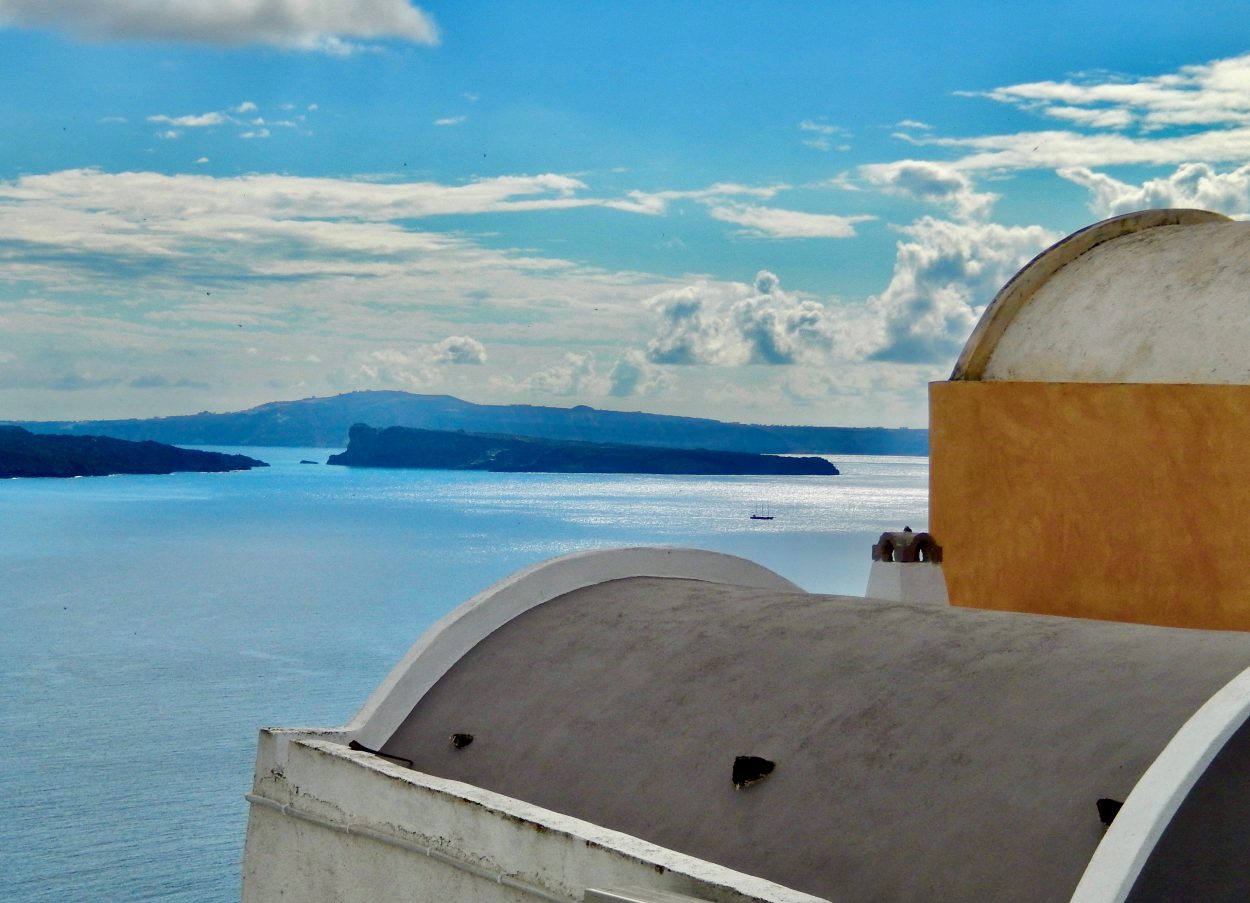
looking to the islands on far side of caldera fromSanto Wine patio
The view from Santo Wine

Things To Do – First, the island and it’s towns are the primary attraction. Your ship will be anchoring in a huge circular caldera with its shear inner walls forming the coast of several islands. Clinging to the upper sides of these cliffs are a number of iconic towns inviting you to stroll their streets.
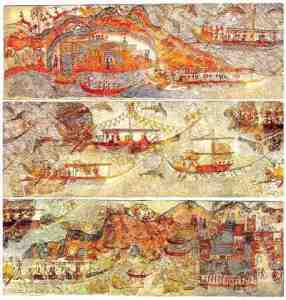
Minoan frescos of boating scenes from ruins at Akratiri
Akratiri Frescos

Minoan Akrotiri – A major archeological excavation site open to the public will probably exceed the size of the archeological excavations at Pompeii. It is also a treasure trove of some of the worlds oldest frescos, most preserved by the eruption showing remarkable detail and vibrant colors.

Wineries – Santorini is also home to a number of small, good wineries. The wine at the Santo Wines is only exceeded by the fabulous views from their patio. There are a number of wine tours available.

Donkey Rides – One option to get from Old Port up to the town of Fira (the islands Capital) is to ride the donkeys. These sturdy animals climb a winding trail that switches back and forth as you ascend about seven to nine hundred feet to the top. While not for everyone it is very similar to going down into the Grand Canyon by donkey.
Cruising Through The Panama Canal

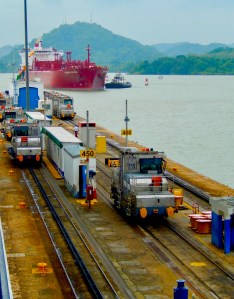
Above: A Holland America ship enters a lock on the left while a dry cargo ship gets ready to enter the lock on the right and a tanker exits the locks heading west.

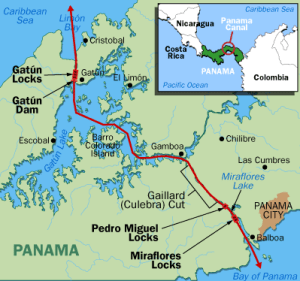
Going up a lock to Gatún Lake

The best way to experience the canal is on a cruise ship. Generally these cruises start from major cruise ports of Miami, Ft. Lauderdale, San Diego, Los Angeles and San Francisco. They usually include a number of itinerary stops that can include Grand Cayman, Cartagena, Columbia, Colon in Panama, ports in Guatemala, Costa Rica, Honduras and Mexico but the star of the trip is the Canal.

In 1880 the French tackled what was to be one of the biggest engineering projects ever. The intent was to dig a canal from the Caribbean across Panama to the Pacific Ocean. They were defeated by some mountains but mostly by a mosquito and the single celled organism that causes malaria.

In 1903 President Theodore Roosevelt of the United States took on the responsibility of getting done a long-term United States goal, completing the trans-isthmian canal. In order to get the U.S. authority a number of treaties were attempted and finally the U.S. backed a revolutionary movement that gained Panama independence from Columbia and granted the U.S. ownership of the property.
The new canal projects success was partly the result of healthcare advances made during the construction, led by William Gorgas, an expert in controlling tropical diseases including yellow fever and malaria. Gorgas was one of the first to recognize the role of mosquitoes in the spread of these diseases, and by focusing on controlling the mosquitoes greatly improved worker safety and health.

Gatún Lake

This slideshow requires JavaScript.

The American engineers abandoned the French plan of a sea level cut and went to a design using locks to lift ships up to the level of Gatún Lake and back down again. One of the biggest projects was the Culebra Cut through the roughest terrain on the route and remains one of the largest earth –moving projects ever tackled.

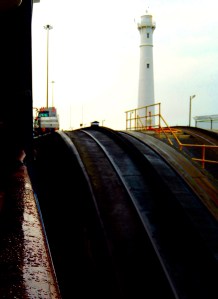
Transiting the locks

Later in the construction it was decided there would not be enough water reserves to operate the locks. Several dams were built with one being a dam at Pedro Miguel which encloses the south end of the Culebra Cut (actually an arm of Gatún Lake). The Gatun Dam is the main dam blocking the original course of the Chagres River, and resulted in creating Gatún Lake. Additionally two dams were built at Miraflores that enlarged Miraflores Lake.

Cabo San Lucas, Mexico
Mules prepare to receive a tanker
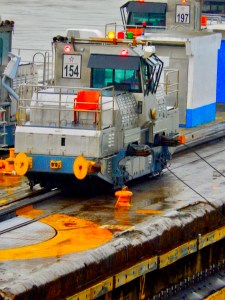
A new electric Mule

We have taken a couple of cruises that transit the canal and are always enthralled by the trip thru the locks and lakes of this remarkable place. Ships are pushed and pulled by tugs and canal rail engines called “mules” into locks with only inches of clearance. Water roars out of exhaust ports and massive ships rise and drop effortlessly within the locks.

Cruising across Lake Gatún is like a journey thru a primitive and beautiful rain forest with numerous islets. Dozens of ships glide along near us as they line up to re-enter the locks. Transiting the Culebra Cut with its walls towering above leaves us overwhelmed by the shear tonnage of dirt that had to be excavated and hauled away.

Many cruises stop at Cristobal Pier near Colon where locals offer crafts and wares for sale with usually Kuna Indians from the San Blas Islands among the merchants. Many of the cruise ships require a quick paint touch-up at the exit dock to cover up numerous rubs and scrapes from the passage through the locks

Up until recently the canal could only accommodate ships designated Panamax. Those original locks are 1,050 ft (320.04 m) in length, 110 ft (33.53 m) in width, and 41.2 ft (12.56 m) in depth. These limits have influenced the ship building industry to build Panamax vessels for the past hundred plus years

On September 7, 1977, President Jimmy Carter signed the Panama Canal Treaty and Neutrality Treaty promising to give control of the canal to the Panamanians in the year 2000. After Panama took control the Panama Canal Company started an expansion project. The expansion project started construction in 2007 and opened for commercial operation on 26 June 2016. The new locks allow transit of larger Post-Panamax and New Panamax ships, which have a greater cargo capacity than the original locks could accommodate. New Panamax ships will have a dimension of  1,200 ft (366 m) in length, 160.7 ft (49 m) in width and 49.9 ft (15.2 m) in depth. Unfortunately many of the cruise industries new mega-ships still cannot cruise the canal mainly because they are too tall to cruise under the bridge at the Pacific end of the canal.

All-in-all this is a fascinating journey and one of the three or four  best itineraries we’ve taken. The ports-of-call are an opportunity to visit a number of Central American countries and see some of this interesting region.

This is a very popular cruise itinerary, transiting the Panama Canal. Canal cruises generally cover three options. First is west to east normally starting in a California port like San Diego or LA and ending in a Florida cruise port like Miami or Ft. Lauderdale. Next there is the reverse, east to west finally some Caribbean cruises that include a trip part way through the canal returning to the Caribbean.

Port of Call Lisbon Portugal

It’s easy while walking the streets of Lisbon to think you have somehow slipped back in time. The port of call of Lisbon really seems to live in the past. Quant cobblestoned streets lead to plazas bordered by palaces, churches and castles. Attractive small cafes and restaurants abound and shops and galleries invite at every turn. Streetcars that look like they really belong in another time, glide down narrow streets. Even much of this cities graffiti rises to the level of fine art. Portugal seems to have deliberately let the world speed on by, having discovered a comfortable place to sit back and watch everyone else frantically race on to – not sure where.

Where Your Ship Docks

There is a stretch along Lisbon’s central waterfront where cruise ships dock. There are two terminals not far apart, Terminal de Cruzeiros de Lisboa and Terminal de Cruzeiros de Santa Apolonia. Both feature good access to ships and town and have free public facilities. Much of central Lisbon is within a mile of the cruise piers.

Transportation

Lisbon features a good public transport network, both underground and surface with buses and trams and can also add the Transtejo (river connection). Lisbon Metro is one of the most cost efficient and flexible ways of traveling around the city.

There are 24 and 48 hour passes available and the funicular system can also be used.

1 Day ticket (24h)

Carris/Metro 6.40€ -Valid for unlimited journeys on Carris and Metro, networks during 24 hours following the first validation.

Carris/Metro/Transtejo (Cacilhas) 9.50€ – Valid for unlimited journeys on Carris, Metro and Transtejo (river connection), during 24 hours following the first validation.

Ticket Offices are open every day 7:45 a.m – 7:45 p.m at the following Metro stations:

Marquês de Pombal, Campo Grande, Colégio Militar/Lu, Jardim Zoológico, Marquês de Pombal

Rossio, Baixa-Chiado, Cais do Sodré, Oriente Aeroporto. There are also vending machines at every station.

There is also a visitor’s card called the Lisboa Card where you get unlimited travel for 24 hours for just €20 that also includes free access to Lisbon’s best museums and attractions like the Torre de Belem, Jeronimos Monastery and the Santa Justa Elevator and more. You can buy the card online HERE.

Currency

The currency of Portugal is the Euro and major credit cards are welcome almost everywhere.

Attractions

Castles, museums, churches and palaces all within a mile or so from the cruise ship.

  • Castelo de S. Jorge at R. de Santa Cruz do Castelo. Hilltop Moorish castle & palace ruins
  • Jerónimos Monastery at Praça do Império 1400-206 Lisboa. World heritage listed Gothic monastery
  • Oceanário de Lisboa at Esplanada Dom Carlos I. Waterside aquarium with ocean ecosystems
  • Museu Nacional do Azulejo at R. Me. Deus 4. Ceramic collections located in a church
  • Belém Tower at Av. Brasília. Medieval defensive tower
.
  • Padrão dos Descobrimentos at Av. Brasília. Concrete monument to maritime explorers
  • Santa Justa Lift at R. do Ouro. Elevator linking city levels from 1902
  • Carmo Convent at Largo do Carmo. Medieval ruins & archaeology museum
  • Basílica da Estrela at Praça da Estrela. Baroque church with twin bell towers
  • Ajuda National Palace at Largo Ajuda 1349-021. 19th-century royal palace and museum
  • Arco da Rua Augusta at R. Augusta 2. Triumphal arch with a viewing platform
  • Miradouro da Nossa Senhora do Monte. Popular destination for city views
  • Museu Nacional de Arte Antiga at R. das Janelas Verdes. Historical art collection in old palace
  • Palácio dos Marqueses da Fronteira at Largo São Domingos de Benfica 1 Grand palace
  • Miradouro Sophia de Mello Breyner Andresen at Calçada da Graça, Terrace park featuring sweeping city views
  • Museu de Marinhaat Praça do Império Maritime museum in sixteenth century monastery

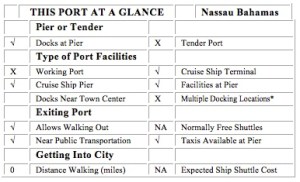
The Port Of Nassau, Bahamas

A favorite port for three and four day cruises out of Florida as well as returning longer cruises, Nassau has a lot to offer.

Where You’re Ship Docks

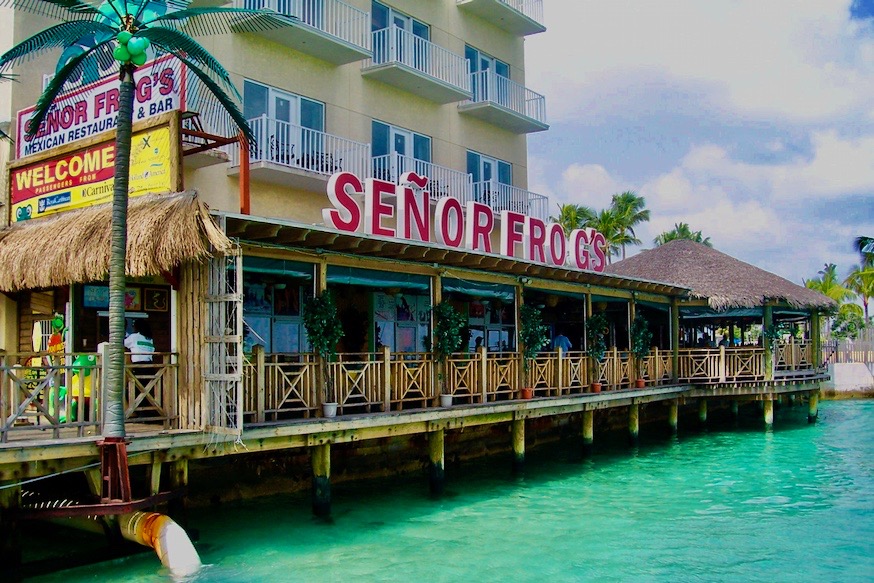
Cruise ships dock at Prince George Wharf, sometimes as many as five are there at once. The wharf is located right in downtown Nassau with a large number of good restaurants and plenty of “duty free” shopping. The island is also famous for it numerous great beaches as well as coral reefs, sport fishing and boating.

Downtown Nassau, The Bahamas

Crossing a bridge in downtown Nassau gets you to Paradise Island, home of Atlantis and other resorts. It is a two mile walk from the cruise piers over to Paradise Island across a connecting bridge.

Transportation
harbour light
Harbour Entrance

If you just want to walk around and see the town it is only a short stroll into the main downtown area. You can rent cars and scooters right at the wharf as well as book land and water tours. Taxis are readily available but you need negotiate price before heading out. If you are going to rent a car and especially a scooter pay special attention as the Bahamas drive on the left.

Currency

The countries currency is the Bahama Dollar which is on par with the U.S. Dollar but there is no need to change currency as the U.S. Dollar is readily accepted. Most major credit cards and many debit cards are welcome.

Cruise ships in port
Attractions

Because it is the nearest foreign country to the Eastern United States, Nassau takes full advantage of its duty free status. Downtown Nassau offers a number of opportunities for saving on duty free goods but know the U.S. duty free limits before you start shopping.

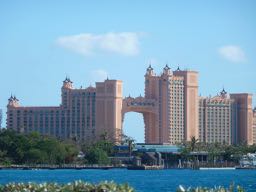
Traveling three miles east along the north shore out of Nassau you’ll find the exclusive Cable Beach area, a resort beach with great beaches and a number of good restaurants and spectacular resort hotels. Nearer to town there is also Paradise Island featuring the Atlantis resort (most cruise ships offer day tours over to Atlantis to visit the water park, beaches and exhibits).

Atlantis
Atlantis
  • Atlantis on Paradise Island   A destination all its own. Features aater park, aquariums, beaches, restaurants and more. Requires admission (day passes) unless you are a resort guest.
  • Fort Fincastle  1793 stone fort & former lighthouse
  • Ardastra Gardens Zoo, gardens & conservation center
  • Prince George Wharf    The cruise ship dock with local crafts and tour vendors
  • Clifton Heritage Park   Nature trails, historic ruins & beaches
  • Dolphin Cay Atlantis & Bahamas Dolphin Adventure  Marine habitat with dolphin interaction
  • Marine Habitat at Atlantis    Large aquarium at the upscale resort
  • Fort Charlotte   1788 stone fort with moats & dungeons
  • Queen’s Staircase   Stone staircase, circa 1793
  • Pirates of Nassau   Pirate museum with replica ships and good exhibits
  • National Art Museum Local history & art in a historic villa
  • Sea Trek Helmet Diving. An interesting way to explore under water

Good links for additional information:

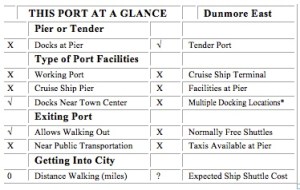
Dunmore East, Ireland A Port of Call

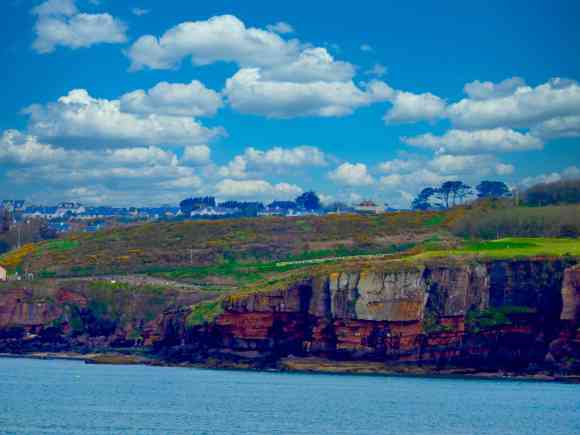
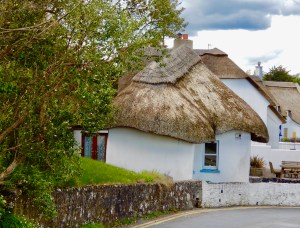
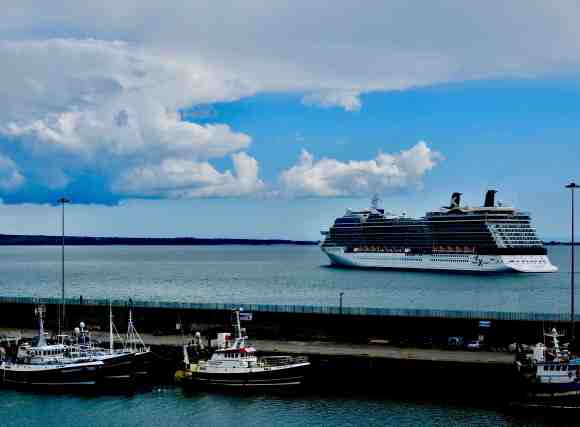
The port of Dunmore East is located very near the city of Waterford and while Dunmore East has a small harbor it is not an industrial port. The larger ships visiting are primarily cruise ships. The town itself is a quant seaside village with galleries, gift shops and restaurants and some nice walking trails along the shore. The villages charm and natural surroundings are well worth spending some time ashore. It is a bit isolated however and transportation options are few. It is also a tender port as there are no docks capable of handling large ships.

Where Your Ship Docks

Large ships cannot dock at Dunmore East and will anchor offshore. Tenders will bring you into an enclosed harbor that serves small commercial boats. The harbor is adjacent to the village proper and there are a number of shops and trails along the shore line.

Transportation – Because of the distance and lack of available transportation this is a port where booking tours thru the cruise ship might be a better option, especially if you want to visit Waterford. The trip into Waterford is about twelve miles and often cruise ships will offer a shuttle service to Waterford. The quickest way to get from Dunmore East to Waterford is a taxi which costs about $35 and takes about twenty minutes. The only other option is a direct bus service departing from Dunmore East and arriving at Lombard Street in downtown Waterford. Buses depart every four hours, and operate Monday to Saturday. Again the journey takes about 20 min.

Money – Ireland (the Republic) uses the Euro and generally do not accept the British Pound. Northern Ireland is separate from the Irish Republic, is part of the United Kingdom and uses the Pound.

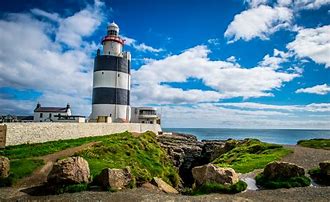
Dunmore East is located on the River Suir and as your ship sails in or departs you should get a good view of the Hook Lighthouse on the opposite shore. The area around the Suir and Waterford is home to a number of notable castles with some dating back to the twelfth century and the Viking era.

Attractions – Other than the scenery and the atmosphere of a quant seaside resort village most of the points of interest are located in the nearby city of Waterford.

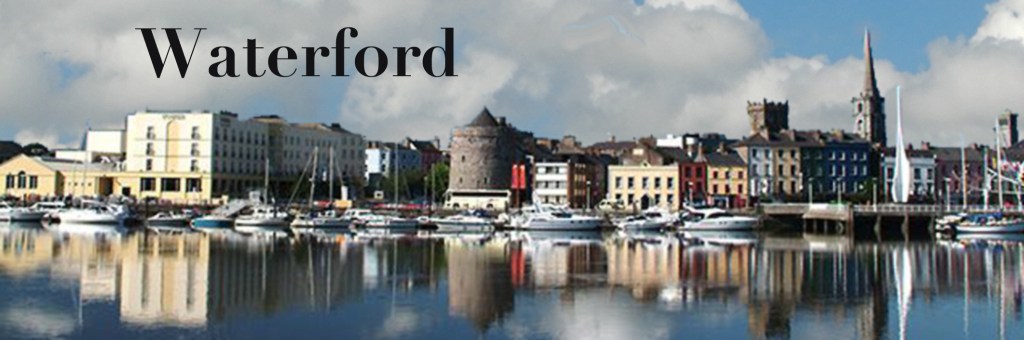
Waterford itself was once one of Ireland’s most important cities, It was historically a place of great wealth due to its role as a seaport and trading center. Much of this wealth was used to build the city’s public buildings in the 18th and 19th centuries. One of the most attractive and opulent of these is the Bishop’s Palace. A beautiful architectural treasure over 250 years old. It is now a museum with the ground and first floors furnished as a very elegant 18th century townhouse.

Waterford was originally established by Vikings and was a major Viking settlement for hundreds of years. In 914, the great Viking adventurer and pirate, Regnall, established a base here and built a Longphort or ships haven. In 918, Regnall took a fleet of ships and left Waterford sailing for York and he became the first Norse ruler with the title ‘King of Waterford and York’. The name Waterford is derived from its Viking name Vadrarjfordr meaning “haven from the windswept sea”. The City was captured by the Anglo Normans in 1170 and the Vikings were expelled. After that Waterford was raised to the status of Royal City owing allegiance to the Anglo Norman King of England, Henry II.

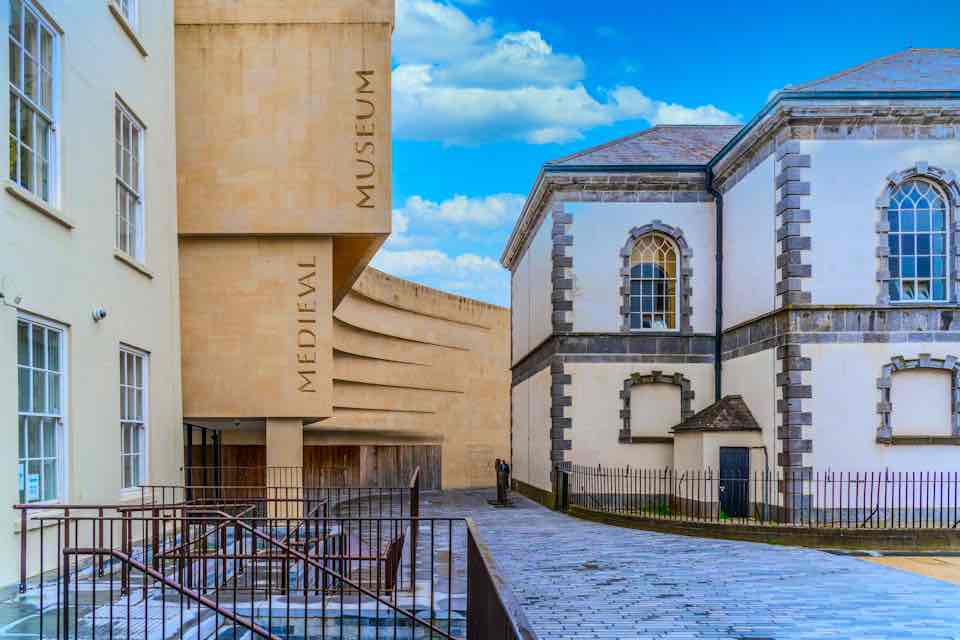
When visiting Waterford be sure and spend time visiting the Viking Triangle, a cultural and heritage area. The Viking Triangle is surrounded by 1000-year-old Viking walls. It is the ‘old town’ of Waterford and is just a short walk from the city’s shopping mall area. The Viking Triangle is an interesting place, with narrow streets and alleys to explore. Inside are a number of attractions of Ireland’s past, including the House of Waterford Crystal, the award winning Medieval Museum, Bishop’s Palace and Reginald’s Tower.‌

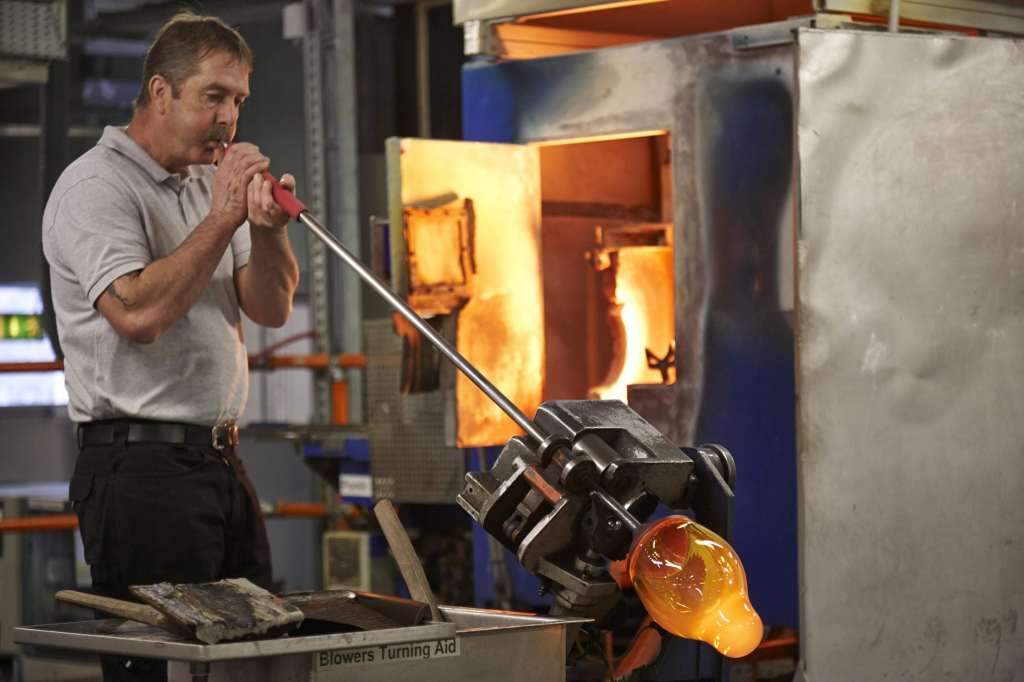
Waterford glass blower

The House of Waterford Crystal provides a fascinating glimpse into the workings behind the famed glassworks that put the city on the international map. Consisting of a manufacturing facility and visitor center, it’s now one of the top attractions in Waterford and is best viewed as part of a guided tour that provides a close-up view of the process behind the finished pieces of cut glass.

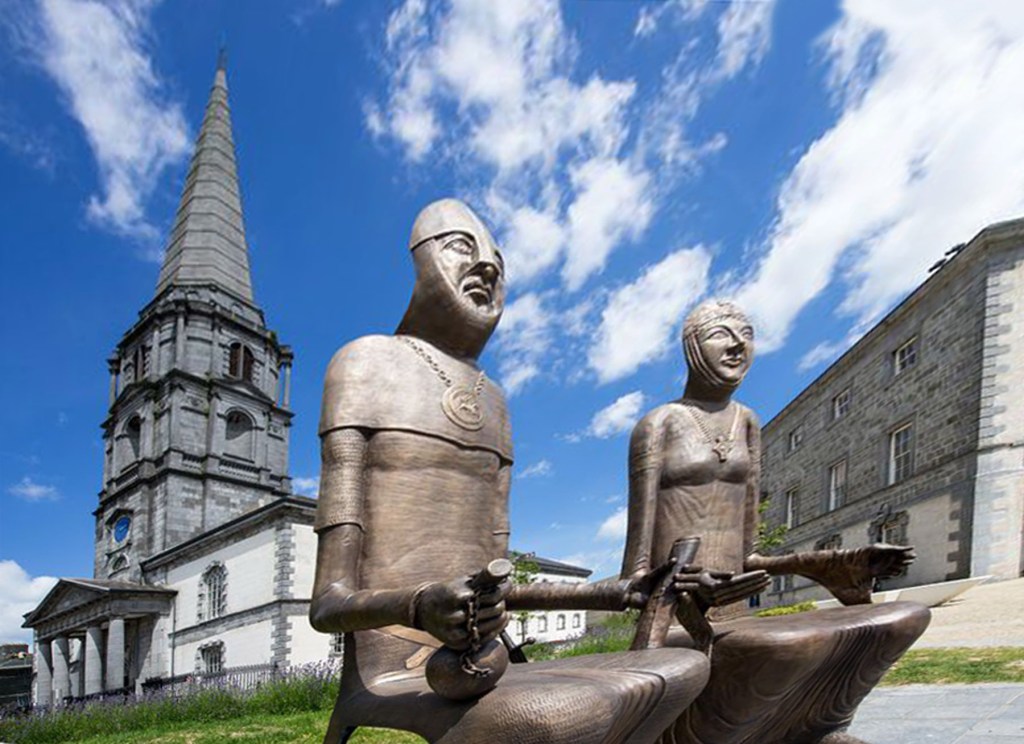
Christ Church Cathedral, also referred to as the Cathedral of The Holy Trinity. This church is Waterford’s principal Protestant place of worship. Constructed in 1779 on a site known for a cathedral dating back to 1096, the Cathedral is a centerpiece of Waterford. It was on this spot in 1170, where the legendary Norman king, Strongbow, married Aoife, daughter of Diarmait Mac Murchada, King of Leinster, thereby forming a great alliance.

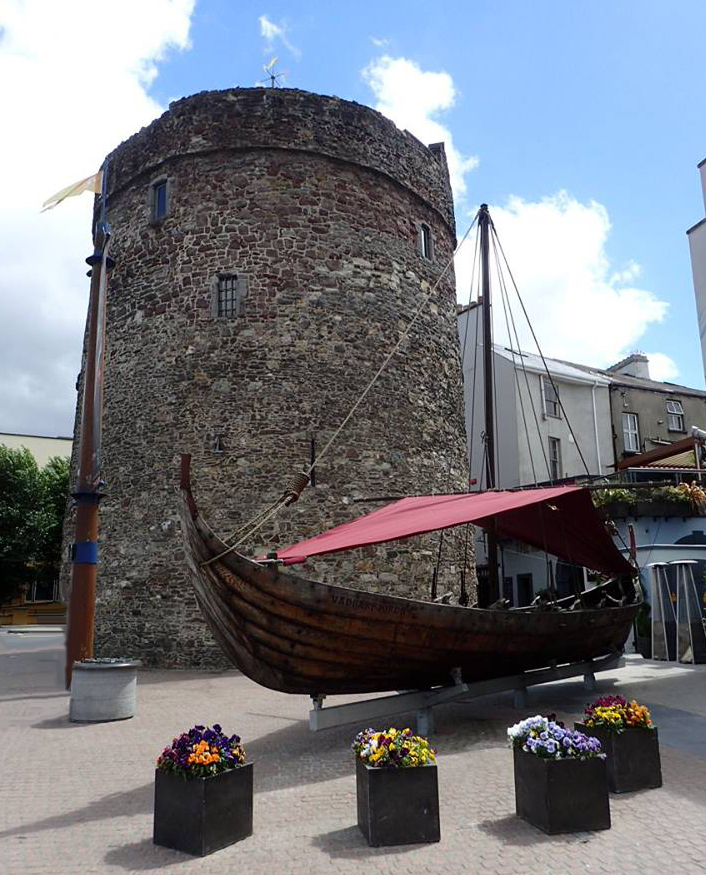
Reginald’s Tower is a historic round stronghold tower in Waterford. It is located at the eastern end of the city quay. The tower has been in use for different purposes for centuries and is an important landmark in Waterford and an important remnant of its medieval urban defense. It is the oldest civic building in Ireland and it is the only urban monument in Ireland to retain a Norse Viking name. Just outside, to the right of the tower entrance, is a 40 foot Viking Long Boat with a red sail named Vadrarfjordr – the Viking name for Waterford. This accurate Viking Longboat was built by a group of Waterford men. The keel and planks of the longboat are of Irish oak, mostly sourced from a mill in Carlow, and the sailcloth is a canvas weave. The Vadrarfjordr longboat is modeled on famous Viking ships found at Roskilde, in Denmark.

The Viking Triangle has lots craft studios, cafes and great places to eat and a real sense of history. Waterford’s motto is ‘Urbs Intacta Manet’, which means The Untaken City.

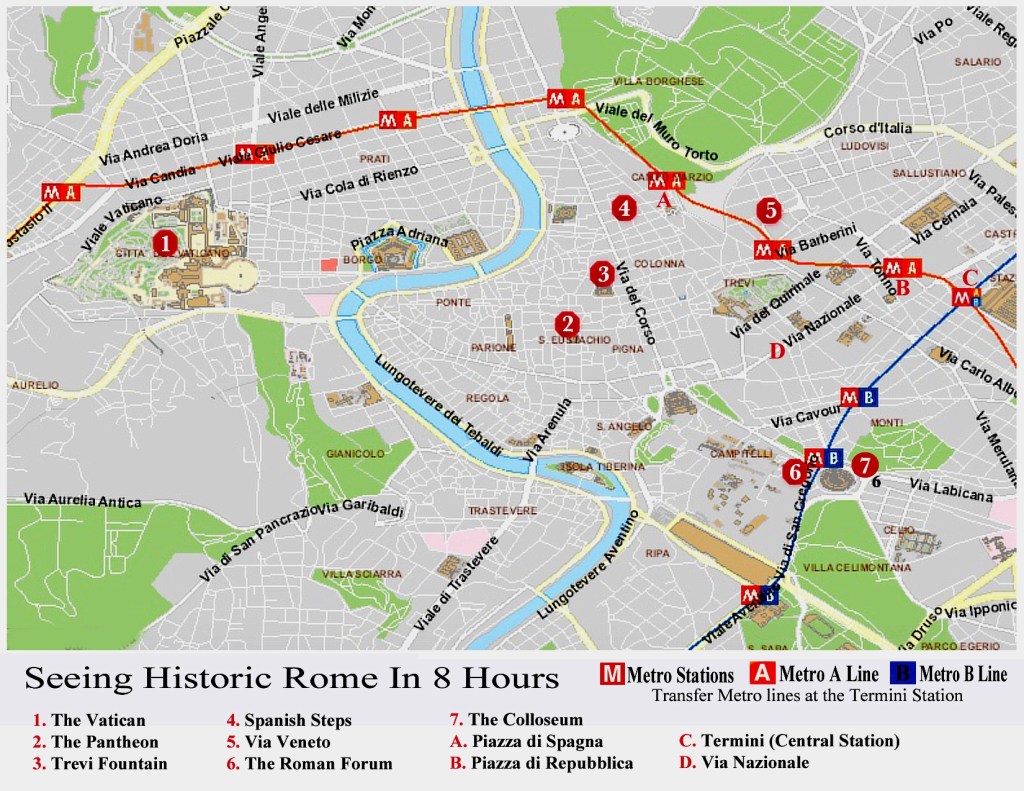
Less Than Eight Hours To See Rome

The Tiber and Castel Sant’Angelo

We have returned to Rome a number of times usually staying a few days with each visit. On a Mediterranean cruise a few years ago it was our sons first trip to Europe. The cruise originated and ended in Barcelona and the ship docked for one day in Civitavecchia the port servicing Rome. With the trip to Rome by bus takes an hour plus each way* that left about seven hours to actually see the city.

Rome is one of the world’s great cities. It is packed full of thousands of years of historic sites. It is home to one of the world’s major religions (yes, I know the Vatican is actually a different city/country). In addition Rome has some of the best food and shopping in Europe and then there are the concerts and opera…

So the challenge is what to do with seven hours in Rome? Since this day is focused on a first timer who probably isn’t real keen on shopping and the symphony and opera are out, that leaves historical highlights. Our seven hours in Rome started and finished at Vatican City where the bus stopped.

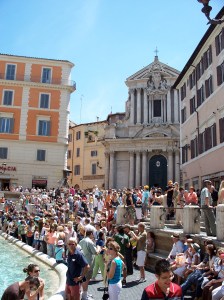
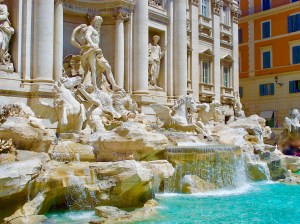
Throwing coins in Trevi

The first time hurdle you will have to deal with in visiting the major sites in Rome, particularly in the summer, are the crowds. As hard as it is to believe, even the outdoor Fountain of Trevi, in the summer, has huge crowds you need to navigate thru. Many of other sites need tickets or hours waiting in line or both.

The Vatican Museum and Sistine Chapel – direct purchase tickets thru the Vatican are 17 Euros and it will still require a fair amount of time in line. You can get Skip-the-Line Tickets to the Vatican Museums & Sistine Chapel thru an agency for about 30 Euros but it requires doing this in advance. Without being aware of this Vatican Museums & Sistine Chapel are out.

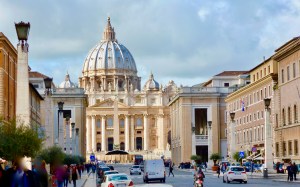
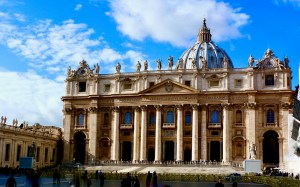
St. Peters Basilica

Getting into St. Peters is free but the lines usually will take up to an hour or more. Since the lines were already long we decided to try later when we returned to the Vatican.

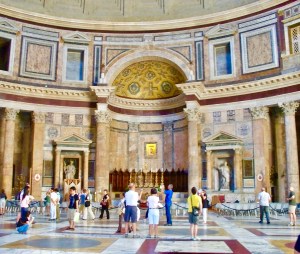
Interior of the Pantheon

From Vatican City we took a taxi over to the Pantheon, which is the oldest intact domed structure in the world and really deserves a look. Unfortunately even the Pantheon now requires admission tickets, instituted to primarily to better control the crowds.

For the next stop it is important to have a really good sense of direction and a map or the use of the GPS on your smart phone because the next stop is only a modest walk away. Everyone has to put in an appearance at the Fountain of Trevi. Remember Anita Ekberg’s famous Trevi Fountain bathing scene from “La Dolce Vita,” and the tradition of throwing coins into the Trevi from “Three Coins in the Fountain”? Stand with your back to the fountain and throw a coin over your right shoulder and you will always return to Rome.

The Fountain of Trevi
The Spanish Steps

From Trevi still walking, head for the Spanish Steps another must do iconic site. While I’ve been there dozens of times I’ve never been sure what you’re supposed to do. Walk up and down? Sit and play an instrument (many do)? At least take a selfie that proves you were there.

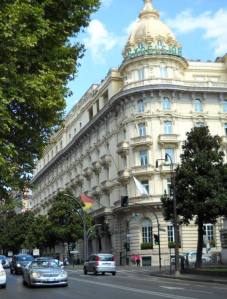
From the Steps another fifteen or twenty minutes walking will get you to the Via Veneto where, if you’re not into shopping at least sit at a café, have lunch or drink an espresso and watch the people passing by.

Via Veneto

An option from the Steps is to head off in the opposite direction thru the Piazza Spagna. This is also a great area for strolling and lunch or perhaps a cappuccino as you take in the sights around the piazza.

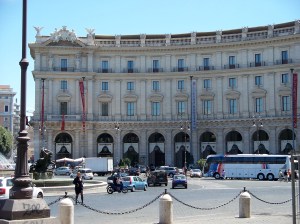
If you are on the Via Veneto and enjoy walking you can walk the dozen blocks over to the Piazza Republica and head down the Via Nazionale toward the Roman Forum. You can also catch the Metro at the nearby Barberini Metro Station and exit at the Piazza Republica.

Piazza Republica

If you are at the Piazza Spanga you can walk to the Roman Forum in about a half hour or catch a metro at the Spanga/Trevi station and take the A line and get off at the Piazza Republica station. From there you can walk or take a bus down the Via Nazionale to the area of the Roman Forum and the Coliseum.

Of course you can take taxis between the various locations. You should expect to pay 15 to 20 Euros per ride between the locations discussed. A better option is rapid transit but in Rome it is somewhat fragmented. The fare system is totally integrated though, so you can pay and use the Metro trains and buses on the same ticket. A minimum fare is a BIT Standard ticket for one ride and costs about $2 per person. Our recommendation is a 24 hour pass for about $9. There are ticket machines at all Metro stations and they accept most major credit cards.

The Roman Forum

Once in the area of the Roman Forum you can walk thru the Forum, visit the Colisseum and Palitine Hill. The Colisseum requires admission tickets and you can expect the line to take up to an hour in Summer.

The Colosseum

Getting from the area of the Forum back to Vatican City by walking or by bus will take about an hour. A faster option is to pick up the Metro B Line at the Colosseo station, change to the A Line at the Termini stop and get off at Ottaviano – San Pietro station.The Metro trip will take well over 40 minutes so this is where we would suggest taking a taxi (about 20 minutes and $25).

Highlights:

St. Peters Basilica

Vatican Museum– A collection amassed by Popes throughout the centuries including some of the most renowned classical sculptures and most important masterpieces of Renaissance art.

Sistine Chapel – A large papal chapel built within the Vatican between 1477 and 1480 by Pope Sixtus IV, for whom the chapel is named. The ceiling along with a large fresco The Last Judgment on the sanctuary wall were painted by Michelangelo between 1508 and 1512.

St. Peters Basilica – Is an Italian Renaissance church in Vatican City, the papal enclave within the city of Rome. It was designed principally by Donato Bramante, Michelangelo, Carlo Maderno and Gian Lorenzo Bernini, St. Peter’s is the most renowned work of Renaissance architecture and the largest Christian church in the world.

Pantheon Exterior

Pantheon – meaning “[temple] of every god”) is a former Roman temple, now a church, on a site of an earlier temple commissioned by Marcus Agrippa during the reign of Augustus (27 BC – 14 AD). The present building was completed by the emperor Hadrian in 126 AD. Almost two thousand years after it was built, the Pantheon’s dome is still the world’s largest unreinforced concrete dome and one of the worlds oldest complete structures.

Fountain of Trevi – Is a fountain in the Trevi district. Commisioned in 1629 by Pope Urban VIII. Designed by Italian architect Nicola Salvi and completed by Pietro Bracci. It is the largest Baroque fountain in the city and one of the most famous fountains in the world.

Spanish Steps – This monumental staircase of 135 steps was built with 20,000 scudi bequeathed by French diplomat Étienne Gueffier’s in 1723–1725, linking the Bourbon Spanish Embassy, and the Trinità dei Monti church that was under the patronage of the Bourbon kings of France to the Holy See in Palazzo Monaldeschi.

Piazza Spanga – Is one of the most famous squares in Rome. It owes its name to the Palazzo di Spagna, seat of the Embassy of Spain to the Holy See. Nearby is the famed Column of the Immaculate Conception of the Blessed Virgin Mary.

Via Veneto – Is one of the most famous, elegant, and expensive streets in Rome.

The Arch of Titus c. AD 82 near The Forum

The Roman Forum – A rectangular plaza containing the ruins of several important ancient government buildings. Originally a marketplace, the Forum became the center of the Roman Republics government and was the heart of ancient Rome.

Colosseum – Originally known as the Flavian Amphitheater it is an oval amphitheater in the centre of the city. Built of travertine and brick-faced concrete, it is the largest amphitheater ever built. commissioned in A.D. 71 by Emperor Vespasian as a gift to the Roman people. In A.D. 80, Vespasian’s son Titus officially opened the Colosseum

Click map to download a pdf printable copy

*If you have come to Rome on a cruise you’ll be docked in Civitavecchia and almost all cruise tours use tour buses to get into the city with St. Peters being the primary Rome drop-off point. That’s a minimum ride of an hour and a quarter. Our recommendation is to take a taxi or the shuttle bus from the port to the Civitavecchia train station and catch a train. Trains run every 20 to 40 minutes, cost only 9€, and the express trains take just 50 mins.