
Amsterdam, Heart of The Netherlands
 Approaching The Netherlands from the North Sea cruise ships navigate the North Sea Canal. The canal runs from the IJmuiden locks to the Coenhaven. East of the Coenhaven, the waterway is called the River IJ (both letters are capitalized) and continues up to the Oranjesluizen locks located in the eastern part of Amsterdam. Than from the Oranjesluizen up to the Passenger Terminal in Amsterdam. Unfortunately ships that are
  transiting into Amsterdam often come in before dawn so as to be tied up early in the day. Passengers that are sailing out of Amsterdam late in the day get a much better appreciation of the systems that protect Holland from the North Sea.

 Amsterdam is the largest city in the Netherlands famous for tulips, cheese, marijuana, red light districts and canals,. Many people call the country Holland but the true name is the Netherlands with Holland being the name of two of its states. The people are Dutch as is the name of their language.
The most important thing to know about Amsterdam is when walking in the city, pay attention and stay out of the bike lanes and watch out for bikes! Everyone rides bikes to get around in this city and in most areas there is a designated bike lane between the sidewalks and the street. The biggest mistake visitors make is seeing the traffic stop and step off the sidewalk without looking for bicycles. Keep you eyes open for bikes – a bicyclist moving at ten miles an hour can do a lot of damage to a pedestrian.
Where Your Ship Docks
 Your ship will dock at the Cruise Terminal on the river IJ. The cruise facilities are modern with good access to public facilities. From the terminal it is just a 10-minute walk to the central train station. With the cruise ship at your back walk off to your right along the waterfront to reach the station and central Amsterdam.
 Transportation

 The cruise terminal is only a 20 minute ride from Amsterdam’s Schiphol Airport and just a ten minute walk to Amsterdam Central Train station. There is also frequent train service from the station to Schiphol Airport. Amsterdam has an excellent and inexpensive bus system
The city is laid out like a fan with major streets radiating out from the Amsterdam Central Train station. The major canals arc across the fan along with a number of city streets. Most major streets are serviced by trams which run every few minutes.
 Traveling within Amsterdam by public transportion is easy to understand and very convenient. The network is operated by GVB throughout the central city and connects its neighborhoods with trains, trams, metro, bus and ferry. The least expensive and most convenient way to see the city is with GVB day passes. Available from 1 to 7 days, with prices starting from €8.50 per person, per day and valid on trams, buses and metros operated throughout Amsterdam. You can buy your tickets in advance from the GVB website HERE.
 Currency
 The Netherlands, like other members of the EU uses the euro as its official currency. You will often discover that to avoid the use of the 1 and 2 cent coins, many cash transactions are rounded to the nearest five cents in the Netherlands. Credit and debit cards a commonly accepted but U.S. Dollars need to be changed into Euros.
 Attractions

This is a beautiful city and great for walking (watch out for the bicycles!). Canals lined with boats are at every turn and like most major cities there are books dedicated to seeing this city. Museums, galleries, gardens and historic places are everywhere but often it’s just the cities neighborhoods that make a visit memorable.
Rijksmuseum – One of Amsterdam’s most popular attractions – and certainly its most important art repository – the Rijksmuseum was founded in 1809 to house the country’s huge collection of rare art and antiquities.
 Van Gogh Museum – A must-visit for art fans and historians, the spectacular Van Gogh Museum has been one of Amsterdam’s top attractions since it opened in 1972.
Vondelpark – The largest and most visited park in Amsterdam, Vondelpark occupies 116 acres.

The Anne Frank House – On the Prinsengracht, the Anne Frank Museum is dedicated to the all-too-short life of one of the world’s best-known Holocaust victims.
If you are visiting in the Spring (between 21 March to 10 May, 2020) a must see is the Keukenhof Gardens, one of the worlds largest flower festivals featuring acres of tulips. Visit our article on the Keukenhof HERE.


 lanes. They’re lime green electric scooters and you will find them in most large cities in France and probably most of Europe as well. You’ll see young men racing each other down streets and couples sharing a
 scooter. On one day we saw two couples take a spill off their scooter, no injuries but it seems to require some coordination between the riders. You’ll see them leaning against buildings or dumped in alleys or standing in neat rows near major attractions. While long racks of rental bicycles have become common worldwide these scooters are a new phenomena.
 We haven’t seen them much yet in major U.S. cities and oddly that’s where they hail from. Seattle to be precise and the company is called Lime (visit their website
 While we have read for years about auto clubs that intend to saturate a market with cars that would work like this, to our knowledge they have never materialized. This system seems to be really working and we expect to see these lime green scooters in every city worldwide.
 Spending a week along the Rhône in France. Traveling up the river from Marseille, through historic Avignon, Arles, the Roman city of Vienne and ending up in Lyon, France’s culinary heart. This trip included time visiting the Beaujolais wine region and a number of quaint Provençal villages.

 Today the region is known world wide for its long tradition of winemaking, and more recently for the popular Beaujolais nouveau. The village of Beaujeu is the heart of the region and where Beaujolais gets its name. The French tradition is to name a region after a central town. This region is famous for its growing conditions with lots of sunshine and its granite-based soils lending a unique character to their wines. The Gamay grape is used to make all Beaujolais wines with the exception of white Beaujolais, or Beaujolais blanc, which is made of Chardonnay grapes.
 The signature Beaujolais nouveau is a red wine is produced in the Beaujolais region of France. It is the most popular vin de primeur, fermented for just a few weeks before being released for sale on the third Thursday of November. This ‘Beaujolais Nouveau Day’ is recognized everywhere, with races to get the first bottles to different markets around the globe.

 listed as a “VMF Historic Heritage” site and has been in the same family since 1809 with some buildings dating back to the 11th Century. The Château itself is a beautiful period castle from the 16th century, in the heart of vineyards and overlooking the Samson valley. It’s a beautiful location with panoramic terrace views and an impressive Renaissance entry court.
 Located just upstream from Notre-Dame there is a bridge made notable by a tall, elegant statue at its’ southern end. Examining a map, the bridge is identified as the Pont de la Tournelle and it is just another example of the shear number of remarkable sites in this incredible city. The Pont de la Tournelle links the Ile St-Louis (the next upstream island from Notre-Dame De Paris), to the Quai de la Tournelle on the Rive Gauche. The Rue des Deux Ponts links the island’s two bridges in a straight line with the Pont Marie on the north bank.
 In 1928, the City of Paris commissioned sculptor Paul Landowski to carve a statue of Sainte-Geneviève for the bridge. Paul Maximilien Landowski (1 June 1875 – 31 March 1961) was a French monument sculptor of Polish descent. He is best-known for his work Christ the Redeemer in Rio de Janeiro, Brazil. Landoswki’s creation represents Sainte-Geneviève, the patron saint of Paris as a young woman protecting a child holding a vessel, the symbol of Paris. He sculpted the sixteen foot high statue directly from a single piece of stone. Mounted on a pedestal of equal height,
  the statue faces westward to symbolically protect the city from danger approaching from upstream. It needed to be tall to be seen from great distances. It is located on the spot where Saint Geneviève’s shrine stood in the year 885 before it was moved to its’ current home in Saint-Étienne-du-Mont Church.




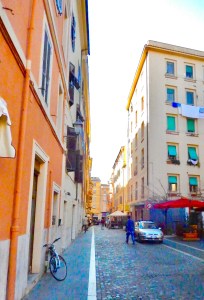


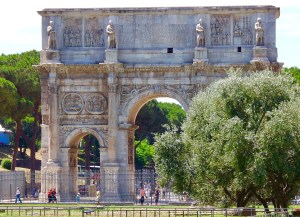
 While most cruises offer tours into Rome with some being nothing more than round trip bus service the fare can run $80 or more per person. If your cruise is ending in Civitavecchia or if it is a stop on your cruise itinerary the best way to get into Rome is to take a train. It’s only a short six to ten block walk up Via Aurelia to the station. Trains run as frequently as ever 20 to 30 minutes. From Civitavecchia a typical trip to S. Pietro (Vatican City) takes 40 minutes, Trastevere 50 minutes, Ostiense 55 minutes and finally Termini (the central train station) 70 minutes. Fare starts at €5 one way on the commuter trains but can cost up to €25 round trip if using regional trains depending on ticket class. There is a manned ticket booth at the station along with vending machines. We would strongly recommend getting a metro train map ahead of time and plan your route before getting to Italy. Our experience is that buying tickets ahead of time online doesn’t save anything and can actually cost you much more.
 We have stayed overnight in Civitavecchia a number of times. It is a pleasant city with a number of nice hotels and restaurants within walking distance of the port. One happens to be our favorite pizza parlor (HERE). The main business district is next to the port and there are a number of nice shops in the area as well as a pedestrian mall. Via Aurelia runs along the waterfront from the train station to the ports main entrance and has a number of restaurants, most with outdoor seating available. There is also a nice park area along the water which is a popular place for locals to stroll in the evening.
 The Intentional Travelers