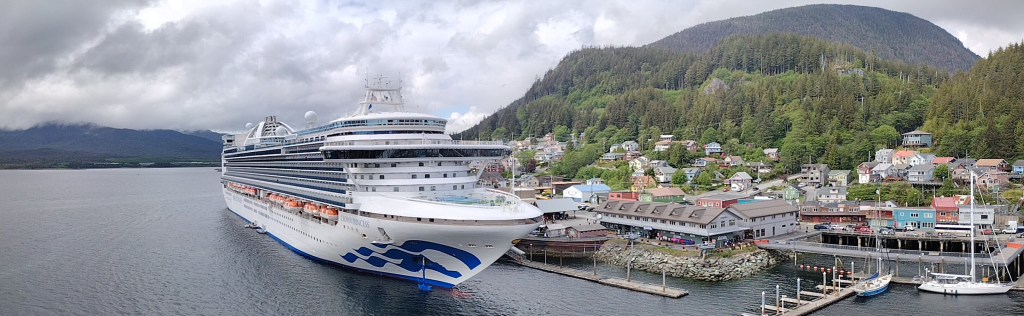
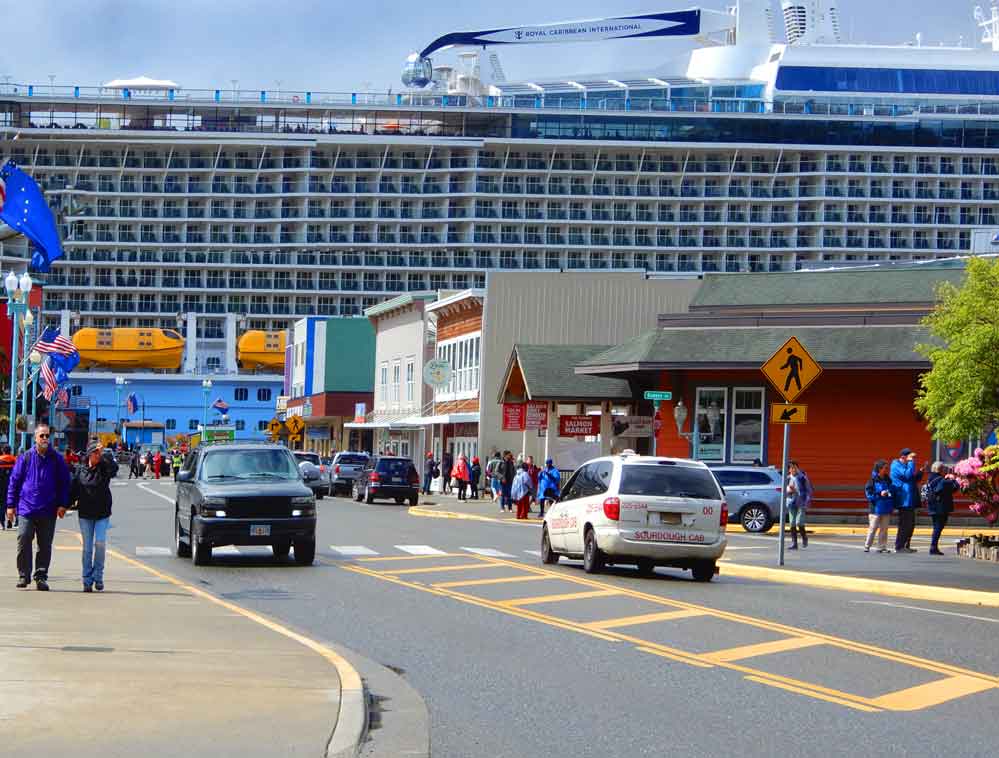
With a year round population in Ketchikan, Alaska of under 7,000 residents and two large cruise ships can literally more than double the population.
The featured image below is a Royal Caribbean ship standing several stories above the Ketchikan’s tallest building and above is a Princess ship dwarfing the Ketchikan waterfront.
Ketchikan’s population swells considerably during the summer months, which is the peak fishing and tourist season due to favorable weather conditions. An influx of cruise ship passengers, seasonal workers and fishing boat crews swell the city’s economy. An estimated 1,500 to 2,000 seasonal workers or transients are present in Ketchikan annually during this peak period.
Planning A Cruise? Start With The Intentional Travelers Port Guides
Recent Posts From The Intentional Travelers You Might Find Interesting:
Maybe it’s a calling or just that they needed a jobor in some cases they were conscripted and rarely perhaps there’s a less noble reason, but in most cases they are our neighbors, family membersand an important part of our society.
Planning A Cruise? Start With The Intentional Travelers Port Guides
Recent Posts From The Intentional Travelers You Might Find Interesting:
Traveling the world all these years has brought us to realize there is much more that connects us than divides us. There are universal emotions regarding family, friends and faith, along with common experiences that play a crucial role in uniting people everywhere. Bonds that transcend geographical location, fostering a sense of being part of a global community and belonging, regardless of race, nationality or geographic location to the family of man…
Planning A Cruise? Start With The Intentional Travelers Port Guides
Recent Posts From The Intentional Travelers You Might Find Interesting:
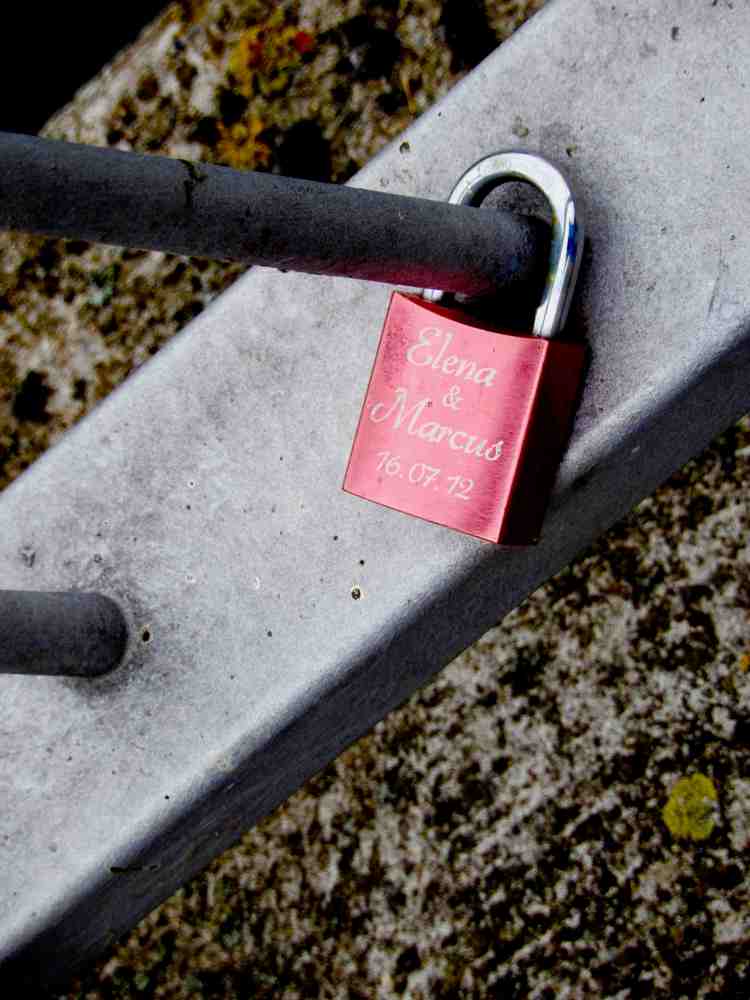
We weren’t aware of love locks before about a decade or so ago but now as we travel we come across collections of padlocks attached to bridges, fences and other public structures everywhere. It wasn’t difficult to figure out what was going on by all the couples names engraved on the locks. In the last five years or so it is becoming difficult to not notice these collections, they’re popping up everywhere.
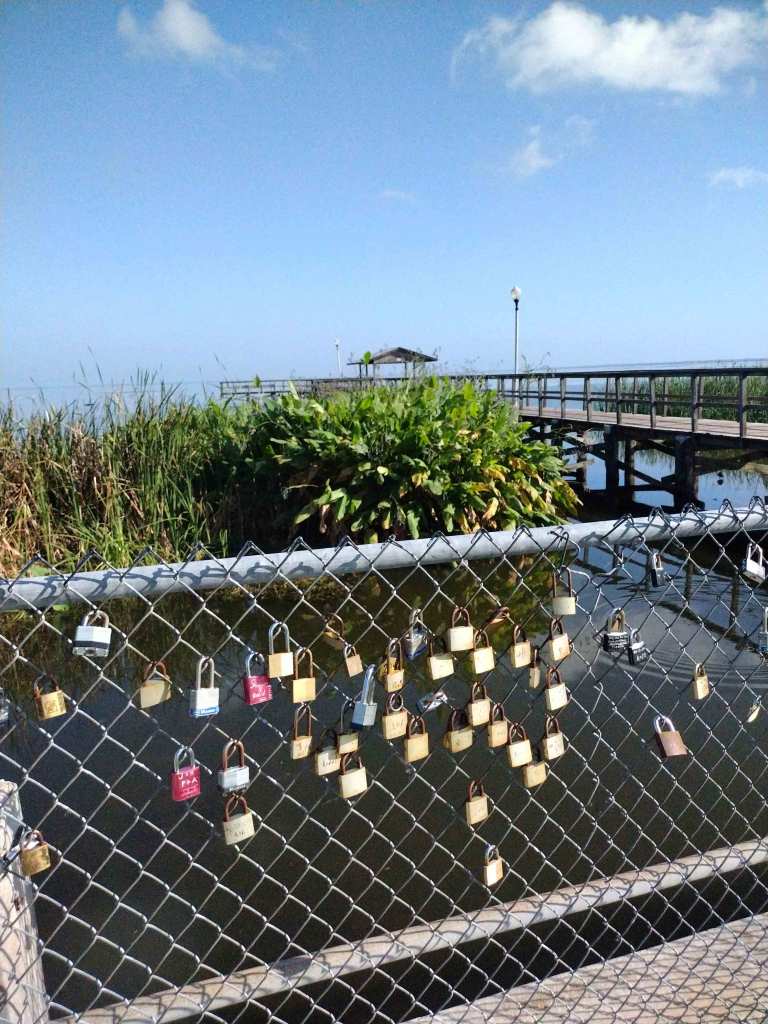
For goodness sake it’s even hit our small Florida town. The weren’t there a year ago but just last month as we walked through the lake front park, there they were!
In our small hometown in Florida
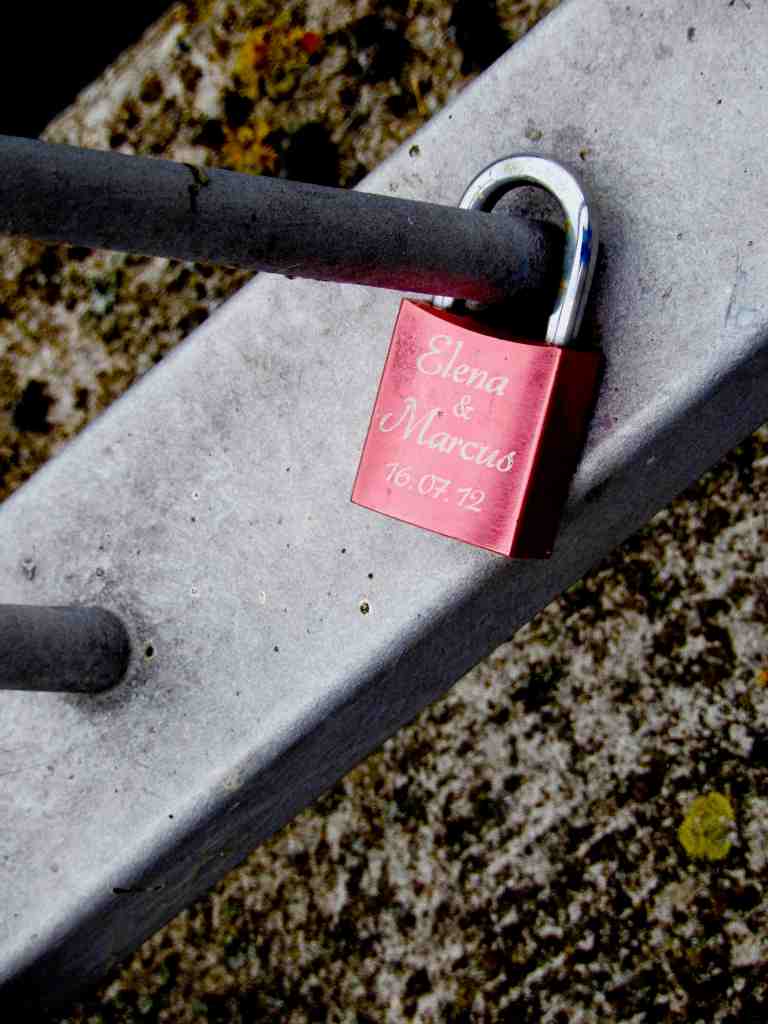
The practice isn’t new but was virtually unheard of outside of a few cities, mostly in Eastern Europe, until recent years. Early in the twenty-first century the practice has exploded worldwide. A love lock is a padlock which lovers lock to a bridge, fence, gate or monument to symbolize their undying love. In recent years the lovers’ names or initials, and the date, are engraved on the padlock, and its key is thrown away, usually into the river under the bridge, to symbolize the couples undying love for each other.
This simple and romantic practice seems innocent enough, but more and more it’s being treated by authorities as litter or vandalism, and there can be serious costs associated with damage caused and their removal. But we’ve also learned that there are places where authorities are embracing lovelock places as a tourist attraction.
Along the Seine in Paris (several locations)
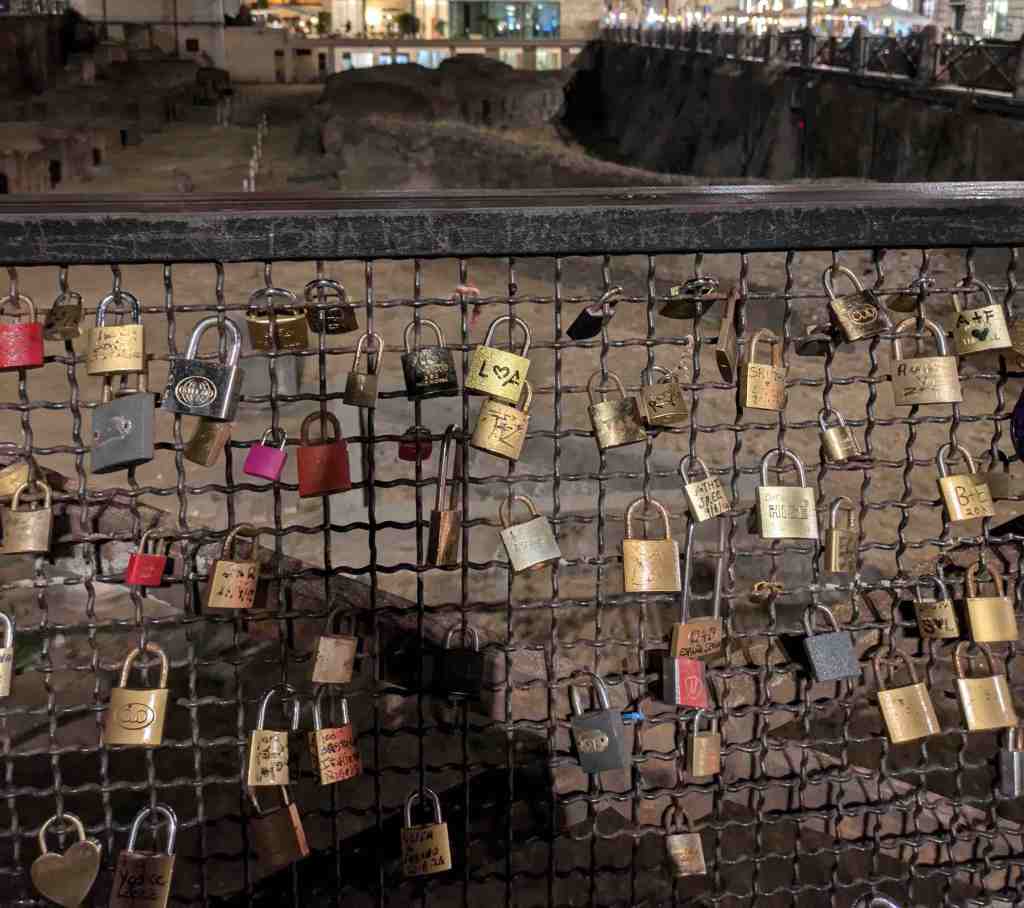
An archeological site near Rome’s Forum
A little research will find that love padlocks date back at least 100 years to a Serbian tale of World War I. It involves the bridge Most Ljubavi or the Bridge of Love in the town of Vrnjačka Banja*. A local schoolmistress named Nada, who was from Vrnjačka Banja, fell in love with a Serbian officer named Relja. He went off to war in Greece, where he fell in love with a woman from Corfu. Heart broken Nada broke off their engagement and after some time died from heartbreak. As the tragic love story circulated, young women from Vrnjačka Banja wanted to protect their love and started writing down their names, with the names of their loves, on padlocks and attached them to the bridge where Nada and Relja used to meet.
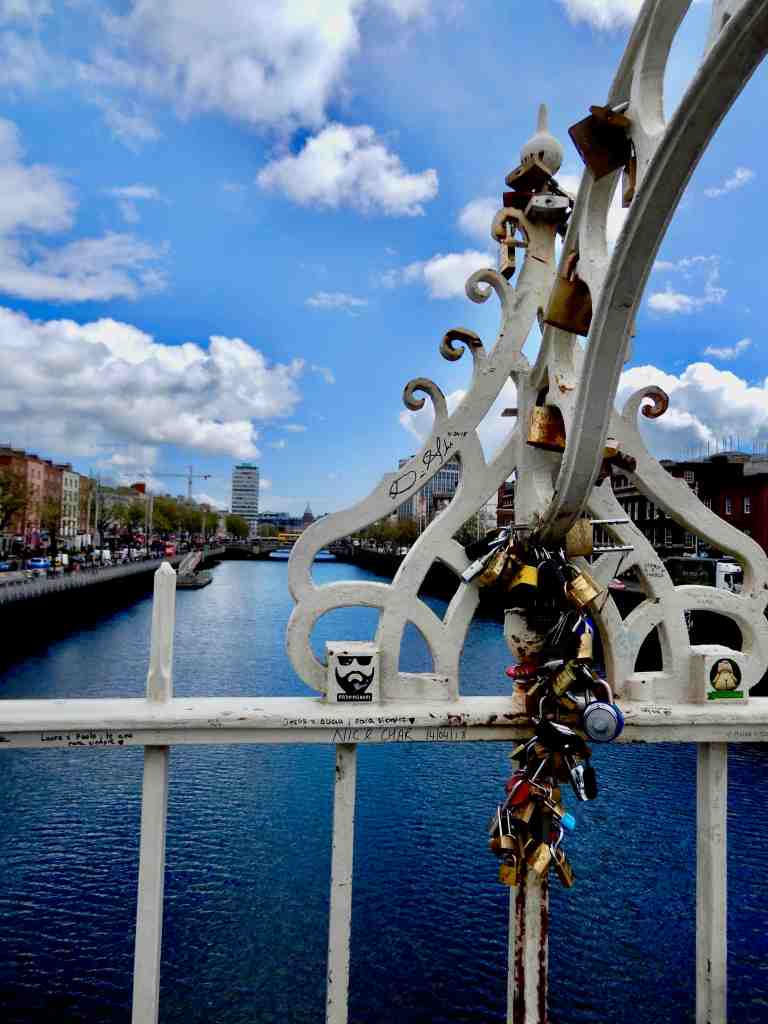
Ha’penny Bridge in Dublin
In Dublin there is a famous pedestrian bridge called the Ha’penny Bridge. It is one of the more famous symbols of Dublin. Nearly 200 years old (1816) it is a protected structure, but in recent years Dublin City Council have had to remove thousands of padlocks from the bridge on a regular basis. They are considered unsightly and are causing damage by chipping paint and adding considerable weight to the historic bridge. Engineers have estimated that at some point, if not removed, they could cause the bridge to collapse.
Today the key to many an Irish heart now sits at the bottom of the River Liffey where couples in love have thrown them after securing their love locks to Dublin’s historic Ha’penny Bridge. Today there is a group dedicated to breaking that bond. Shortly after the lovers have left, an expert lock-picking group arrives to tear these bonds of love apart and stop the locks from making the bridge structurally unsafe.
River walk Wurzburg, Germany
“It’s a fairly constant churn,” said Seán Nicholls, who set up the group when he was on his way to a professional lock-picking meeting. “I was heading to the meeting one day and I walked over the Ha’penny Bridge and noticed all the locks. In my mind it was defacing a city treasure. That’s kind of where the idea came from,” he said.
Dublin City Council embraced the group in the aftermath of a love-lock situation in Paris where the locks caused a section of the Pont des Arts bridge to collapse. The bridge in Paris had become famous for “love locks,” but the locks became too heavy and a two-meter segment of the bridge and railing buckled under the pressure of so many romantic symbols falling into the Seine.
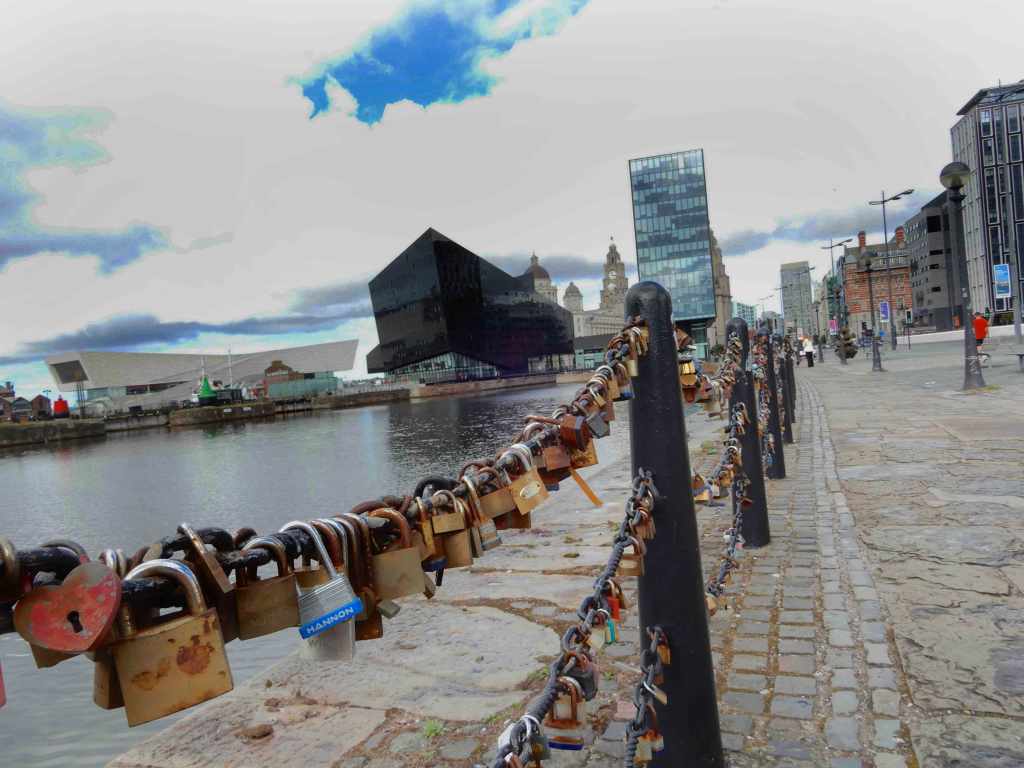
On the waterfront in Liverpool, England
Just this summer we were in Liverpool and along the waterfront – surprise! We found them in a cliffside park in Lima, Peru. From Amsterdam to Zurich and even in Asia it’s no longer a surprise to come across these obtrusive symbols of undying love.
Just recently the practice has come to America and is growing in Savannah, Boston, St. Louis and a number of other cities. Not to walk away from a business opportunity many locksmiths are now offering professional engraving on their padlocks and a number of manufacturers are offering heart shaped padlocks, likely to cause the new tradition to grow and spread even more.
The Ha’penny Bridge in Dublin
On a fence in historic Savannah, Georgia
Are LOVELOCKS legal or prohibited?
Thousands of lovelocks on intersection fountain in Montevideo, Uruguay
Mt. Huangshan, China – Adding love locks? Legal: Encouraged
Brooklyn Bridge, New York – Adding love locks? Legal: No
Hohenzollern Bridge, Germany – Adding love locks? Legal: Yes
Seoul Tower Seoul, South Korea – Adding love locks? Legal: Encouraged
Massachusetts Avenue Bridge, Boston United States – Adding love locks.?Legal: No
Butchers Bridge, Slovenia – Adding love locks? Legal: Yes
Penang, Malysia – Adding love locks? Legal: Encouraged
Tamuning, Guam – Adding love locks? Legal: Yes
Vrnjacka Banja in Serbia* – Adding love locks? Legal: Yes
The Distillery District, Toronto, Canada – Adding love locks? Legal: Yes
Ponte Milvio Bridge, Rome – Adding love locks? Legal: No
The Flame of Liberty, Paris – Adding love locks? Legal: No
Stab Musial Veterans Memorial Bridge, St. Louis – Adding love locks? Legal: Yes
Fountain of Locks, Montevideo, Uruguay – Adding love locks? Legal: Yes
The Casa Di Guilietta, Verona, Italy** – Adding love locks? Legal: Yes
In a park in Lima, Peru
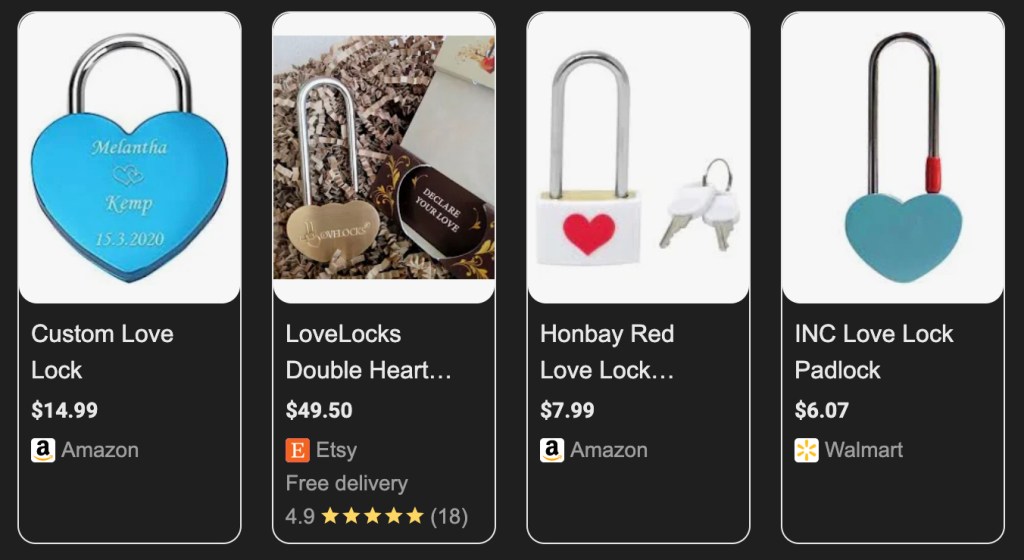
There doesn’t seem to be any real way of stopping this as now a number of people have now recognized this as a growing business opportunity. A simple internet search for lovelocks will turn up hundreds of places to order them from online to probably your neighborhood.
Screenshot
*This bridge “Most Ljubavi” is a pedestrian bridge known as the Bridge of Love in the town of Vrnjačka Banja and is the location where the legend of the love locks began.
**The Casa Di Guilietta is a particularly popular location for adding love locks as it is supposed to have been the home of Juliet Capulet from Shakespear’s Romeo And Juliet.
Are there any love locks near you? Let us know where and we’ll add the locations.
Planning A Cruise? Start With The Intentional Travelers Port Guides
Recent Posts From The Intentional Travelers You Might Find Interesting:
The Dakota Territory Its Historic Monuments, Museums and Sacred Land
The forces that created the confrontation were beyond anyones control and the outcome was inevitable even though the struggle was monumental. Beginning around 1850 new settlers were drawn to the Dakota territory by the prospect of gold and free land, while the tribes of the “People of the Seven Council Fires” pushed back trying to keep their land and what was their very way of life. Efforts by the government and the army to control the situation were swept aside by tidal waves of people filling the Oregon Trail* as it became known as a highway to the riches of this new promised land. Even making the Dakota’s Indian land and off limits didn’t work as stories of gold fanned the excitement of getting rich.
The people of the Sioux nation, also known as the Oceti Sakowin, historically inhabiting the area comprised of present-day Minnesota, Wisconsin, Iowa, and the Dakotas. The term “Sioux” is a shortened version of a French-Canadian term, and the people themselves identified themselves as the “People of the Seven Council Fires”. They were the Lakota, Dakota, and Nakota peoples each with distinct dialects and cultural practices.
As the conflict between these two cultures escalated a war chief named Crazy Horse emerged to lead the fight agains the settles and U.S Army. He was a prominent Oglala Lakota leader known for his fierce resistance against US expansion into the Great Plains. Crazy Horse led numerous raids on the wagon trains along the Oregon Trail along with mining camps and homesteads in the Dakotas.
One of the largest battles between the native tribes and the army occurred at the Little Bighorn**. Crazy Horse was the war chief at the battle against George Armstrong Custer and the 7th Cavalry. Crazy Horse wiped out the men of the 7th Cavalry and won the battle only to lose the war.
Crazy Horse was later killed by a soldier with a bayonet at Fort Robinson, Nebraska, on September 5, 1877. He was fatally wounded during a struggle while resisting imprisonment. The most common account describes a soldier, identified as William Gentles, stabbing Crazy Horse during a scuffle with Little Big Man, who was attempting to restrain Crazy Horse.
The Oglala Lakota Sioux are a band of the Lakota people, primarily located in South Dakota. They are known for their rich history and culture, including their resistance to westward expansion and the preservation of their traditions. The Crazy Horse Memorial was commissioned by Lakota leaders, including Chief Henry Standing Bear, to create the monument celebrating their people. Sculptor Korczak Ziolkowski began the project in 1948 and worked on it until his death in 1982. His widow, Ruth Ziolkowski, and their children and grandchildren continue to work the project.
The Crazy Horse Memorial has been under continuous construction since its beginning in 1948, funded entirely through private donations and visitor fees. While the project is vast, with an estimated completion date far in the future, significant progress has been made on the sculpture itself, particularly in recent years.
The entrance is along US Highway 16/385 (the Crazy Horse Memorial® Highway) 9 miles south of Hill City, SD and 4 miles north of Custer, SD. Crazy Horse Memorial® is 17 miles southwest of Mount Rushmore National Memorial.
The Battle of the Little Bighorn
Little Bighorn Battlefield Memorial, A Place of Reflection. The land was set aside as a memorial and a place to honor and reflect on the sacrifices made here on June 25 and 26, 1876, when Lakota, Cheyenne, and Arapaho warriors fought against a deliberate attack by the U.S. Army’s 7th Cavalry, led by Lt. Col. Custer, who sought to enforce policies that threatened their traditional Indian way of life.
The Little Bighorn Battlefield National Monument is located in southeastern Montana, within the Crow Indian Reservation, near the town of Crow Agency. It is accessible from US Highway 87 (part of I-90) and US Highway 212.
Oregon Trail Museum in Casper, Wyoming
The National Historic Trails Interpretive Center is an 11,000-square-foot interpretive center about several of the National Historic Trails and is located northwest of Casper, Wyoming on Interstate 25.
Planning A Cruise? Start With The Intentional Travelers Port Guides
Recent Posts From The Intentional Travelers You Might Find Interesting:
PLEASE NOTE:Currently we are not members of Amazon Associates* but will reactive our account in the near future. As of now we do not receive any commission on the items we recommend.
Our number one travel necessity is a compact power strip and our major requirements are it has to be compact with several electrical outlets, several USB ports and would prefer a USB-C outlets too. Above is the strip we’ve recommended and carried for over 10 years but it is currently unavailable and has probably been discountinued.
Below is our new replacement and it’s actually more compact than our original. Available from Amazon for around $10 (click the image to order yours).
TheAddtamTravel Power Strip – with 4 electrical outlets, 3 USB and 2 USB C ports with 4FT Wrapped Flat Plug Power Strip, Short Small Extension Cord and approved for Cruise Ships. Ready to travel it measures 4.25 x 2.25 x 1.25 in.
In addition to a power strip there are two additional accessories we carry:
A Short Extension Cord
When traveling outside the United States we often encounter recessed electrical outlets that can prevent us from plugging in charging units or oversized plugs. This small item eliminates this issue. Under $6 – click image to order from Amazon.
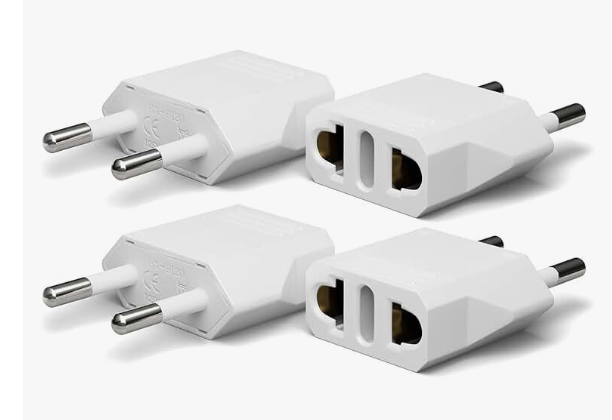
International Outlet Adaptors
Normally this is all you need if your interest is using electronics or a hair dryer as you don’t need a voltage converter. All you need carry is ones specific to you destinations. Oddly this is something that is getting hard to find if you’re looking for a complete set. This set is available from Amazon for around $23.
Octopus Charging Cable
This is a really important back-up item and it’s always in my travel kit. Even though we all have drawers full of cables they don’t do any good back at home. Recently I actually went out without a double USB-C cable and the only replacement I could find was $29. This little 6″ item is only about $8 for 2.
That’s all we need to keep our numerous pieces of equipment charged no matter where we travel and it all fits in a6″ x 2.25″ x 1.25″ inch pouch.
*The Amazon Associate program allows individuals with blogs, websites or social pages to offer Amazon items for sale and receive a small commission for links that result in an order. It doesn’t change the items selling price and in our case it was a great addition to many of our articles.
Planning A Cruise? Start With The Intentional Travelers Port Guides
Recent Posts From The Intentional Travelers You Might Find Interesting:

























 The Intentional Travelers