A long time ago I spent some time in Florence, Italy and got to be friends with an Italian girl. As we walked around the city, every few blocks there would be a beggar, mostly older women, just sitting on the sidewalk usually on a blanket. As we passed each one, my companion would drop a 10 Lira coin or two on the blanket and suggested that I do the same thing. Those women weren’t doing much except just quietly sitting there and my companion said it was Italian tradition to not walk by a beggar without dropping a coin or two. Besides it also brought good luck. In the nineteen sixties a ten Lira coin was a small aluminum coin actually worth only a small fraction of a US cent. They were often used to ride elevators or use a public toilet, so the cost of dropping a coin was negligible in value. Just giving did actually have a good feel to it though…
Times seem to have changed since those days in Italy and not for the better. In much of the world. Homelessness appears to be growing a lot and officials seem to be reluctant to acknowledge it let along suggest solutions.
Recently, in South Africa the Sun had just set and we were making our way up a narrow side street in Cape Town into the courtyard where our hotel was located. A young woman, maybe late teens to mid twenties, approached us begging and said “I’m not a bad person. I just need a little help”. With a quick sorry, we moved on but that encounter has stuck with me.
At that time we’d been in Cape Town for four or five days and had been warned about straying away from the major areas, especially after dark. There were also many travel warnings against engaging with street beggars. While we’ve spent time in a number of sketchy places around the world, Cape Town didn’t seem to be living up to needing those warnings and we had seen less than a dozen beggars around. But, being extra cautious is still our habit when traveling to unfamiliar places and street people can be a threat.
Homelessness may be one thing and crime infested areas another but the margins, at times, can seem to get blurred. And over the past decade or so it does seem that homelessness is a growing issue. Often when we travel we have people warn us against engaging with beggars on the street. And recently in Mumbai the hotel front desk warned us not to even acknowledge street beggars. Just look straight ahead and keep walking, claiming that if we even stopped to say sorry we would begin to attract a crowd of beggars. One hotel manager said that a recent couple had actually been giving beggars money on the street and a large group had followed them back to the hotel and waited outside for hours waiting for the couple to come out again. After a few days walking the streets in Mumbai that seemed to be good advice.
We’re still conflicted on how to deal with beggars and the homeless as we travel. First, what we are able to give seems like a drop in an ocean and often, at times we’re not sure that it is even helpful to give money to street people. That being said we’re not sure we’ve seen any government anywhere offer serious solutions or ideas or even indicate that they understand there is a problem.
“It’s the best of times, it’s the worst of times” and so opens Charles Dickens’ novel, A Tale of Two Cities. “it was the age of wisdom, it was the age of foolishness, it was the epoch of belief, it was the epoch of incredulity.”
I’ve spent much of my life in photography including an education in photography, photographic science and bio-medical photography. Even before that I was exposed to photography through visiting exhibits like the Museum of Modern Art’s photographic exhibit “The Family of Man”* and working with my father in his darkroom. In the Navy I studied photography and was approved to work as a Photographer when an opening became available**. In the Navy I also had the opportunity to meet some working war photographers which at the time inspired me to become a photojournalist. As with almost everything else today photography has changed with the advent of digital images and cellphones. Still, I think it might be of some value to get to know some of photography’s greats – enjoy.
*The Family of Man was probably one of the great photography exhibits of all time and it is still available as a book today HERE.
**In the US Navy, job ratings required you to first be qualified by taking courses and training,. But to get the job (be rated) there had to an opening. At the time there hadn’t been an opening for a Photographers Mate in almost five years. I went on to pursue another rating.
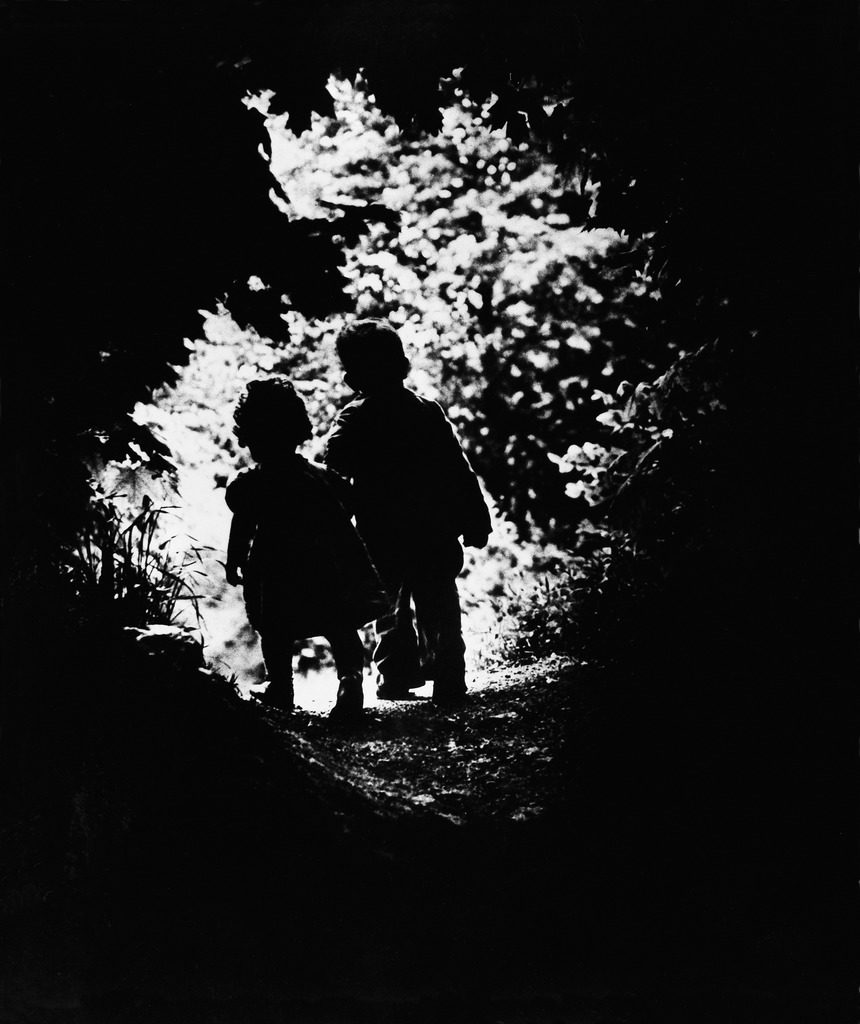
The walk to Paradise Garden, 1946 W. Eugene Smith
W. Eugene Smith – Perhaps the original creator of the photo essay and one of the worlds leading photojournalist. I met Eugene in 1971 when he was invited to a roundtable on photography at my college. After the session we spent a couple of hours drinking and just talking. One of his most famous photographs was “The walk to Paradise Garden” which was included in the Museum of Modern Art’s exhibit “The Family of Man”*. He described taking the picture as a grab shot with his Leica. He was out back of his house with some friends and neighbors when he saw his children walking towards the woods. It was over a week before he developed the film and made a quick print.
Perhaps his last and most famous published essay as a Magnum photographer was his article about industrial mercury poisoning in the Japanese city of Minamata, helping to bring justice and visibility to the victims of careless industrial pollution.
In a reflective mood that evening he commented that when he was in the battle of Okinawa in 1945, he was seriously injured by mortar fire that broke his arm. Wouldn’t it be a sad finale to my life and career if I now fell off the barstool and broke my arm again. He was 53 at that time.
I still keep that softcover copy of “The Family of Man” from the 1960’s in my photography book collection.
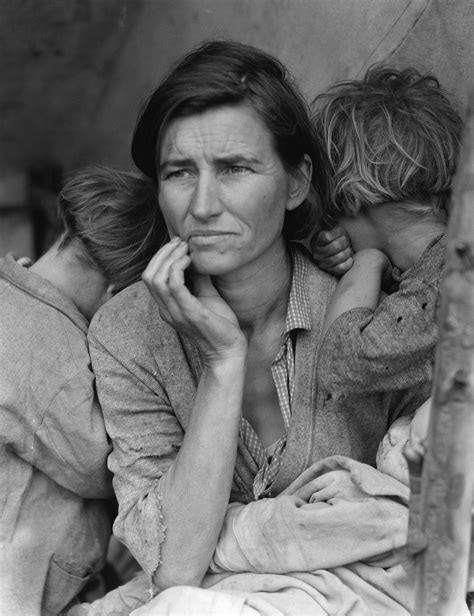
Migrant Mother 1937 Dorothea Lang
Dorothea Lang – This is one of photography’s most famous photographs. From 1935 to 1940, Dorothea traveled the country documenting the hardships of the great depression for the Farm Security Administration, of the U.S. Agriculture Department. Lange photographed the people she met and that included Lange’s most well-known portrait, “Migrant Mother”. It’s the iconic image from the period that captured the hardship and pain of what so many Americans were experiencing.
Because she was working for the government, much of her negatives are in the collection of the Library of Congress and National Archives and oddly enough you can order prints made from her original negatives for just a printing fee.
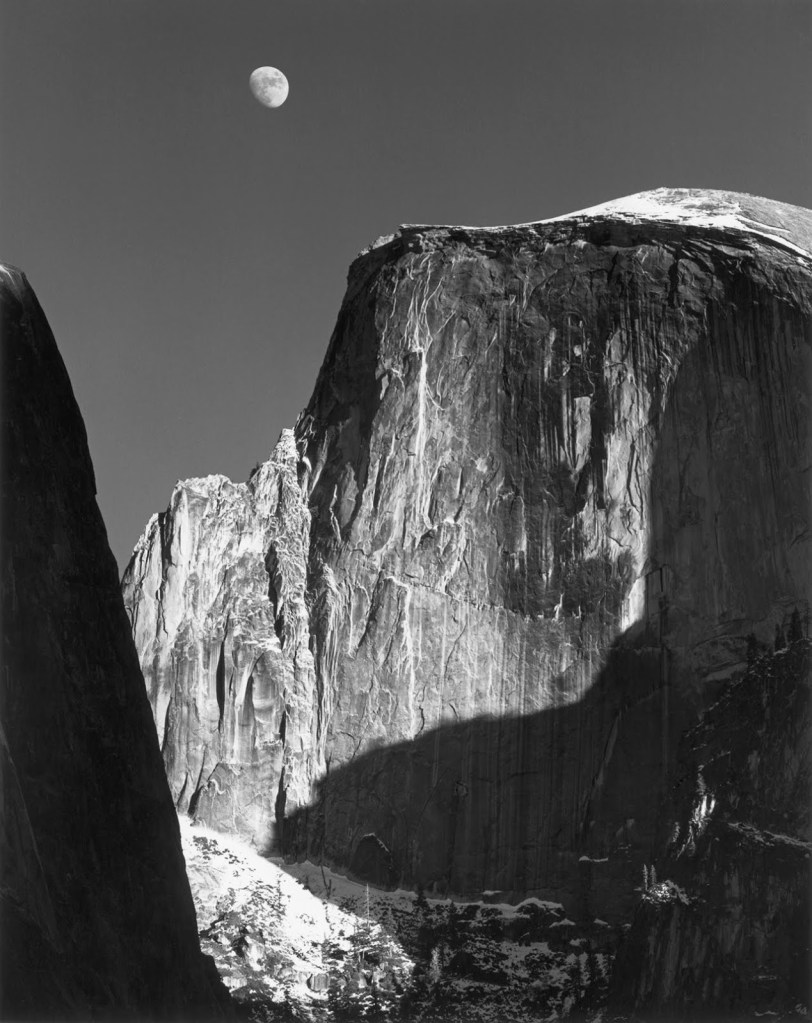
Moon and Half-Dome Ansel Adams
Ansel Adams – The dean of American landscape photographers, was famous for lugging his large view cameras up mountain sides. “Moon and Half Dome” above is my favorite photograph. A classmate of mine and a photographer, introduced his mother to Adam’s work. She was an executive with Continental Can Company and contacted him at his studio in Yosemite valley wanting to buy photographs to display at the company headquarters. His reply when he learned the name of the company was that there was no amount of money from Continental Can that could buy his prints.
Gathering Storm Winter Yosemite Valley
My own collection has two original Adams prints.
The Two Photographers That Influenced Me The Most
I had an opportunity to encounter both of these photographers during the Vietnam war and they were responsible for me believing I could make a career in photography.
‘Reaching Out’ taken 5 October 1966 after the Marines were ambushed on Mutter’s Ridge. Larry Burrows
Larry Burrows – Anyone that spent time with Larry quickly understood that he was one of the greatest photojournalists of that era. Burrows later died when the helicopter he was in was shot down over the Ho Chi Minh Trail in Laos while covering Operation Lam Son 719.
About Reaching Out pictured above, “Larry Burrows made a photograph that, for generations, has served as the most indelible, searing illustration of the horrors inherent in that long, divisive war — and, by implication, in all wars.” — Ben Cosgrove, Life Magazine
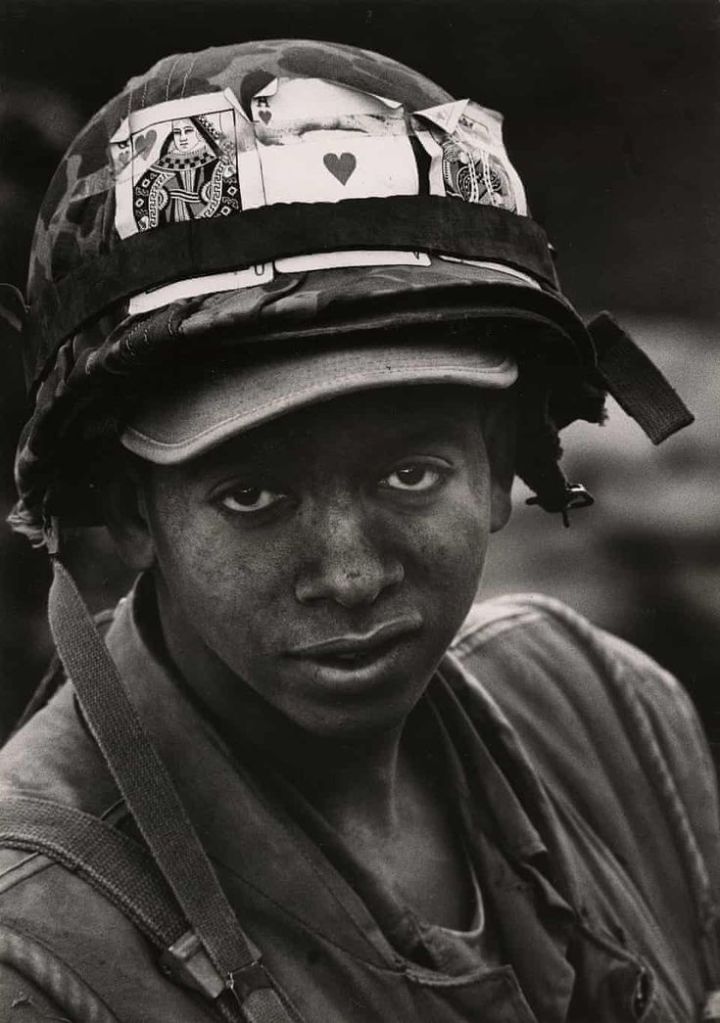
The Battle of Khe Sanh, David Douglas Duncan
David Douglas Duncan – I met him briefly “in country”. He was a photojournalist who documented the Vietnam war over several years. He is perhaps most famous for spending several weeks with the Marines at The Seige of Khe Sanh. After that experience he published a book called “I Protest“*** about the American policy during the war. He is also remembered for his images of Picasso taken over the few years he spent with the artist.
One of my prized possessions is a copy of his “I Protest“.
***Copies of I Protest can be found from vintage booksellers, on Ebay and maybe at Amazon HERE.
While the two proceeding photographers inspired me to go to college and study photography, their lives also ended up convincing me that a life on the road following wars and disasters didn’t leave much room for anything resembling a normal life.
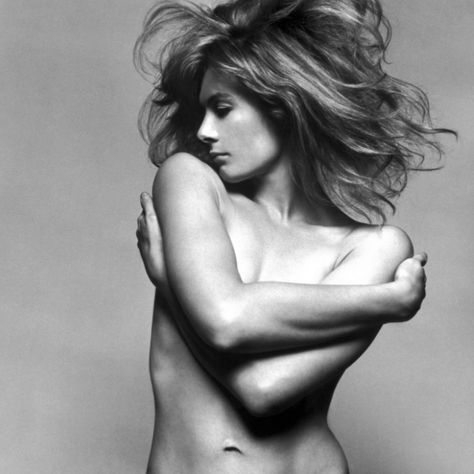
Vanessa Redgrave, by Victor Skrebneski
Victor Skrebneski – A fashion photographer based out of Chicago. I met Victor when he came to school to give a series of lectures and workshops. At the time he was the main commercial photographer for Estée Lauder. One evening out drinking, he told me that he was going to have to leave early to do a shoot he couldn’t pass up. His agent had contacted him about Gulf Oil’s ad agency wanting him to do a series of outdoor period shots for some magazine ads. He didn’t want to do it and to get out of it he quoted an outrageous five times his normal day rate. The agent called back that afternoon and told him he had the job with a bonus if he could get it done on a fast schedule. My collection includes several of Victor’s prints.
Marilyn Monroe by Bert Stern
Bert Stern – I never met Bert but his work also inspired me. He was self taught and became famous for his celebrity portraits and his advertising images.
I met a photographer at a workshop who worked in Sterns studio. He had an interesting account. I believe it was Smirnoff’s ad agency that wanted a photograph of a martini glass with the Egyptian pyramids in the background. Most commercial photographers at the time would have kept the work in the studio by doing a back-screen projection of the pyramids. Bert’s approach to photography was pretty basic, so instead he took the crew to Egypt and shot the photographs outdoors with the actual pyramids as the background. It’s said that he spent hours on that one scene.
Iceland Volcano by Pete Turner
Pete Turner – I met Pete several times when he was starting out as a commercial photographer in New York and shortly after that he was picked up to do regular work for several major magazines. Pete was more an artist than a photographer, having this incredible vision and feel for the use of color. His images seemed to always be at the edge of becoming abstract art. He’s one of the few photographers where I see an image and immediately know it’s his.
Searching the internet for the best or most famous photographers in history you will probably come across the following names in addition to my picks. Each of them is a legend in the art and craft of photography and worthy of getting to know about:
Mathew Brady – An American photographer. Known as one of the earliest and most famous photographers in American history, he is best known for his scenes of the Civil War.
Henri Cartier-Bresson – Considered a pioneer of photojournalism, he is known for his candid street photography and the concept of “the decisive moment.”
Robert Capa – He was a Hungarian-American war photographer and photojournalist. He is considered by some to be the greatest combat and adventure photographer in history. His photographs of US forces’ assault on Omaha Beach on D-Day, June 6 1944, became an invaluable historic testament to the bravery of the soldiers in the Allied invasion of France.
Richard Avedon – A renowned fashion and portrait photographer, known for his minimalist style and striking black and white images.
Annie Leibovitz – One of the most influential portrait photographers of our time, famous for her bold and creative celebrity portraits.
Alfred Stieglitz – A key figure in establishing photography as a fine art form in the early 20th century. He was a pioneering gallerist and photographer.
Robert Frank – His book “The Americans” is considered one of the most influential photography books ever published, capturing the postwar American social and cultural landscape.
Diane Arbus – Known for her intimate and unconventional portraits of people on the margins of society.
Edward Weston – A master of 20th century photography, known for his innovative and formal studies of natural forms and the human body.
Helmut Newton – Renowned for his provocative fashion and portrait photographs featuring bold, empowered women.
Esztergom, Hungary is located about 44 miles from Budapest and was originally the religious and political center of Hungary.
Featured above is the Basilica of Esztergom, Esztergom Castle and Vizivaros Parish Church.
The Basilica of Esztergom, is a Roman Catholic basilica and the largest Christian building in Hungary. Located on a hill high above the Danube River, overlooking the town of Esztergom. Construction was completed in 1869,.
Sitting next to the Basilica is Esztergom Castle, a medieval castle in built on the site of an ancient Roman fortification Iit has been the seat of the Hungarian Catholic Church since the early 10th century. It was the seat of the Hungarian kings from the 11th century until the 13th century.
Situated below the Basilica and castle is the Vizivaros Parish Church located on Mindszenty tér, the main town square. It was built in the first half of the 18th century by the Jesuits in honor of St Ignatius of Loyola.
Subscribe now to The Intentional Travelers and you’ll receive notices of new postings, newsletters and special offers.
Join Us • We understand that the last thing you want is more emails cluttering up your inbox, but we promise we’ll work hard to make this worth while. Give us a try and if we don’t live up to our promise all you need do is click the unsubscribe link in our emails.
Don’t Miss Out, SubscribeNow!
You’ll receive notices of new posts, special features and updates right in your inbox…
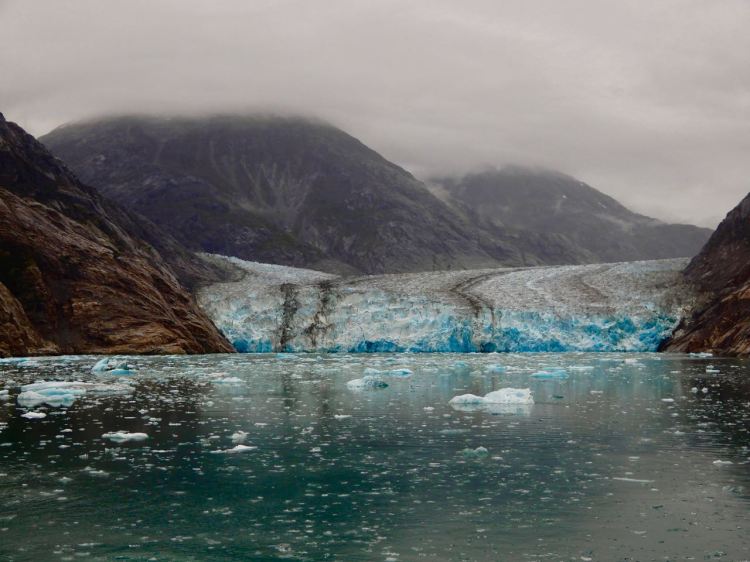
One of the most thrilling sights on an Alaska cruise is encountering a glacier terminating at the sea. The two most often visited by cruise ships are Dawes Glacier and the much larger Hubbard Glacier. Dawes is located some distance up Tracy Arm Fjord while Hubbard is on a bay open to the ocean. If you’re planning an Alaska cruise try to select one that visits Hubbard Glacier.
Dawes Glacier in Tracy Arm Fjord
Cruising To Hubbard Glacier
Hubbard Glacier is the largest tidewater glacier in North America. In contrast to most glaciers in Alaska and northwestern Canada, Hubbard Glacier actually grew and advanced faster during the 20th century. Even today Hubbard is still advancing.
This behavior is an example of how the growth dynamics of glaciers work. While global warming is a measurable fact that has been happening for several hundred years and is a contributing factor to glacier recession it is not the only process at work on glaciers.
Glacial Dynamics
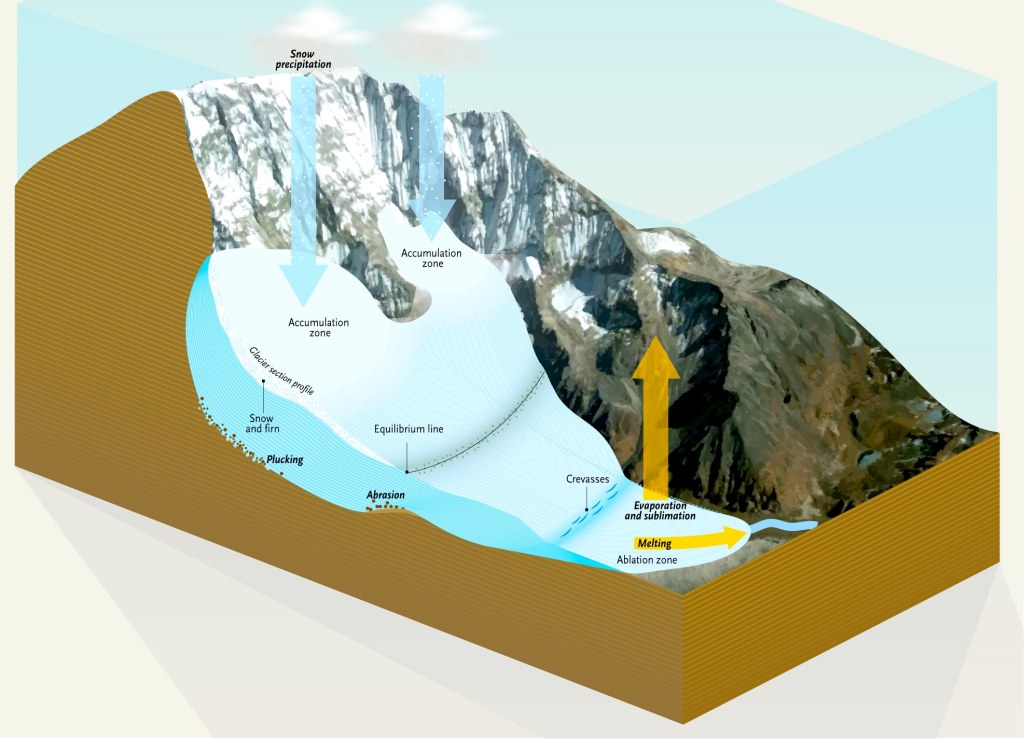
Most glaciers begin inland and at higher altitudes and are created mostly from winter snowfall. As the weight of heavy snows compact they turn into solid ice. As more snow falls the weight and pressure of the ice pushes the mass down and outward and the glacier’s front edge moves forward through the landscape. The more snow the faster the glacier moves. As the glacier moves into lower terrain it encounters warmer temperatures and most glaciers experience rapid summer front margin melting. What controls the glaciers advance or retreat is the amount of new snow at higher altitudes pushing the glacier forward working against the speed of melting at its front margin. While many glaciers are in retreat there are glaciers that are still growing and pushing forward.
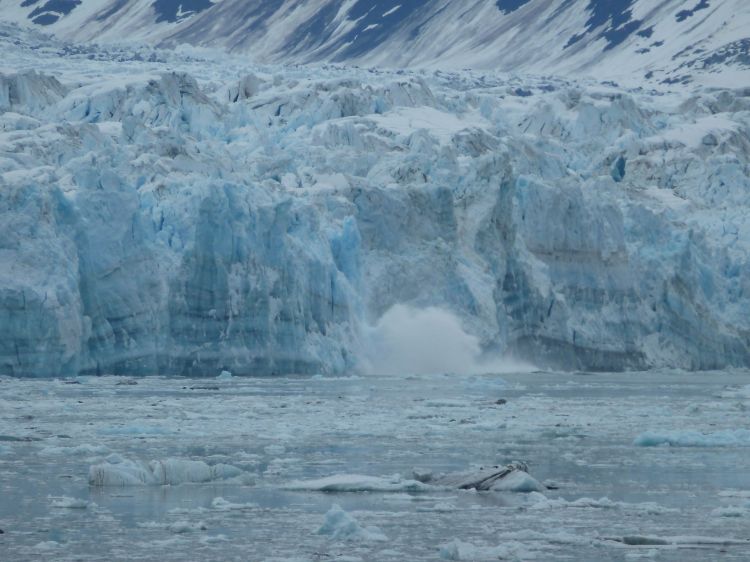
Hubbard is one of the growing glaciers but because its front margin touches the sea its front edge simple breaks off in huge chunks that float away. Those huge falling pieces stand 150 feet tall above the water and are referred to as calving.
The Hubbard Glacier Event
Hubbard Glacier
In May 1986, the advance of Hubbard Glacier surged forward calving huge sections, blocking the outlet to Russell Fjord and creating Russell Lake. All that summer, the new lake filled with runoff and its water level rose 82 feet.
Somewhere around midnight October 8th, the dam began to collapse. In only 24 hours, an estimated 1.3 cubic miles of water roared through the growing opening, and the fjord returned to its previous level. This was the largest glacial lake outburst flood in recorded history.
Photographing Hubbard Glacier
In cruising Alaska most people want to take home great photographs of Hubbard Glacier and catching a calving would be the perfect image. Unfortunately there’s a lot working against you. Hubbard Glacier is massive and the face is over six miles wide and stands 150 feet out of the water. Cruise ships are only allowed to come within a couple of miles of the face and while you will hear the roaring of a calving by the time you hear the sound and turn to face it the event is almost over. Videos are great but you’ll also need to focus on a point and start filming before an event begins. Even if you miss capturing a calving with a camera it is still an amazing experience.
The Alaskan coast at sunset
please consider subscribing to The Intentional Travelers and receive notices of new postings, new newsletters and special offers.
Join Us • We understand that the last thing you want is more emails cluttering up your inbox, but we promise we’ll work hard to make this worth while. Give us a try and if we don’t live up to our promise all you need do is click the unsubscribe link in our emails.
Don’t Miss Out, SubscribeNow!
You’ll receive notices of new posts, special features and updates right in your inbox…
Linville Falls on the Blue Ridge Parkway consists of two different trails along with several wilderness trails for serious hiking: The falls trails are the upper twin falls, and the trail to the larger lower falls. The trails are marked leading to these falls, with the lower falls being visible from the upper twin falls trail’s overlook.
The lower falls
Spring on The Blue Ridge Parkway is probably the best time of year, while the fall colors, while spectacular, attract much larger crowds.
Find a complete guide to Blue Ridge Parkway hiking trails HERE.
Subscribe to The Intentional Travelers and you’ll receive notices of new postings, new newsletters and special offers.
Join Us • We understand that the last thing you want is more emails cluttering up your inbox, but we promise we’ll work hard to make this worth while. Give us a try and if we don’t live up to our promise all you need do is click the unsubscribe link in our emails.
Don’t Miss Out, SubscribeNow!
You’ll receive notices of new posts, special features and updates right in your inbox…
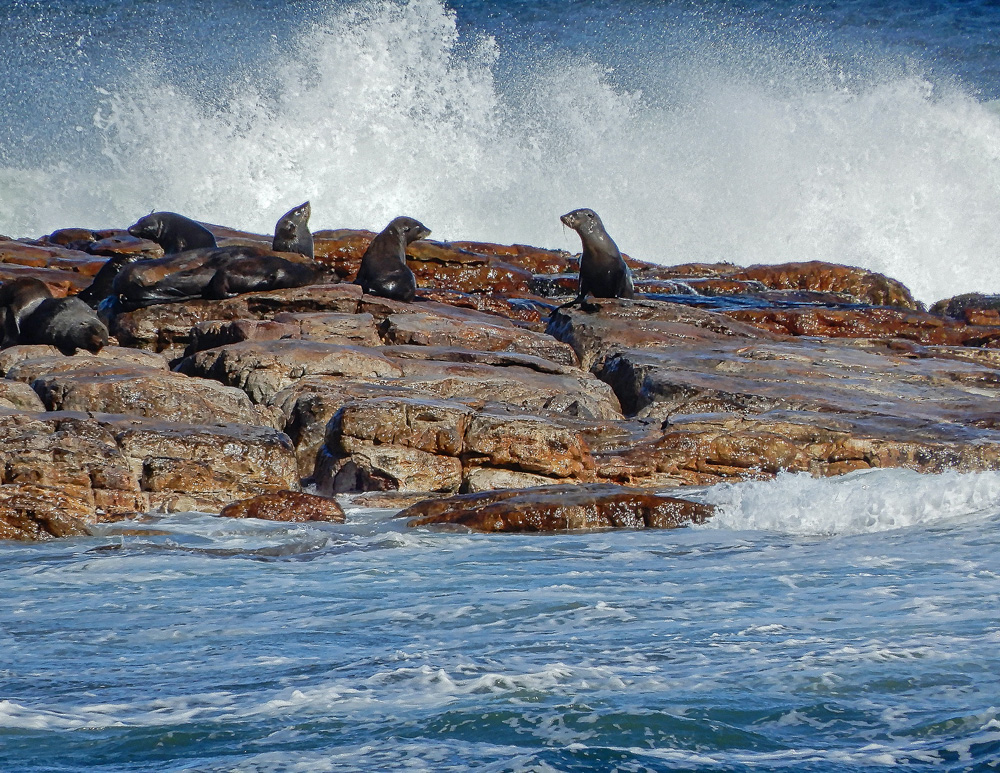
Traveling down the Cape in South Africa the scenery and wildlife just overwhelmed! Above is one of many photos taken of the rocky shore, surf with lots of seals. This particular image is right at the Cape Of Good Hope, the very southern tip of Africa.
The point of land at the Cape Of Good Hope
The brown fur seal, also known as the Cape fur seal and South African fur seal, is one distinct species of fur seal. It is estimated that approximately two million Cape fur seals inhabit the coasts of southern Africa, mostly living in 25 to 40 colonies on rocky shore lines.
Consider subscribing to The Intentional Travelers and receive notices of new postings, new newsletters and special offers.
SEARCHTHE INTENTIONAL TRAVELERS
Join Us • We understand that the last thing you want is more emails cluttering up your inbox, but we promise we’ll work hard to make this worth while. Give us a try and if we don’t live up to our promise all you need do is click the unsubscribe link in our emails.
Don’t Miss Out, SubscribeNow!
You’ll receive notices of new posts, special features and updates right in your inbox…














 The Intentional Travelers