
Introduction
 The Cruise Port of Civitavecchia is a seaside city and the port serving the city of Rome. The city is served by frequent train service from and to Rome along with regular service to other Italian destinations. The Cruise port is only a short five or six block walk from the train station along the waterfront on Via Aurelia. Once at the port there are usually free shuttles to the cruise ships. From where and how the shuttles run seems to change often.

The main gate to the port is next to Forte Michelangelo and the nearest to the train station and across the street from the McDonalds. Recently the cruise shuttles are being organized nearer the Roman Dock entrance about 5 blocks farther up Via Dalmazia from the main gate.
Rome Cruise Port Civitavecchia is both a cruise ship embarkation port as well as a popular port of call and for that reason it can have a large number of ships in port at times. On one day we counted seven large cruise ships tied up along the sea wall and piers. Because it is a working port and its size the port normally requires a shuttle to get out of the port or to your ship.
Where Your Ship Docks

The seaport stretches along the waterfront in downtown Civitavecchia and there are no cruise terminals or public facilities. Walking out is usually not permitted because it is a large working port but usually there are free shuttle buses to one of two gates. The city near the the port has a nice stretch along the sea toward the train station featuring a number of outdoor cafes. There are a number of nice shops in the colonnade strip behind the port and a walking mall just two blocks up from the McDonalds at the seaport.
Transportation

When you are cruising out of Rome, Italy the distance to the port requires you to do some planning. If you are arriving at Fiumicino, Leonardo da Vinci airport specifically to get to your cruise ship you can save a lot of money by taking a train. The airport train station is inside the airport and a ticket to Civitavecchia is around €5 (* see note below). It does require taking a local train and switching trains at Trastevere station. Taking a taxi to the port can be an expensive trip with fares running from €150 to €300. If your not inclined to go the train option most cruise lines will offer transfer services to and from Rome airport at an additional fee. When booking your cruise usually transfers are provided as an option.

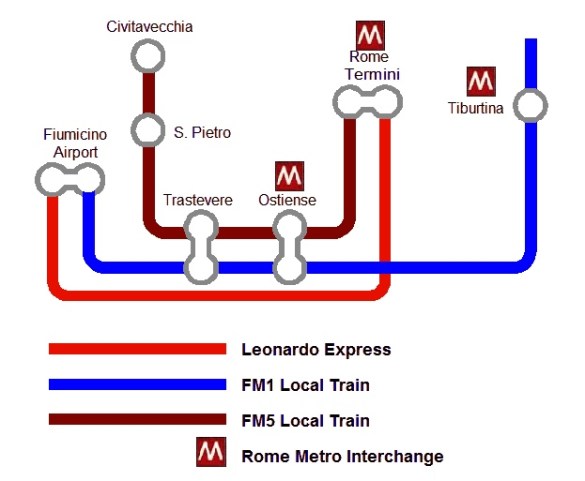 While most cruises offer tours into Rome with some being nothing more than round trip bus service the fare can run $80 or more per person. If your cruise is ending in Civitavecchia or if it is a stop on your cruise itinerary the best way to get into Rome is to take a train. It’s only a short six to ten block walk up Via Aurelia to the station. Trains run as frequently as ever 20 to 30 minutes. From Civitavecchia a typical trip to S. Pietro (Vatican City) takes 40 minutes, Trastevere 50 minutes, Ostiense 55 minutes and finally Termini (the central train station) 70 minutes. Fare starts at €5 one way on the commuter trains but can cost up to €25 round trip if using regional trains depending on ticket class. There is a manned ticket booth at the station along with vending machines. We would strongly recommend getting a metro train map ahead of time and plan your route before getting to Italy. Our experience is that buying tickets ahead of time online doesn’t save anything and can actually cost you much more.
In Civitavecchia taxis are available but are famous for overcharging with the short ride from the port to the train station (6 to 10 blocks) quoted as high as €10 or €15. Taking a taxi into Rome or to the airport can be an expensive trip with fares running from €150 to €300.There are also shuttle services to the airport with an average price starting at €25 per person. It is recommended that reservations be made ahead of time as schedules can vary a lot.
Currency
The local currency is the Euro and the U.S. Dollar is generally not accepted. Most most major credit cards are accepted and an easy way to exchange money is to use an ATM machine if you have a debit card.

Around Civitavecchia
 We have stayed overnight in Civitavecchia a number of times. It is a pleasant city with a number of nice hotels and restaurants within walking distance of the port. One happens to be our favorite pizza parlor (HERE). The main business district is next to the port and there are a number of nice shops in the area as well as a pedestrian mall. Via Aurelia runs along the waterfront from the train station to the ports main entrance and has a number of restaurants, most with outdoor seating available. There is also a nice park area along the water which is a popular place for locals to stroll in the evening.

Forte Michelangelo is a historic monument erected as a fortress in the 16th century that runs along the waterfront behind the port. In the day time there is a central courtyard open to the public and on the street side it features a colonnade and also offers panoramic port and ocean views.
Terme Taurine, also known as the Taurine Baths, is an archaeological site of a Roman bathhouse complex outside of Civitavecchia. The site features ruins dating to the Republican and Imperial eras with the oldest structures dating to the first century BC.
The National Archaeological Museum Of Civitavecchia, also known as City Museum, is located inside the eighteenth-century building commissioned by Pope Clement XIII in the eighteenth century, a block away from Fort Michelangelo. It features exhibits from the dawn of civilization, during the whole Roman times, up to the Middle Ages.
*Please Note: If you are taking a train during morning or evening rush hour many of the local trains are commuter trains and if you are traveling with suitcases the Italians may get upset with taking up extra seats. Put your bags overhead or at a car entrance.
 If you consult a map of the Caribbean you can trace an arc of islands stretching from Hispaniola and Puerto Rico down to Trinidad just off the coast of South America. Along that arc are several dozen islands but one, Barbados, sits all alone one hundred miles into the Atlantic Ocean. Its East and Southeast coast catch the waves crossing the Atlantic making for a rugged coast and great surfing. The West coast of the island faces the calmer Caribbean Sea with long stretches of flat beach and calmer water.
 Along that rugged Southeast coast of Barbados in Saint Philips Parish is a bay with a great beach. It’s called Crane Bay and the beach sits under a cliff where the rolling countryside drops off forty feet to sea level. History says Crane Beach gets its name from a crane that was installed at the top of the cliff to lift cargo up from the beach where it had been off-loaded from boats. While the neighborhood is rural and mostly residential there are a number of large estates and a resort that sit along a mile of this rugged coast.
 This resort is rated one of the best in Barbados and maybe the entire Caribbean. It’s the oldest operating hotel in the Caribbean, open since 1887, The Crane Resort overlooks the Crane Beach – one of the top 10 beaches in the world and named the “Best Beach in the Caribbean” by USA Today’s 10 Best Readers Choice. Located on Barbados’ beautiful South East coast, The Crane marries its historic old-world charm, with the 21st century amenities and services expected by today’s upscale travelers. After Crane Beach itself, the resorts biggest asset is its courteous, and dedicated staff who are always ready to help in any way.
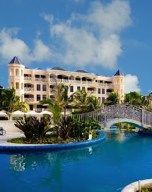 If you’re looking to get away from it all and do it in style The Crane Resort fits the bill. Wether the location is an advantage or not depends on what your looking for as it is a bit out of the way, being far from town and away from other hotels and resort beaches. In addition to world class scenery, great service and peace and quiet it is also only 10 minutes from Barbados International Airport.



 There is also a world of cruise lines out there and while a number base their operations on serving American cruisers there are lines that have been focused on Europe, Asia and other regions. For examples, with Carnival, almost all your fellow passengers will be American, giving Carnival cruises a real American feel. On Costa and Azamara, passengers are usually from a number of different, mostly European countries. MSC historically has been another line focused on the European market but is now reaching for a share of the American market. It is based in Italy, but now with a U.S. office in Florida and a number of Caribbean itineraries.

 West of southern Morocco in the Atlantic Ocean sits a cluster of volcanic islands called The Canaries. The Canary Islands feature a rugged volcanic landscape known for the black and white sand beaches. Tenerife, the largest island, is dominated by an active volcano Mt. Teide, which has its own astronomical observatory and is part of Teide National Park. Tenerife hosts a huge pre-Lent Carnival each year in the capital of Santa Cruz de Tenerife.
 Most cruise ships will dock at the piers in Santa Cruz de Tenerife. There are no cruise terminals or readily available public facilities at the pier. While docked in the city it is still a good walk to reach the central business district. At times there can be shuttles available to get out of the port area.
 Transportation
 being about fifty miles.
 Currency
 Attractions
 The Canary Islands are a favorite holiday destination for Europeans, particularly the British. It features a good selection of fine restaurants along with a thriving wine industry with a number of vineyards of note.


 The Military Sea Services Museum

 Civilian Conservation Corps, the park features a lush and incredibly diverse 9,000 acre refuge for endangered animals and ancient flora. While the park is a great place for hiking, it is also home to the
 been visiting for years. Located on the southern end of North Hutchinson Island at Ft. Pierce is
  The Seal teams have overshadowed UDT in recent years but Seals are a progression from the UDT units that were active in WWII up to the early 1970’s and they share the same training program (Buds for Basic Underwater Demolition School). Stop by and learn something about Seals, their training, missions and their predecessor’s, the Underwater Demolition Teams..
 UDT prided themselves as the first on the beach in a landing assault
 Getting pickpocketed is a terrible thing. If you travel often, the chances are that it’s going to happen. Even if you don’t travel it can happen. If you take precautions and stay alert the risk is greatly reduced but the fact is no one is immune.
 Keep your valuables secure in a money belt. There are a number of styles and sizes available but the common design is a pouch that secures to a belt and is tucked under your clothes. If you find it awkward to access the pouch, a pickpocket will find it near impossible. If you have to carry a passport, cash or credit cards they really should be in a money belt.
 Stay aware. The best thing you can do is avoid getting into crowds. That is the favorite environment for pickpockets. If you do end up in tight quarters be aware that pickpockets are masters of disguise. Most choose to look just like other tourists or well-dressed professionals or a young mother carrying a baby so don’t let down your guard because of hoe someone looks.
 Always expect the worse and keep a firm grip on you purse. Don’t expect a strap hung over your shoulder to prevent a snatching. Often the thieves carry a knife to cut the strap. If you get into crowded areas keep an arm wrapped around the purse.
 drivers license unless you are going to rent a car. Likewise you usually don’t need to carry your passport. Our recommendation is to leave those in your hotel along with credit and debit cards you won’t be needing. You should still have some forms of identification and a copy of your divers license will usually suffice. Another strong recommendation is to have and carry an emergency identification card that includes contact information and any medical needs (a great source of a downloadable card is
  The Intentional Travelers