One of the most popular ports of call on Mediterranean cruises, Venice (in Italian Venezia) is also regularly an over-night stay for many cruise itineraries and a port of departure for some cruises. It is an island city criss-crossed with a number of canals and is home to the iconic gondola. If you are planning your first Mediterranean cruise we would strongly recommend you selecting an itinerary that includes this marvelous city.
Where You Dock
The cruise ships dock primarily at the cruise terminal of Venice called Venezia Terminali Passeggeri. Large cruise ships tie up in the Marittima basin (Bacino Stazione Marittima), smaller ships tie up at the nearby San Basilio pier and Santa Marta pier. The piers are located just to the southwest of the northern entrance to The Grand Canal and to the west of Piazzale Roma. The larger piers are equiped with terminals that offer facilities and some shops.you can take
Transportation
The main city island is cut in half by The Grand Canal which acts as a sort of waterway main street. The heart of the city is centered around St. Marks Square (Piasa San Marco) which is the most popular first destination for visitors.
Most cruise ships usually operate shuttle boats from the pier to docks along Riva degli Schiavoni which are just east of St. Marks Square in front of the Doge’s Palace. Cost has ranged from free to $12 round trip. Some cruise ships also provide a shuttle bus service to Piazzale Roma near the port or take a land taxi or the People Mover located near the front of the first
pier. From Piazzale Roma, youcan than catch a water bus (vaporetto) on either Line 1 or Line 2 along the length of the Grand Canal to St Mark’s.
Venice is a very walkable city as well and while the streets seem to zigzag throughout the city it is isn’t difficult to keep your bearings. Numerous directional signs will point the way to the Rialto Bridge, which is one of two bridges across the The Grand Canal with additional markers pointing to St. Marks Square. The other bridge across The Grand Canal is a footbridge called the Ponte dell’Accademia located farther south than the Rialto.
Glass shop St. Marks Square
Currency
Italy uses the Euro with an exchange rate usually under $1.50. US Dollars are not readily accepted but most major credit cards are.
Glass factory on Murano
Attractions
Just strolling thru this remarkable city is the main attraction with its interesting neighborhoods, historic architecture, famous upscale shopping streets, open-air marketplaces and an endless assortment of restaurants and cafes. Venice is noted for art and architecture, the canals separating the 118 small islands on which it was built in the 5th century, its mask making, art glass , and of course Carnival.
A few of the more notable mask shops are Atelier Marega, Calle del Scaleter, 2940/B, Tragicomica, Calle dei Nomboli, 2800, Carta Alta Venetian Masks, Sestiere Giudecca, 796, Venice Masks by Alberto Sarria, San Polo 777, and Atelier Flavia, Sestiere Castello, 6010.
The glass factories of Venice of which the most famous is Murano Glass Works are located on Murano which is a series of islands linked by bridges in the Venetian Lagoon which can be reached by ferry.
We just got home from a European river cruise and it didn’t go as we had hoped. Sometimes the rivers experience high water conditions that prevent the long boats from passing under bridges. In our case, Europe has been suffering a long drought in the Danube and Rhine Regions, and the rivers were so low they kept the long boats from sailing in certain areas.
Our Experience
It is not my intent to single out Viking River Cruises but they are the company we cruised with this year. We were also novices to river cruising and were totally unprepared regarding a couple of areas where we experienced serious problems. We offer what has happened to us as a cautionary tale which will hopefully help others in their planning.
To start, we were very surprised at the number of longboats and cruise boats plying these European rivers. There were places where there were as many as six boats tied up three abreast at the docking area. Along one stretch of the Danube River, in the course of a mile, we passed five of these cruise boats headed in the opposite direction. Not that it affected us, but the traffic was almost unbelievable.
There are a few major companies offering river cruises and more than a dozen smaller ones. Avalon Waterways and Viking River Cruises are probably the two largest with the most experience. In addition to these, the list includes AmaWaterways, Uniworld Boutique River Cruises, Tauck World Discovery, Crystal River Cruises, Scenic Cruises and a number of newer operators. Generally they have similar policies regarding cancellation, itinerary changes and what is covered in a cruise package.
Getting the cruise you want usually requires making a selection over a year in advance so there is no way of knowing the water conditions ahead of time. Most lines reserve the right to modify the itinerary as conditions warrant. To fulfill the contract, this can include putting you on buses and in hotels instead of on boats. Once you show up to take the cruise, except in the case of a medical emergency, you are in their hands through to the end.
Air Fares
Many lines include airfare and transfers in the package price. In our case with Viking we asked if we could remove the air portion as we were considering taking a trans-Atlantic cruise back to the States. Viking’s policy without exception required us to pay for the air portion even if we weren’t going to use it.
Since this was our first river cruise we didn’t know that there were options in approaching airline ticketing. We were advised of a $100.00 per person deviation fee for Viking to schedule us into Budapest a week early. Apparently there is also a program called Air Plus which costs $50.00 and provides you a bit more flexibility with the airline reservations but can also increase the cost of the airfare.
In our case the reservations booked by Viking were terrible and nothing we would ever have arranged for ourselves. Going to Europe we were routed Florida to Frankfort with a connection to Budapest. We had an impossibly short time between flights so we missed our connection. For the return flight we were booked at 7:00 AM out of Amsterdam to Munich, connecting to a flight to Frankfort to catch our flight back to Florida adding up to a twenty-two hour travel day where a normal trip would be less than 13 hours. When we asked for changes to the schedule, we were advised that any alterations would require a change/upgrade fee of $600.00.
Added Tours
Also included in many itineraries are local tours in the cities visited. While this is normally a good feature, in our case Viking’s insistence on providing these tours ended up adding additional hours on buses getting to many of the tour sites. You could stay on the boat and choose not to participate but that meant you missed one of the places on the original itinerary. Some smaller cruise companies either don’t provide tours or charge extra and that should be a consideration when making plans.
Cabin Types
Most cabins on river boats are small and the options are usually a matter of the window size, having a French balcony or a full balcony. We had booked a French balcony cabin with Viking on this trip and if we return to Europe we will probably down grade our selection. First the cabin was so small that it was uncomfortable to use for just sitting (no chairs either) so we spent most of our onboard time in the lounge (there are also suites with sitting rooms). Additionally because when we were docked we were usually tied up to another boat. To avoid looking into another stateroom we usually kept our curtains closed. The French balcony wasn’t a valuable option.
Trip Insurance
Because of the high price of river cruising, in the future we will select trip insurance that allows us to cancel for any reason and pay much closer attention to river conditions weeks before the trip. It seems that an adjusted itinerary is not justification to cancel for many insurance plans including the one we used for this trip.
Information On River Conditions
For more information on river conditions see Ralph Grizzle’s information at River Cruise Advisor, a site that tracks water levels as does River Cruise Information. We will also pay for the air upgrade option (in the case of Viking that’s another $50.00 per person) and become more involved in selecting flights.
On the positive side Viking has recognized that they didn’t deliver what we were expecting and have provided some compensation for all of the problems we experienced, which makes for a slightly better ending to this story.
Longboat Tied-up on the Danube in BudapestThe Grand Europe Cruise
We had planned a river cruise across central Europe about a year and a half ago. You have to book way in advance as these cruises fill up. As trips go, this was the most per-day cost we have ever spent traveling, but everyone we know kept saying we must do it. This excursion was on Viking and went from Budapest to Amsterdam and was to be two weeks.
Early on in the planning we found that water levels in the rivers can be a problem – mostly the issue is high water. We have travel friends who had done this same trip a few years ago and almost never got on the boat. For them it was high water and the boats couldn’t get under many bridges. Their trip was two weeks of buses and hotels – nice buses and first-class hotels – but not what they had signed up for.
All summer I had watched the weather and it looked as if flooding wasn’t going to be a problem. We made our final plans which included spending a week in Budapest with a train excursion or two using Budapest as a base before the cruise. Two days after getting to Budapest we got messages from Viking informing us that low river levels was now a problem and our trip was going to experience some modifications.
As it turned out that was a major understatement. First our longboat couldn’t get up to Budapest so we were going to be put up in a hotel and bused to Vienna the second day. On the bus ride to Vienna we were told that our boat couldn’t make it to Vienna so we would drive past Vienna to Melk to catch the boat. After we had been on the boat for a few days we were then told that the Rhine River was closed to boats our size due to very low water. Two days later we spent another day on a bus to transfer to another boat that was nearer the Rhine. The new boat sailed thru canals for a couple of days and than we were stuck. After that we were taken on a bus trip thru the middle Rhine valley with a boat excursion, but no Rhine River cruising and because of that we also couldn’t get to the canals in Holland to sail past the iconic windmills. The trip ended with an all-day bus ride with a tour stop in Cologne followed by a very late arrival in Amsterdam.
The Viking Modi tied-up on a foggy day in Passau GermanyThree longboats tied-up at Melk Austria
At this point we need to be fair and comment on what these cruises can be. If we hadn’t encountered extremely low water it is easy to see how wonderful this could have been. Most of these boats are absolutely beautiful. In our case, the crew couldn’t have been nicer or offered any finer service. The meals were absolutely fantastic and we loved the lounge and the music in the evening. The sections of the rivers where we did sail and the towns that we docked at were a great experience. Had we been able to stay on the boat for the whole trip and tie-up at more towns the experience would have been everything we had hoped for.
This brings up the big question – what can be done to prevent this from happening? In most cases not much, be we do have some ideas leaned from hindsight. We will be more specific and offer some ideas in part two Here.
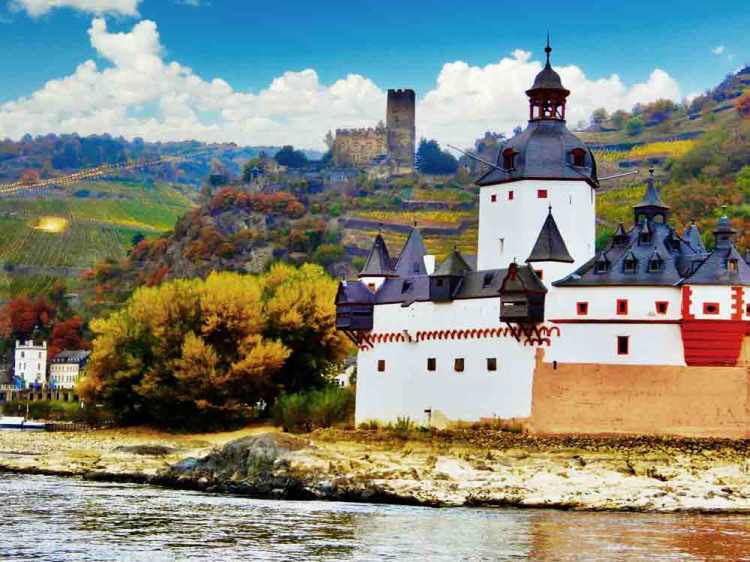
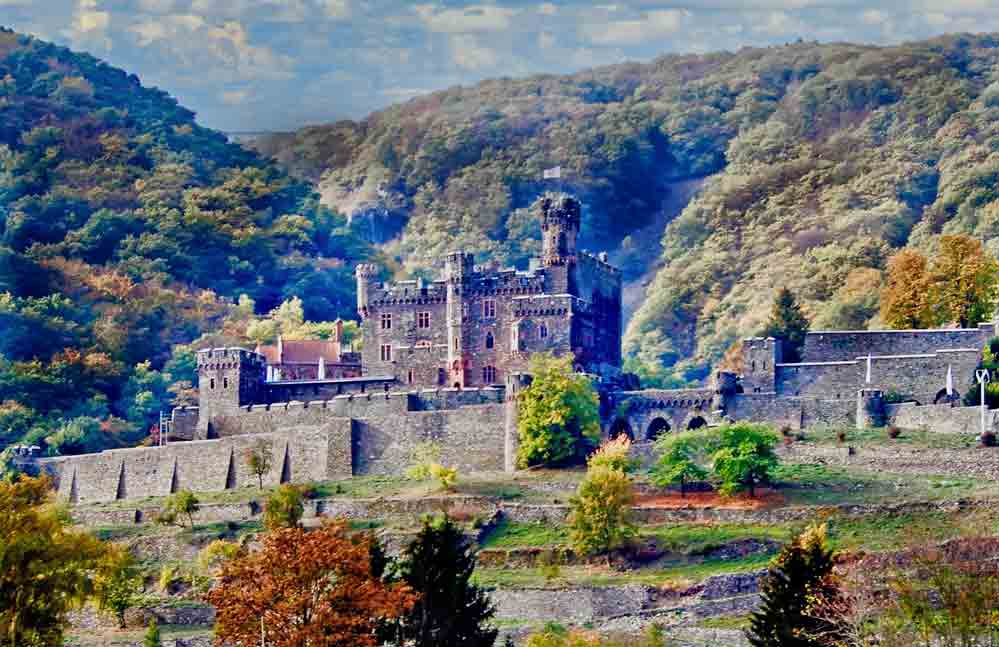
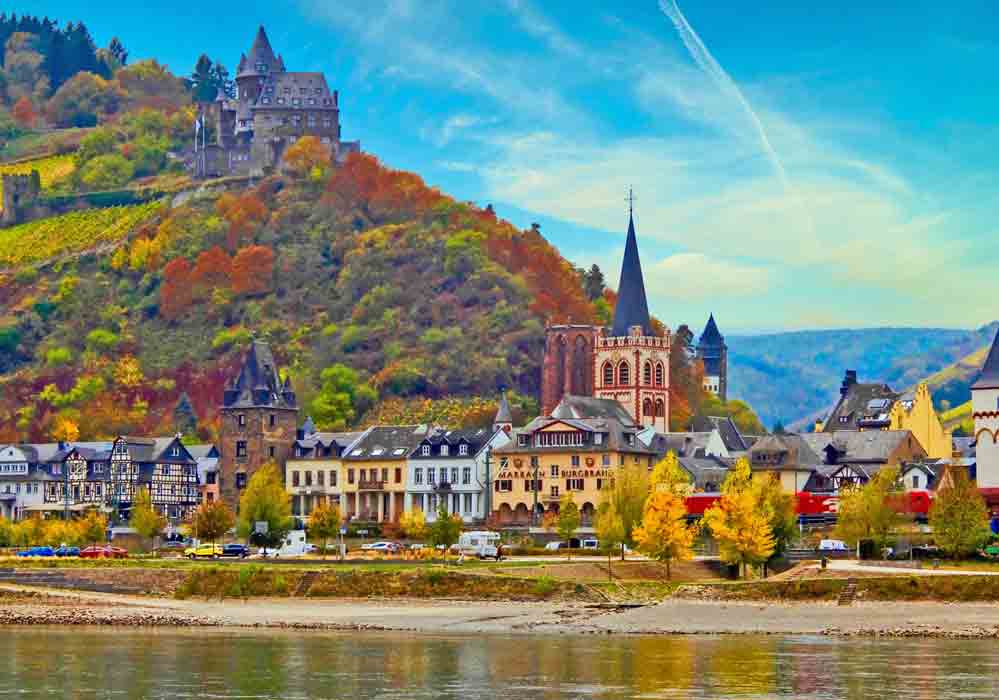
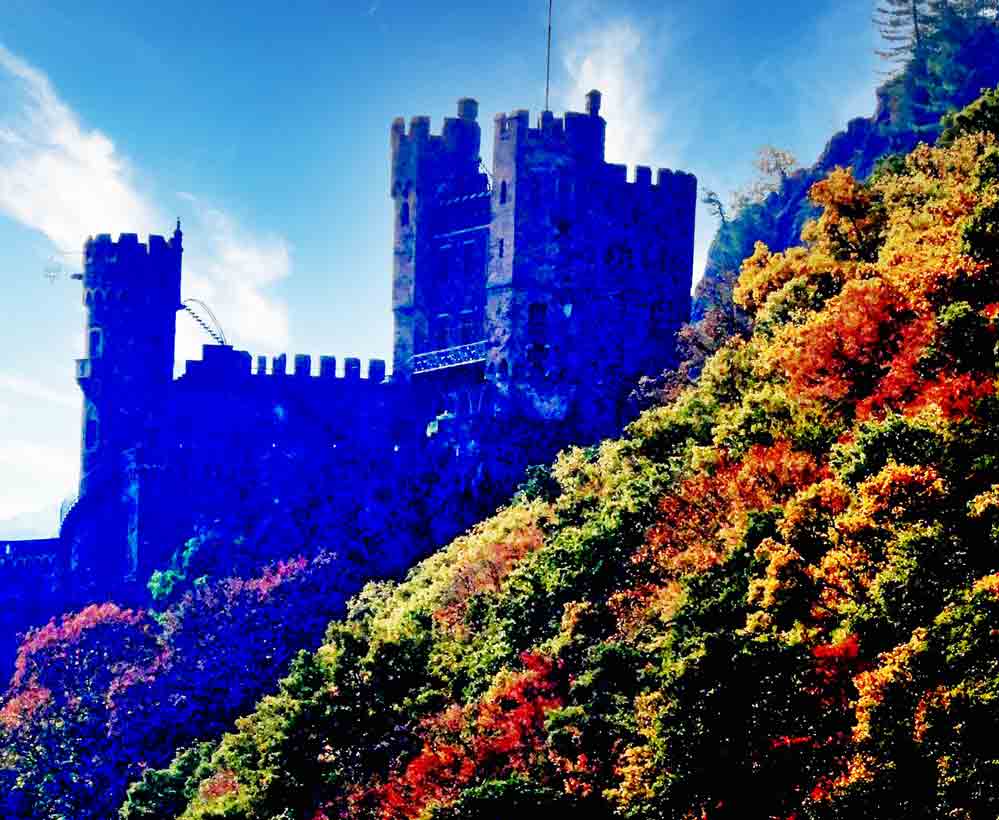
The “Middle Rhine” is one of four sections (High Rhine, Upper Rhine, Middle Rhine, Lower Rhine) of the river between Lake Constance and the North Sea. The upper half of the Middle Rhine (Rhine Gorge) from Bingen (Rhine-kilometer 526) to Koblenz (Rhine-kilometer 593) is a UNESCO World Heritage Site (designated in 2002) with more than 40 castles and fortresses from the Middle Ages along its banks along with many picturesque wine villages. The lower half from Koblenz (Rhine-kilometer 593) to Bonn (Rhine-kilometer 655) is also known as “the romantic Rhine”.
Probably the best way to see the historic Middle Rhine with its vineyards and castles is by spending a day on a river cruise. You will find a good selection of available cruises HERE.
At Rhine-kilometer 655 the river takes a sharp bend around a rocky promontory with flags flying from its summit and a large statue at river level commemorating the legend of Loreley . Parts of the legend date back to the middle ages and involve the dangerous waters and the sound the river makes flowing past the rock. Lorelei, Lore Lay or Loreley, refers to a large rock on the bank at a narrows of the Rhine River near Sankt Goarshausen, Germany. The rock is associated with a legend of a beautiful maiden who threw herself into the Rhine in despair over a faithless lover and was transformed into a siren who sang an irresistible song attracting boatmen to their destruction in the rivers currents and rocks.
A good map showing the castles along the Rhine in this area can be found HERE.
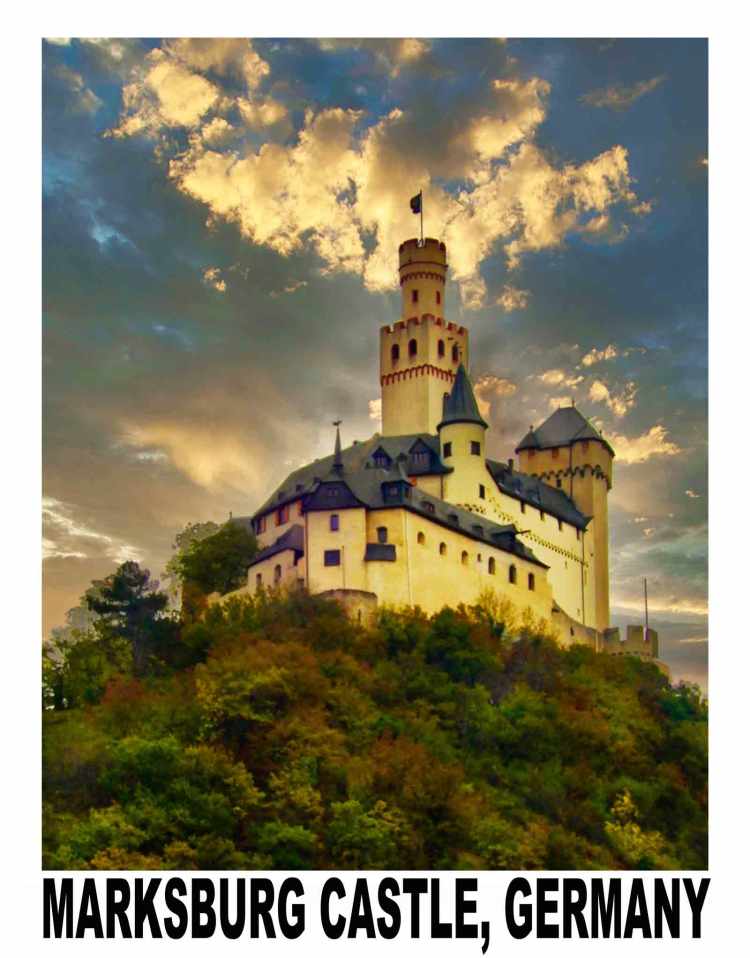
Marksburg Castle
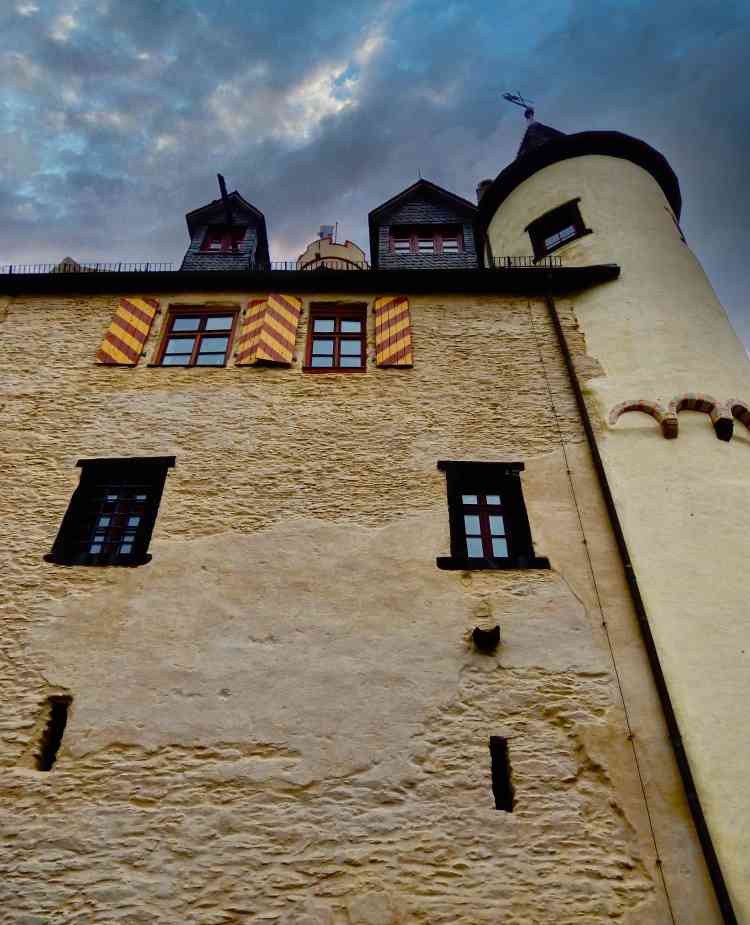
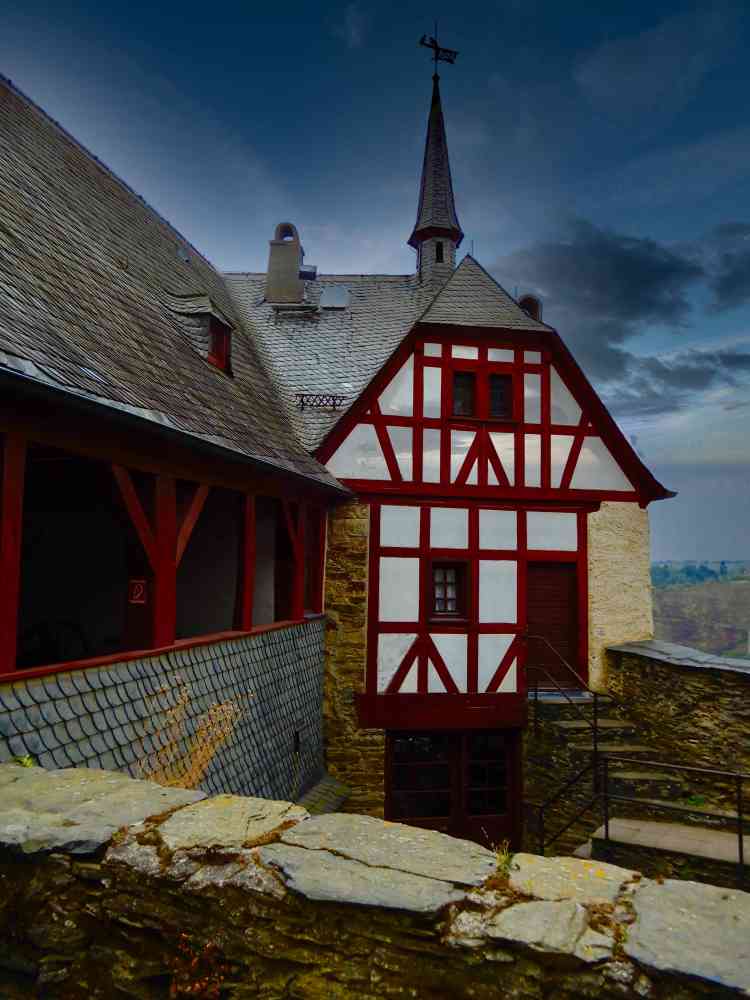
The highlight of the day was a visit to Marksburg Castle. The original name was Burg Braubach, the Marksburg Castle sits atop a high hill overlooking the Rhine River. Marksburg Castle is most famous as the only castle on the Middle Rhine to avoid destruction or serious damage thru its over eight hundred year history. The Marksburg Castle came under serious attack in 1945, when it received artillery fire from American forces attempting to dislodge Nazi forces inside the castle. Damage even then was minor.
The castle came under attack and seige a number of times but was never captured or destroyed.
In 1135 the castle and half the town of Braubach were the property of the Archbishop of Mainz, a member of the house of Eppstein. His family owned the castle until 1283. The last Eppstein to have claim to the castle married Eberhard von Katzenelnbogen and when she died the castle became the property of the Counts of Katzenelnbogen until 1479.
With the death of Count Philipp the Elder in 1479, the county of Katzenelnbogen passed to the Landgraves of Hesse through a benefactress, the daughter, who was married to the Landgrave Phillip II. The Marksburg Castle was attacked a number of times during the 30 years war and during Louis XIV’s campaigns again in the 17th century.
Another interesting aspect of this castle is that it was used as part of the foundation for the early video game Castle Wolfenstein where players hunted Nazi’s inside an old castle.
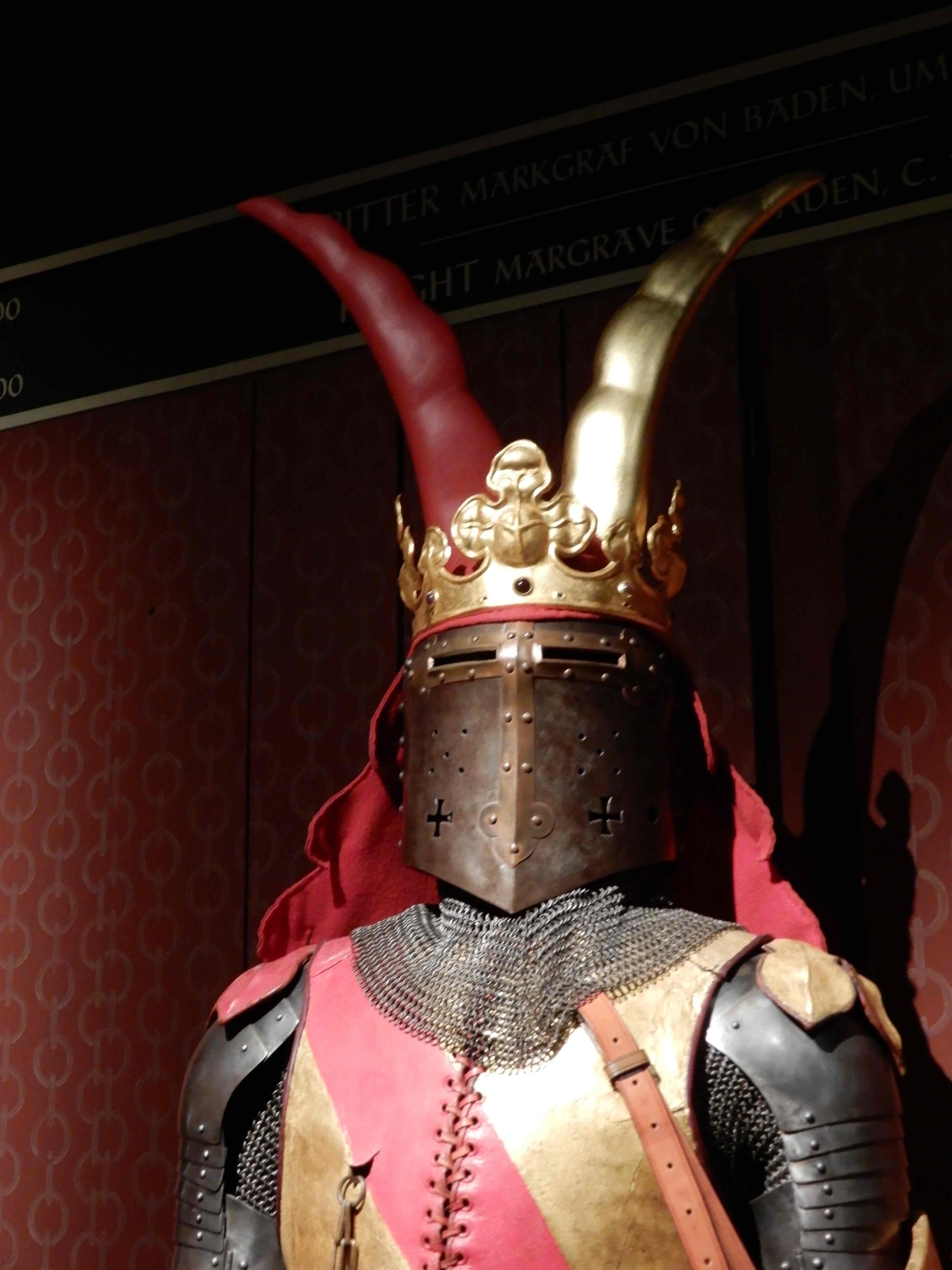
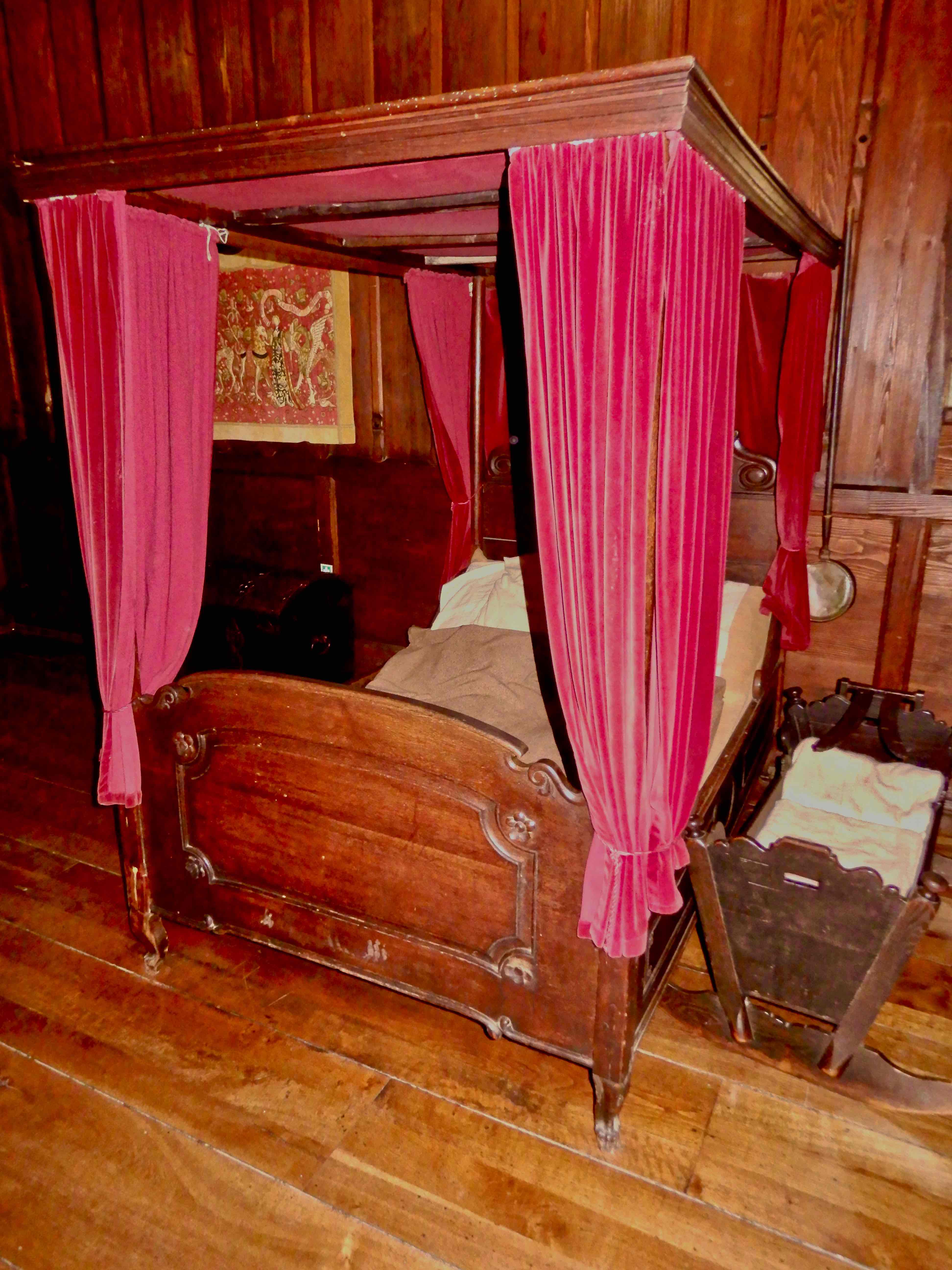
Since 1900, The Marksburg has been home to the Association for the Preservation of German Castles (Deutsche Burgenvereiningung) and along with tours offers exhibits of armor, a dungeon with implements of torture and rooms furnished with typical period pieces.
Cop
Planning A Cruise? Start With The Intentional Travelers Port Guides
Starbucks is becoming as ubiquitous as McDonalds around the world. We have become accustomed to looking for these outlets as we travel. While we are not huge fans you can expect a consistent coffee offering along with free WiFi from Starbucks as you travel.
We just got home from Europe and we just jumped to conclusions about using our Starbucks Gold Card in Europe from our experience on previous trips. Several years ago we cautiously started using a Starbucks card to purchase coffee in various cities. Over time we came to expect it to work everywhere.
While traveling in Australia and Ireland we were very surprised at how the process worked. After paying with the balance on our card we would get a receipt that showed the amount used in local currency along with the card balance expressed in Dollars and local currency.
After this trip a correction is in order. We were in Hungary, Austria and Germany and our card wouldn’t work at all. Checking the Starbucks web site we found the following statement:
Starbucks Cards activated in any of the participating countries can be used to make purchases and be reloaded in any other participating country. Starbucks Cards must first be activated by loading money onto the card in the country of purchase before being used internationally. The participating countries are; UK, USA, Canada, Australia, Hong Kong, Mexico, and the Republic of Ireland.
I guessed we jumped to conclusions based on too small a sampling. The good news is the coffee was what we expected and the WiFi is still free.
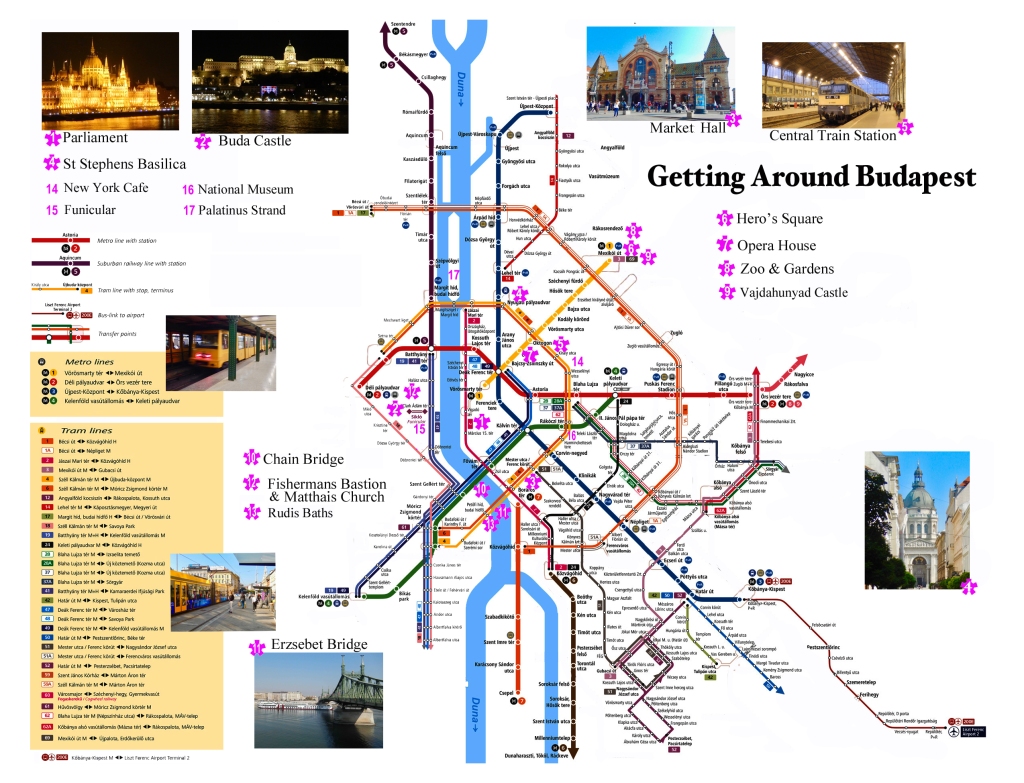
Click the map above to download our pdf Budapest Visitor’s Map re-imagined to get you to the major attractions using public transportation.
The first problem trying to get around in Budapest is the Hungarian language. While many Hungarians speak English you will find few maps, signs or streets in anything but Hungarian. If you follow the tips here you will quickly get the hang of navigating through this city and its public transportation.
Budapest is a remarkable, beautiful and large city with the Danube River running thru the middle of it. Along the river in the central city are four major bridges. Starting from the north at the southern tip of Margit Island is Margit Bridge.
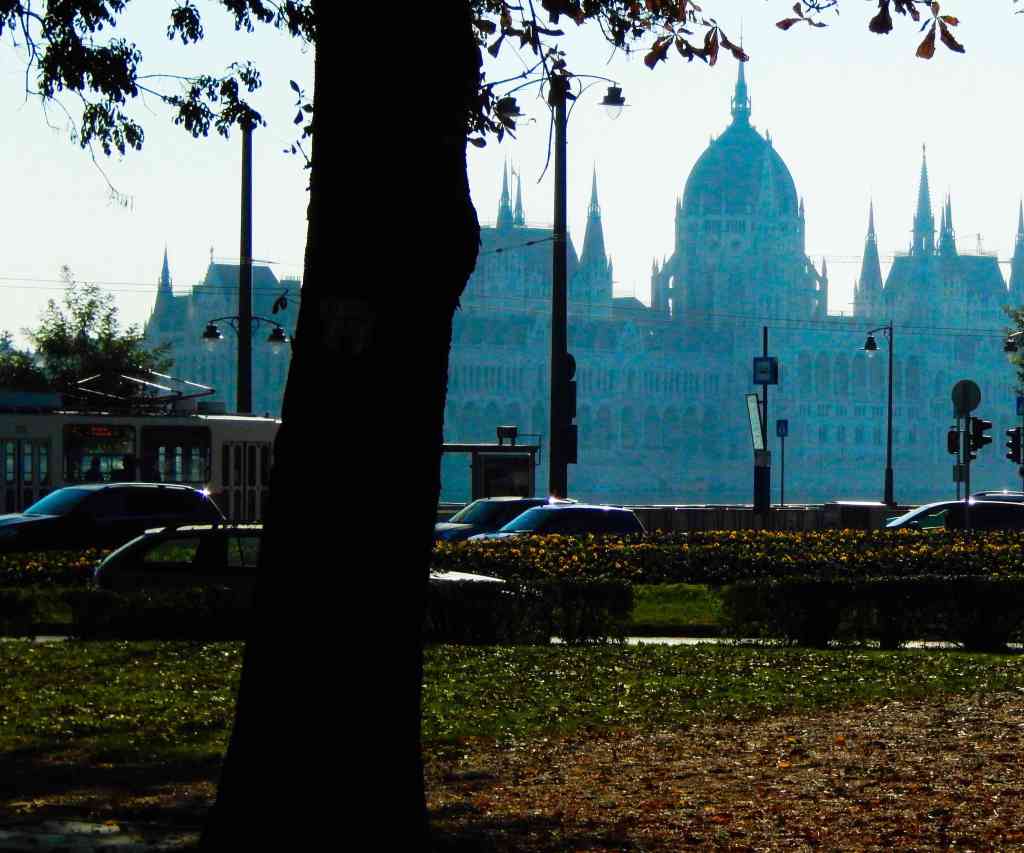
Hungarian Parliament Building
Margit hid or Margaret Bridge is a bridge carrying trams, cars and pedestrians connecting Buda and Pest along with access to Margaret Island. It was designed by French engineer Ernest Goüin and built by the construction company Maison Ernest Goüin et Cie. between 1872 and 1876. Margaret Bridge was the second permanent bridge in Budapest.
Next is the Széchenyi Chain Bridge. Designed by the English engineer William Tierney Clark and built by the Scottish engineer Adam Clark, it was the first permanent bridge across the Danube in Hungary. It was opened in 1849.
Next is Elisabeth Bridge (Hungarian: Erzsébet híd) is the third newest bridge of Budapest. The bridge is situated at the narrowest part of the Danube in the Budapest area, spanning only 290 m. It is named after Elisabeth of Bavaria, a popular queen and empress but often referred to by locals as the “White Bridge”.
Going south the fourth bridge is Szabadság híd (in English it means Liberty Bridge or Freedom Bridge. It was originally named Ferenc József híd (Franz Joseph Bridge). At its two ends are two public squares, Gellért tér, at the foot of Gellért Hill, next to the Gellért Spa and Fővám tér at the Great Market Hall. Built as part of the Millennium World Exhibition at the end of the 19th century, the bridge features art nouveau design and mythological sculptures.
Station on the Budapest subway
Navigating the city by surface streets can be confusing with neighborhood streets seeming laid out like a maze. Many areas have very few streets that are laid out in a square grid pattern but rather seem to zig zag back and forth. For this reason even trying to use a compass heading can be frustrating if you are walking. If you are walking to destinations we recommend using a detailed map or cell phone navigation. Fortunately major tram routes and subways trace prominent paths thru the city easily found at major intersections.
Budapest has a very efficient and inexpensive metropolitan transit system. The best option if you are going to be spending a couple of days in this city, is to get a Metro “day pass” which averages about $6.00 per person per day or less and is available in one, two and three day passes. A day pass operates on a 24-hour cycle so if you buy one at 10:00 am it can be used until 10:00 am the next day. You can purchase them from vending machines but our recommendation is to purchase them from a manned ticket window open during business hours at most major stations. These are usually at major street intersections where you will find there are stairs going underground that are often also the best way to cross large city streets. While an amazing number of Hungarians know a passing amount of English, signage is another story in this city. Finding good signage in English is actually very rare in Budapest. Beside being able to talk to an agent about purchasing the best pass for your needs, they will also give you a complete set of pocket maps with some information brochures in English that are not available at the machines. The metro system is based on individual tickets based on tapping onto trams and busses. If you buy a day pass you do not need to tap on or off the various transports but simply have the passes with you. The truth is that after three or four days of riding rapid transit, nobody ever asked to see our pass.
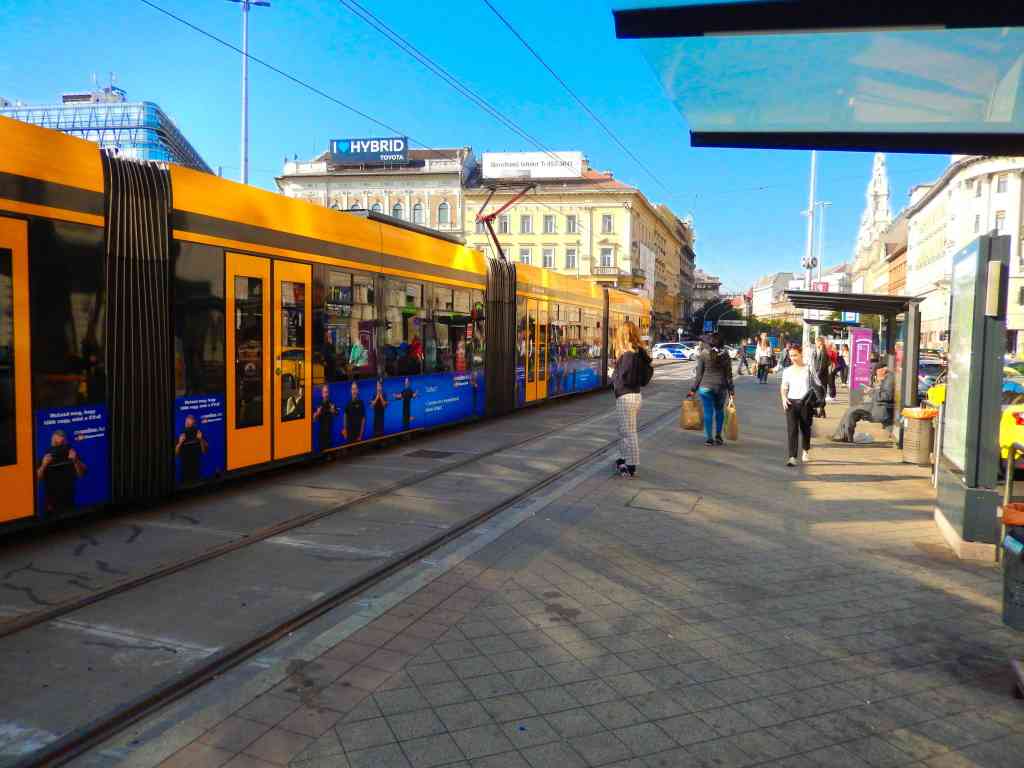
Tram stop on the Route 4 line
One exception to that was one day we bought a train ticket for an hour trip out to Slovakia which offered a partial discount off the price if we had an active transit pass. The conductor on the train did want to see our metro pass to confirm that we were entitled to the reduced train fare.
Metropolitan transit in Budapest has three primary systems. They are subways, buses and the street trams. The easiest to navigate are the surface trams which are clearly marked on maps by their routes. They also have the advantage of being operated at street level where you can see where you are.
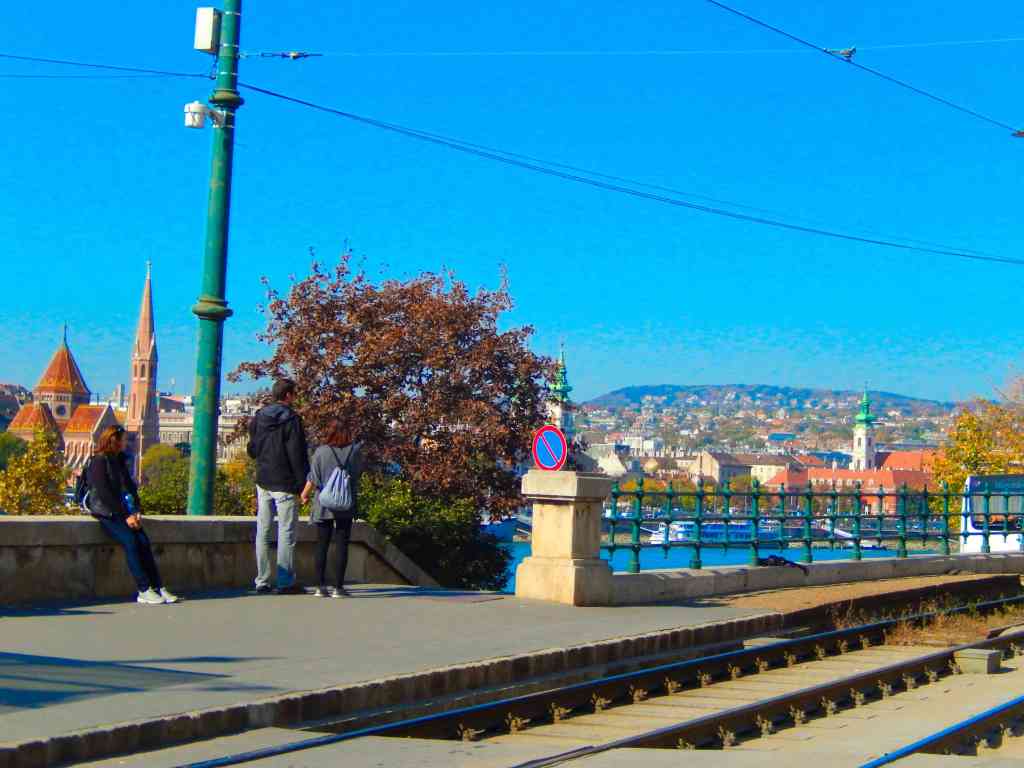
As a visitor think about Budapest as being divided up into several areas of interest. First the city is divided by the Danube River. The east side of the river is the old city of Buda with most areas of interest located within a mile of the river. Much of this terrain is steeply inclined up to the fortifications, the castle and Matthias Church and the old city. There is also a funicular that goes up to the castle level from near the Fisherman’s Bastion.
The west side of the river is the old city of Pest and includes most of the large commercial areas and additional major attractions. Some major sights include St. Stephen’s Basilica, The Hungarian Parliament Building, Hero’s Square as well as a number of major museums and galleries.
There are two primary tram lines designated 4 and 6 inside the central city that cross the river at the Margit bridge and the Erzebet Bridge. These two lines are major routes for people to use going to work and shopping and can get busy at times. Along these routes are the Central Train Station, the Market Hall, the New York Cafe and the Octagon intersection. From Octagon you can switch to the #1 subway line to get to Hero’s Square, the National Museum and or toward the river to the Opera House and a popular restaurant neighborhood.
There is an intersection of tram routes 4 and 6 with the #4 subway line at Jozsef Krt and Rakoczi Ut where you can switch routes and take the subway toward the Danube..
The easiest way we found to use the trams and subways is to know the map location where you get on and count the number of stops to where you are going, Understanding the Hungarian tram and subway announcements is often difficult and reading stop locations can be a challenge. Also station names at the various stations in the subway are poorly marked. For example boarding a west bound subway at the Octagon station and wanting to get off at Heroes Square to visit the gardens simply count five station stops.
After just a couple of trips you will easily get the hang of the system. Rush hour is also an interesting time on the trams. When the doors open on a packed full tram you will quickly realize that the crowd behind you believes there is plenty of room for a number of additional riders inside. You may be reluctant to push in but the next thing you know you are right there, packed into the car that you thought you wouldn’t fit into. Don’t worry most everyone is friendly and accommodating. Also if you aren’t sure where you are ask for help. We rarely found anyone that couldn’t understand some English and were happy to help.

 One of the most popular ports of call on Mediterranean cruises, Venice (in Italian Venezia) is also regularly an over-night stay for many cruise itineraries and a port of departure for some cruises. It is an island city criss-crossed with a number of canals and is home to the iconic gondola. If you are planning your first Mediterranean cruise we would strongly recommend you selecting an itinerary that includes this marvelous city.
 The cruise ships dock primarily at the cruise terminal of Venice called Venezia Terminali Passeggeri. Large cruise ships tie up in the Marittima basin (Bacino Stazione Marittima), smaller ships tie up at the nearby San Basilio pier and Santa Marta pier. The piers are
  located just to the southwest of the northern entrance to The Grand Canal and to the west of Piazzale Roma. The larger piers are equiped with terminals that offer facilities and some shops.you can take


 It is not my intent to single out Viking River Cruises but they are the company we cruised with this year. We were also novices to river cruising and were totally unprepared regarding a couple of areas where we experienced serious problems. We offer what has happened to us as a cautionary tale which will hopefully help others in their planning.
 There are a few major companies offering river cruises and more than a dozen smaller ones. Avalon Waterways and Viking River Cruises are probably the two largest with the most experience. In addition to these, the list includes AmaWaterways, Uniworld Boutique River Cruises, Tauck World Discovery, Crystal River Cruises, Scenic Cruises and a number of newer operators. Generally they have similar policies regarding cancellation, itinerary changes and what is covered in a cruise package.
 Since this was our first river cruise we didn’t know that there were options in approaching airline ticketing. We were advised of a $100.00 per person deviation fee for Viking to schedule us into Budapest a week early. Apparently there is also a program called Air Plus which costs $50.00 and provides you a bit more flexibility with the airline reservations but can also increase the cost of the airfare.
 Also included in many itineraries are local tours in the cities visited. While this is normally a good feature, in our case Viking’s insistence on providing these tours ended up adding additional hours on buses getting to many of the tour sites. You could stay on the boat and choose not to participate but that meant you missed one of the places on the original itinerary. Some smaller cruise companies either don’t provide tours or charge extra and that should be a consideration when making plans.
 Most cabins on river boats are small and the options are usually a matter of the window size, having a French balcony or a full balcony. We had booked a French balcony cabin with Viking on this trip and if we return to Europe we will probably down grade our selection. First the cabin was so small that it was uncomfortable to use for just sitting (no chairs either) so we spent most of our onboard time in the lounge (there are also suites with sitting rooms). Additionally because when we were docked we were usually tied up to another boat. To avoid looking into another stateroom we usually kept our curtains closed. The French balcony wasn’t a valuable option.
 Because of the high price of river cruising, in the future we will select trip insurance that allows us to cancel for any reason and pay much closer attention to river conditions weeks before the trip. It seems that an adjusted itinerary is not justification to cancel for many insurance plans including the one we used for this trip.
 On the positive side Viking has recognized that they didn’t deliver what we were expecting and have provided some compensation for all of the problems we experienced, which makes for a slightly better ending to this story.


 Budapest so we were going to be put up in a hotel and bused to Vienna the second day. On the bus ride to Vienna we were told that our boat couldn’t make it to Vienna so we would drive past Vienna to Melk to catch the boat. After we had been on the boat for a few days we were then told that the Rhine River was closed to boats our size due to very low water. Two days later we spent another day on a bus to transfer to another boat that was nearer the Rhine. The new boat sailed thru canals for a couple of days and than we were stuck. After that we were taken on a bus trip thru the middle Rhine valley with a boat excursion, but no Rhine River cruising and because of that we also couldn’t get to the canals in Holland to sail past the iconic windmills. The trip ended with an all-day bus ride with a tour stop in Cologne followed by a very late arrival in Amsterdam.














 Starbucks is becoming as ubiquitous as McDonalds around the world. We have become accustomed to looking for these outlets as we travel. While we are not huge fans you can expect a consistent coffee offering along with free WiFi from Starbucks as you travel.
 After this trip a correction is in order. We were in Hungary, Austria and Germany and our card wouldn’t work at all. Checking the Starbucks web site we found the following statement:
 I guessed we jumped to conclusions based on too small a sampling. The good news is the coffee was what we expected and the WiFi is still free.



 The Intentional Travelers