A Fantastic Utah Road Trip

Sensational Utah has the largest concentration of National Parks anywhere in America. Featuring The Intentional Traveler’s essential itinerary for a killer Utah driving adventure.

Utah is home to a number of America’s most amazing National Parks. Featuring spectacular scenery, great hiking trails and breathtaking natural formations.

Traveling around the United States, some of the most visited destinations are parks, with the National Parks being by far and away the most popular. The Blue Ridge Parkway is the most visited in America, probably because of its’ location near the Eastern Seaboard. Yellowstone, the Grand Canyon and Yosemite come in second, third and fourth because of the scale, grandeur and spectacle of the scenery. If you’re looking for the most concentrated park experience, consider the state of Utah. After taking a two week driving trip through Utah we decided that if you took away the National Parks, the National Forests and State Parks there wouldn’t be much left of the state.

Traveling about a five hundred mile route starting in Salt Lake City we visited five spectacular National Parks and some additional state parks. This is the order of the parks we visited:

  • Arches National Park
  • Canyonlands National Park
  • Capital Reef National Park
  • Bryce Canyon National Park
  • Zion National Park

Throwing in a few Utah State Parks along the way we concluded this was one of the most worthwhile road trips we have ever taken.

We started our trip in Salt Lake City which was NNW of Arches National Park and even that first part of the drive was memorable. We ended our adventure in Los Vegas which is about 150 miles SW of Zion National Park. In planning a trip like this you’ll discover that there are a number of lesser known National Parks to also consider like Red Rock Canyon, Tule Springs Fossil Beds, Gold Butte and the Grand Canyon Park Utah sections.

Following is a synopsis of the trip with a few recommendations.

Nine Mile Canyon
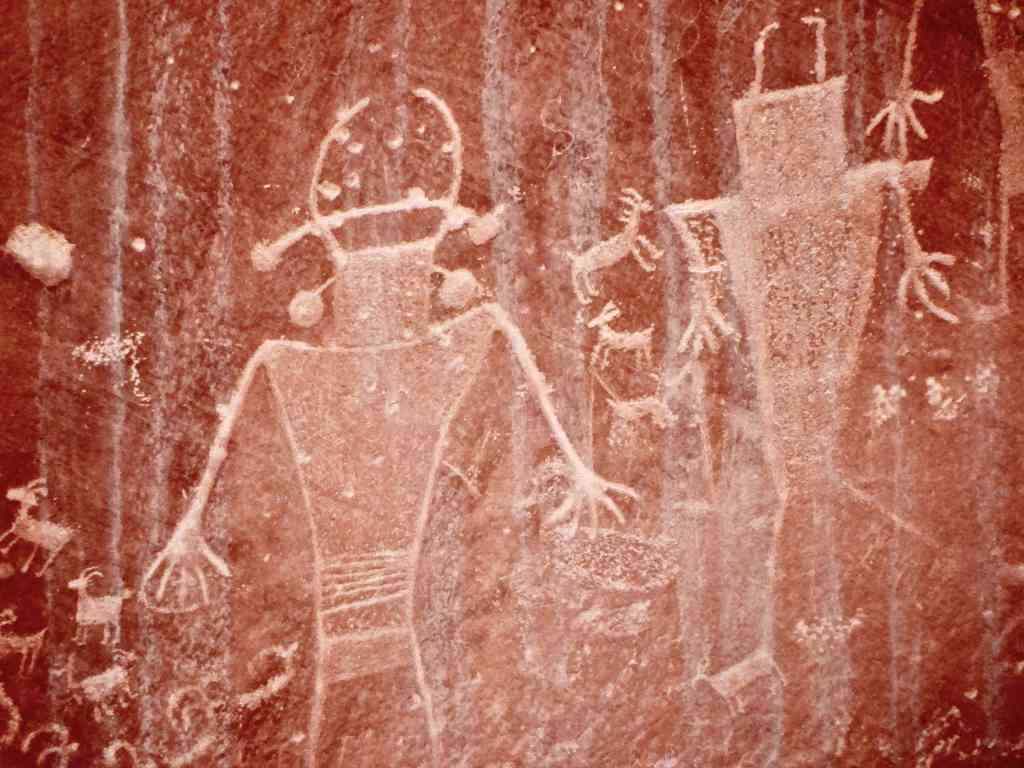
On our way south we took a side trip to Nine Mile Canyon. We had been told about the canyon and had also read an article regarding the locations of petroglyph sites in the area. The canyon is actually forty-eight miles long, not nine, with the first petroglyph site about twenty-seven miles in. Unfortunately we misplaced the article, which listed the location of each site based on your odometer reading at a sign at the start of the canyon. Without that information, once into this isolated area, we realized what a mistake that was. The two-lane road had virtually no traffic (except some free roaming cattle) and there was very little in the way of signage. We passed the first marker twice without seeing it – a small green sign on a post only six inches tall and ten inches wide that simply said “First Site” and an arrow. If you have the time, a visit to a few of these thousand year old sites is really interesting.

Getting into Moab late in the afternoon we checked into the motel and got something to eat with a plan to start in Arches National Park the next day.

Arches National Park

We visited Arches National Park early in the morning and realized that no photograph or description can begin to express the massive size of its’ formations or the scale of the arches and balancing rock towers. This place just has to be experienced to be believed. The sandstone formations are enormous, the colors are fantastic and you feel like a child entering a world of giants. If you are a hiker, there are a large number of very walkable trails in the park, temperature permitting, along with a number of scenic drives. On the subject of weather, it is very important that you carry water in your car and with you if you are hiking. The high temperatures and dry conditions can be punishing and even dangerous.

Canyonlands National Park
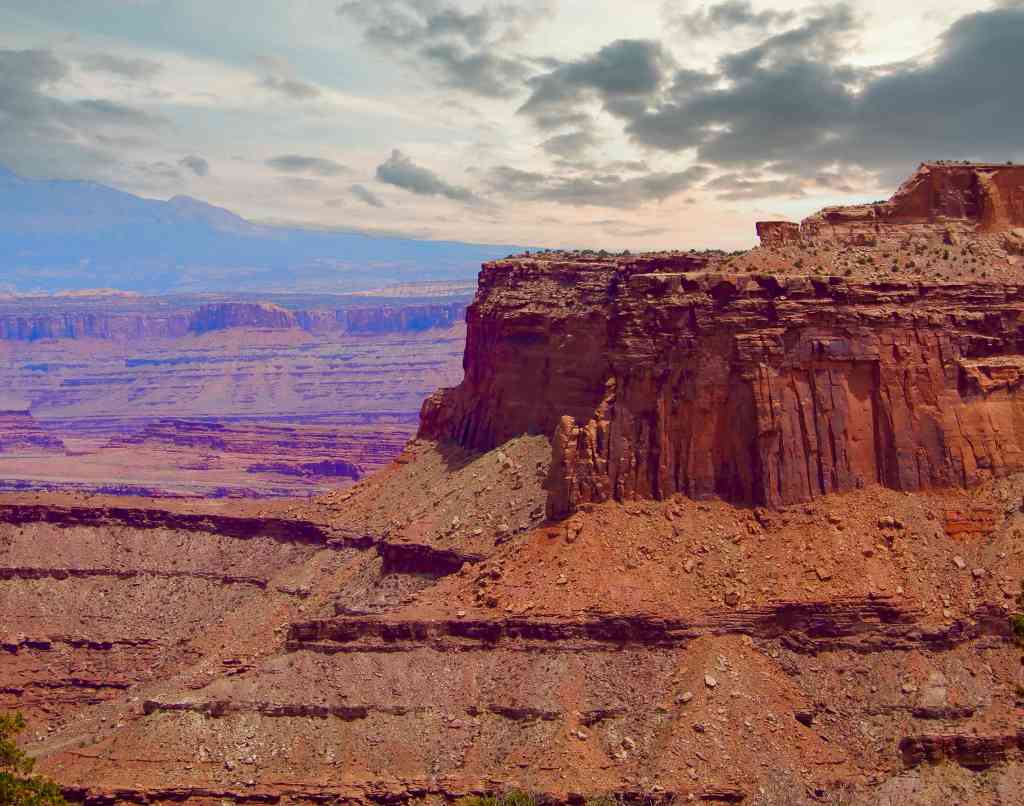
Only about twenty-five miles from Arches is the northern entrance to Canyonlands National Park and it is a wholly different experience as you enter on high bluffs and look down into the canyons. The landscape is similar to the Grand Canyon in character and color as you stand on the rim. In the western area of the park are the best hiking trails where an extinct volcano caldera formed an interesting bowl-like valley. There is also a second entrance to Canyonlands about sixty miles south of Moab that features the Needles District with a strikingly different look, featuring backbone formations of rows of sandstone spires.

Dead Horse Canyon

Between Canyonlands and Arches is a state park named Dead Horse Canyon which is worth a visit as well. Stand at Dead Horse Point, 2,000 feet above a turn in the Colorado River, and amaze at the ever-changing landscape below. Immense vertical cliffs climb up from canyons carved by ions of weather creating this masterpiece.
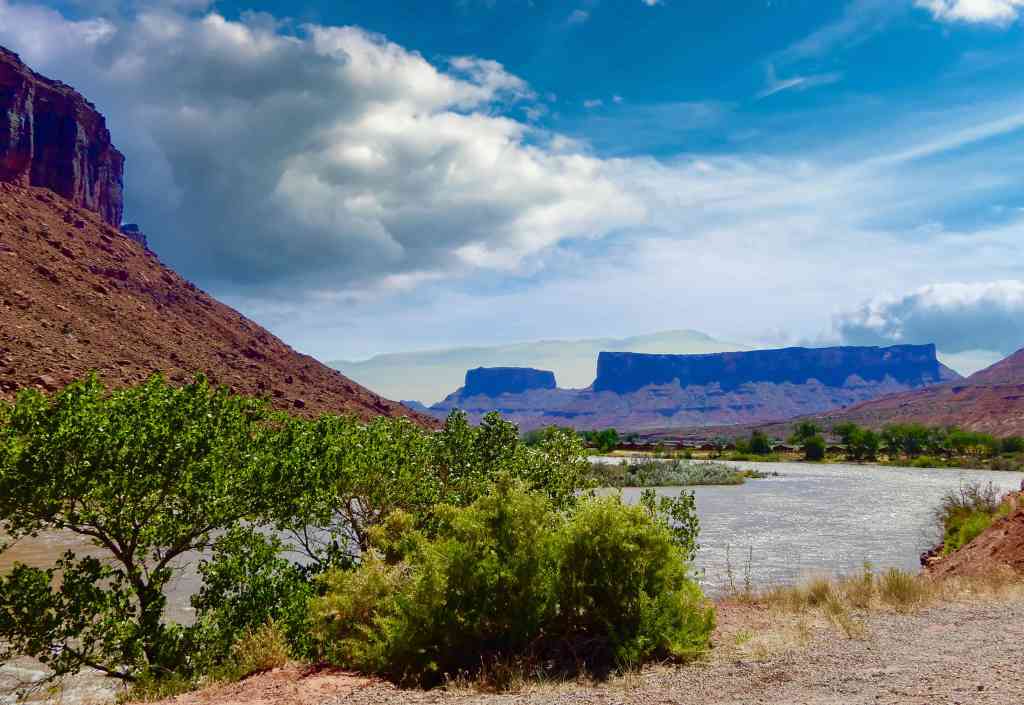
Scenic Route 128

Just south of Arches National Park take a free drive along scenic Route 128 North as it runs up another canyon of the Colorado River. As you follow the river, you are surrounded by 500 to 1,000 foot rust colored sandstone cliffs with many completely vertical. On the river you see numerous rafting groups and as you drive deeper into the canyon the land opens up revealing dozens of spires and buttes.

In the canyon is a small town named Castle Valley and on the river is the Red Cliffs Lodge and the Castle Creek Winery. The winery offers tastings and features some good wines that are popular in the region’s restaurants.

On the map you may notice a ghost town named Cisco and might be tempted to go take a look. Do not bother – the town is a junkyard of abandoned trailer homes and RVs laced with obscene graffiti. Our suggestion is when you reach Dewey Bridge, turn around and drive back unless you are going on to US 70. While we didn’t visit, we were told that there is an interesting movie museum near the Castle Creek Winery and there are numerous raft operators that will take you down this stretch of the Colorado River.


Capital Reef National Park

Leaving Moab the next morning we headed north on 191 to US70 west. We exited 70 onto Route 24 south and headed to Capital Reef National Park. Capital Reef is home to another collection of petroglyphs and these are well marked with easy access from the road. This is also the location of Fruita which was established by Mormons as an agricultural area in 1880. A few structures from the original settlement still remain as do the orchards.

Route 24 travels right through Capital Reef with one scenic side road inside the park featuring a number of good hiking trails. After exiting Capital Reef on 24 west we picked up Route 12 heading south towards Bryce Canyon National Park.

Driving The Hogs Back (Utah Hwy 12)

Leaving Capital Reef National Park going west on St. Rt. 24 you meet an intersection with St. Rt. 12. 24 goes north at the T while 12 heads south. Our GPS and our trip map both indicated we should turn north on 24 toward the interstate. Looking at the map it seemed a much shorter trip taking 12 to the left. Utah Route 12 is a scenic and interesting trip from Capital Reef to Bryce Canyon. It crosses some spectacular country with ridges, canyons and mountains at every turn. One stretch, called the Hogs Back, navigated a ridge with only two narrow lanes and steep drops on both sides. It is, without a doubt, the scariest piece of road we’ve ever driven in good weather. (See our article on the Hogs Back.)

Anasazi State Park

Another unexpected find was the Anasazi State Park on St. Rt. 12, shortly before getting to the Hogs Back. It is an archaeological site of an Anasazi Indian village excavation with a trail through the site and a nice museum displaying artifacts.

Bryce Canyon National Park

Bryce Canyon is a must visit. The park sits atop high country, looking down into the canyons which are packed with geological features called hoodoos. There are interconnected spires of colorful sandstone creating mazes that rise from the canyon floor and hiking trails down into the hoodoos. While hoodoos are not unique to this site, nowhere in the world are they as abundant as in the northern section of Bryce Canyon. Many of the hiking trails are steep, going down the canyon face, descending an average of 700 feet but, there are also a few walkways, for those seeking less of a challenge.
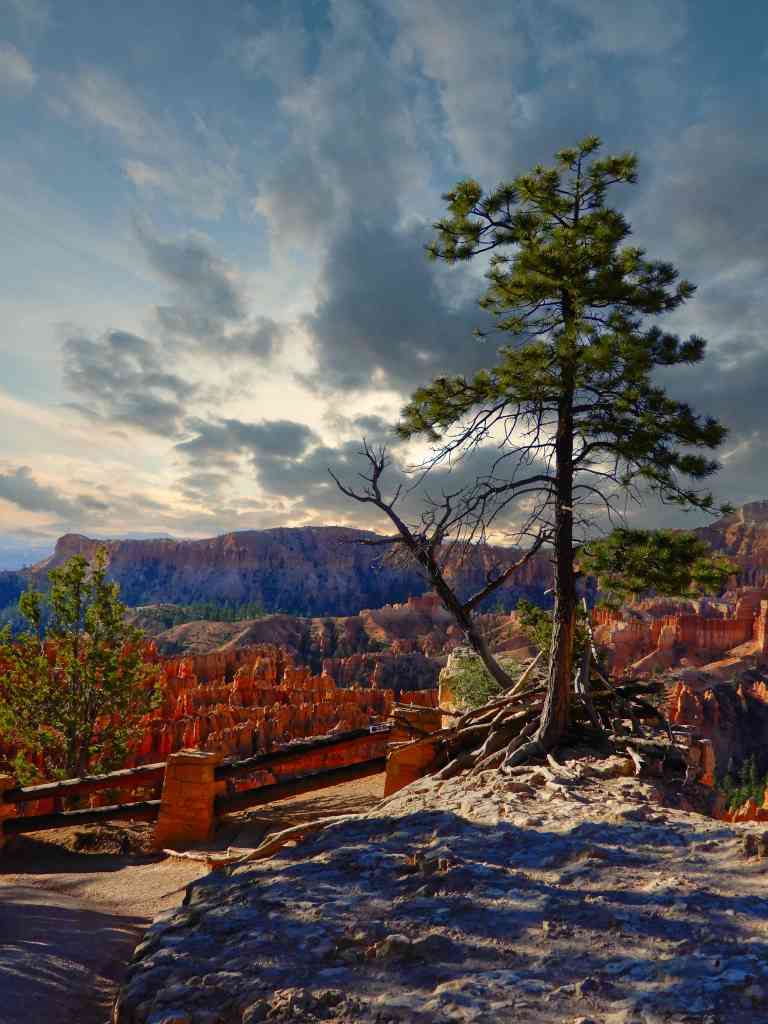
There is a hotel with a restaurant inside the park but there are also a number of accommodations just a short drive away starting at Bryce Canyon City. The Park Service, in an effort to reduce traffic, operates free buses with pick-up stops in the “City”. The drive through the park is about nineteen miles to the end at Rainbow Point with an altitude of nine-thousand feet. At the point, the morning we were there, the winds were howling and the temperature dropped over twenty degrees after leaving the Visitors Center.

Red Canyon is between Bryce Canyon and Panguitch where we spent two nights. Our motel had a colony of resident prairie dogs that liked to come out and socialize around dusk and the second night we were visited by a pronghorn antelope. The canyon road goes through two short tunnels cut through sandstone with a couple of parking areas for access to some interesting hiking trails. One cautionary note here is that Panguitch is mostly closed on Sundays and it can be a challenge finding a place to eat.

Zion National Park

After two nights near Bryce Canyon in Panguitch we headed off early for Zion. We had read that Zion has a traffic problem and that by late morning parking is almost impossible to find. Like Bryce Canyon, Zion also has a free shuttle bus that picks up at stops in Springdale, the town just outside the southern entrance to the park. In season Zion Canyon Scenic Drive is only open to the park’s buses, which can be picked up at the Visitors Center near the south entrance. Of the parks we visited, Zion had the largest number of hiking trails ranging from wheel chair accessible to strenuous. One of the park’s more popular hikes goes through “the narrows” which is a narrow width passage through a sandstone canyon with a stream flowing through it . Unfortunately, this trail and a few others require a permit and there is usually a wait of several days to get one.

Driving down from Panguitch we entered Zion around 9:00 am at the east entrance. There were maybe three or four cars ahead of us and we traveled down canyon walls through numerous switchbacks and two tunnels. One two lane tunnel was almost a mile long with no lights, so it is important to test your headlights before entering. We got to the Visitors Center around 10:00 and had to search for parking. We took a couple of hikes on trails near the Visitors Center and by noon the line for the tour buses wound through the complex and out into the parking lot requiring a wait of over an hour. A few hours later when we exited to the town of Springdale the line of cars to get into the park was backed up over a mile through town.

We spent the night at The Red Rock Inn and it was the highlight of the trip’s accommodations. Located in town and a couple of miles from the park it was comfortable, beautifully decorated and clean. The owners were helpful and friendly and the room came with a voucher for breakfast at Oscars, a block away. Oscars was also great, offering a full breakfast and plenty of coffee. The whole town is nestled in a canyon with towering red sandstone cliffs above it and unbelievable traffic “in season.”

The next morning we headed for Los Vegas for a couple of nights on the strip and our flight home. During the trip we saw snow (Panguitch averages six inches in June), windy conditions and virtually no rain. In summary, it was a road trip of a lifetime offering spectacular scenery and temperatures ranging from freezing to over one hundred degrees.I think we will make a return visit someday…
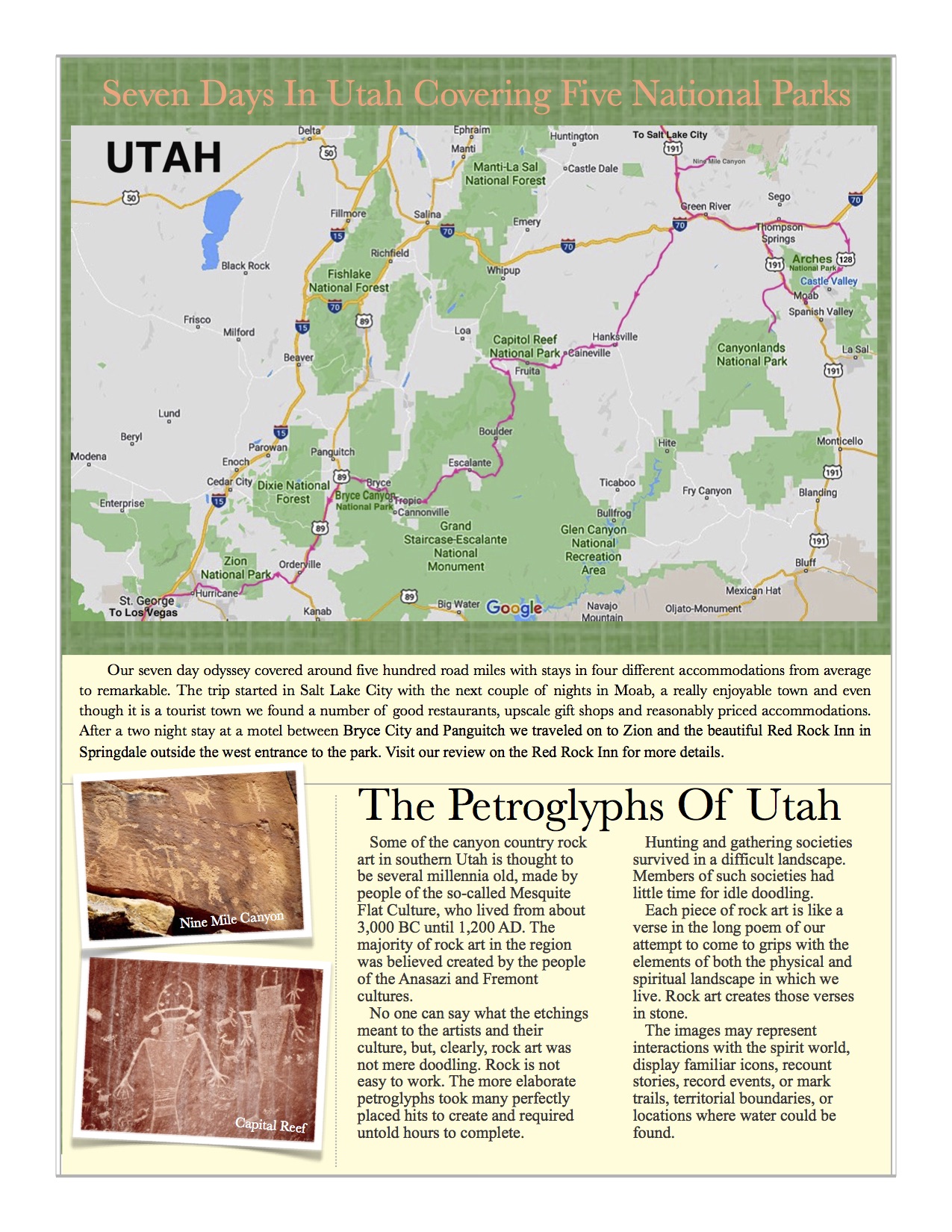

A map of Utah showing a park itinerary. Pictures of petroglyphs

Spectacular vistas greet you at every turn as you travel through the parks of breathtaking Utah. A road trip is the best way to experience this place so get packing…
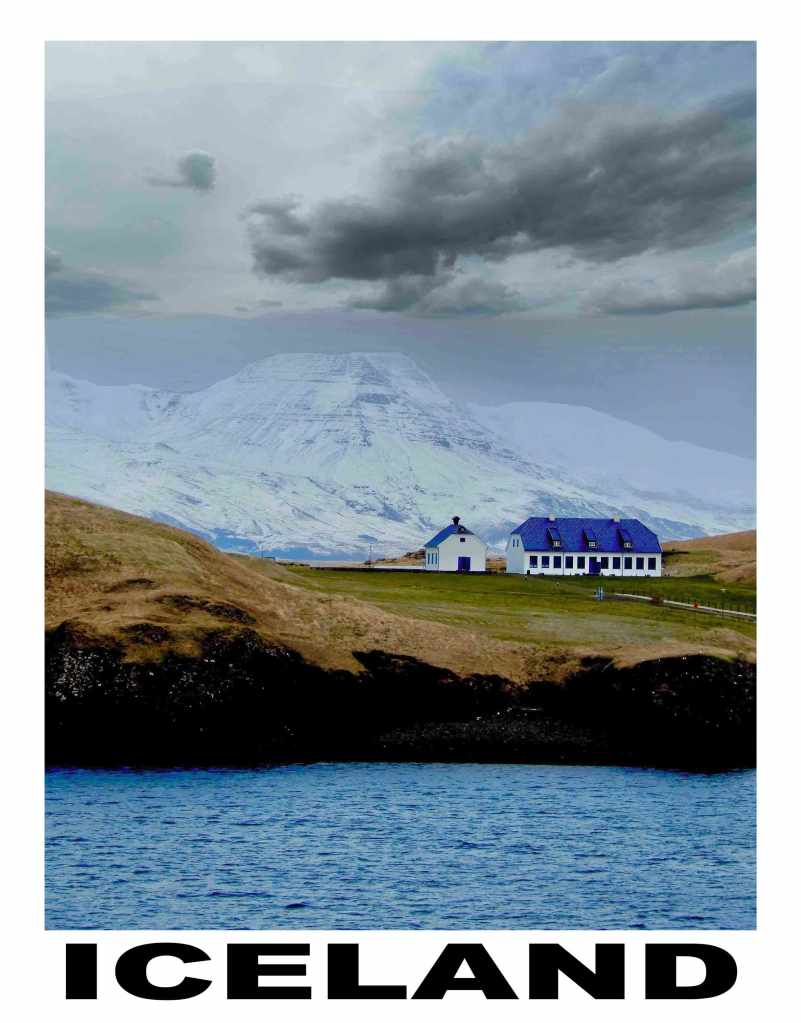
Todays Featured Poster • Iceland

Iceland Poster #2. Wild, stark and beautiful, Iceland is a place that needs to be experienced to be believed. This poster’s seascape is actually the view from the waterfront of downtown Reykjavík, the countries capital.

These giclée prints will soon be available in several sizes, custom printed for each order on archival paper using fade resistant inks. Create a decorating theme based on your world travels.

Join us as we visit historic treasures, natural wonders and vibrant cities set against backdrops that are endlessly changing and visually magnificent. Celebrate a world of travel experiences with these decorating accessories that are perfect for framing.

Haven’t Joined Us Yet? We Promise To Make It Worth Your While.

The Cruise Port Of St. Thomas USVI

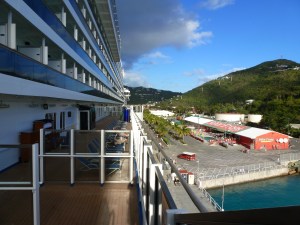
St. Thomas is the most populated of the U.S. Virgin Islands and is a major port of call for Caribbean cruise itineraries. There are two widely separated cruise ship docks so you should try and check out where your ship will tie up. It will either be Crown Bay that’s west of Charlotte Amalie or The West Indian Company Dock next to Havensight just to the east of town.

Where Your Ship Docks

Crown Bay

Crown Bay Dock – These docks have been developed to handle the increased cruise ship traffic. It features a number of duty free shops and stores. Getting into Charlotte Amalie from the Crown Bay dock, which used to be referred to as the Sub Base area, will require a taxi or an open air tourist bus (about $4 each way). Walking is about 1.75 miles along busy roadways and is not recommended.

West Indian Company Dock

Havensight and the West Indian Co. Docks – The original cruise docks is located in a popular island shopping area and offers a number of popular duty free shops. There is a great walking trail less than a mile and a half along the water from the docks near Havensight, which goes thru the shops of Yacht Haven and into Charlotte Amalie. Yacht Haven is an upscale marina with a number of designer shops along with cafes, bars and a good grocery store. It’s also from Havensight where you catch the cable car up to Blackbeard’s Castle Resort for a drink and to take in the views.

Yacht Haven and Charlotte Amalia in the distance

Getting Around – The best way of getting from either dock into Charlotte Amalie is to take a tourist bus (of which there are plenty) currently $4 per person each way. For traveling around the island it would be best to hire a taxi or rent a car (remember the island drives on the left side). Taxis fares are moderately priced and rental cars are readily available.

You can also take a ferry  over to St. Johns for the day. St. Johns is the other US Virgin Island and is mostly preserved as a National Park. If you go, don’t forget your beach gear, mask and snorkel as St. John is famous for Trunk Bay with its beach and its laid-out underwater snorkeling trails. The shortest ferry route is between Red Hook on St.Thomas and Cruz Bay on StJohn. That trip costs $6.00 each way, takes approximately 20 minutes and runs hourly between 6:00 am and Midnight. A longer ferry route runs from downtown Charlotte Amalie to Cruz Bay.

Currency – The U.S. Virgin Islands use the U.S. Dollar and most major credit cards are welcome. Some U.S. banks have branches in St. Thomas and American based ATM machines are plentiful.

Places to Visit – Charlotte Amalie is the islands center of activity and it is easy to reach from either cruise dock. At the northeast end of town is Fort Christian recognized as the oldest standing structure in the U.S. Virgin Islands. Expanded and modified through the years, its colorful past includes functioning as the original town center, a place of worship and the governor’s residence.

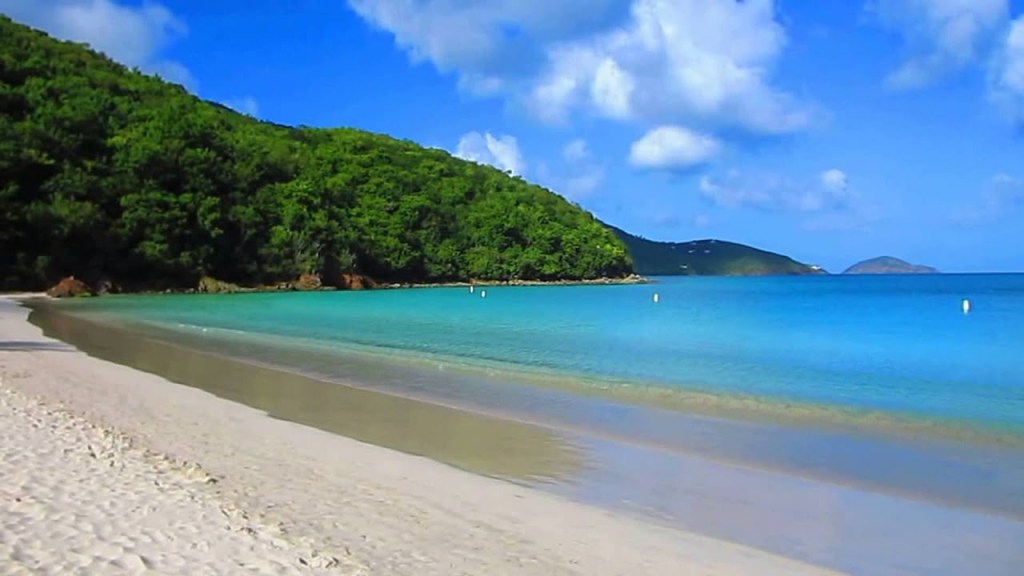
Most of the tourist buses will drop off and pick up cruise passengers at the open air market near Fort Christian.If you’re intersted in some beach time, take a trip over to the far side of the island to visit Megan’s Bay, which is consistently named one of the world’s ten best beaches.  Frenchman’s Reef and Morning Star beach is a good choice and the reef is about 100 yards from shore.  We would also recommend a visit to the sea life park, Coral World, especially if you have younger children with you.

Megans Bay

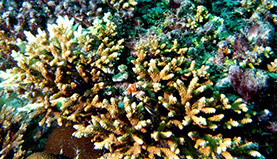
In addition to the great beaches St. Thomas has a number of snorkeling and diving opportunities. If the coral reefs interest you there are often day boat tours that go to some of the areas reefs and if it’s available during you day in port look into a trip to St. Johns, featuring one of the USVI’s underwater parks.

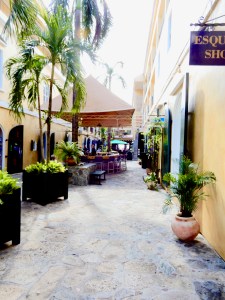
In Charlotte Amalie the main downtown shopping district stretches about ten blocks west from the Danish fort along the waterfront. The waterfront road is Veterans Highway and one block up is Kronprindsens Gade with dozens of interesting alleys and streets connecting the two. Stroll down the ten blocks of Kronprindsens Gade for some good duty free shopping or visit the shops, cafes and galleries in the alleys with names like Drakes Passage and Creque’s Alley.

Duty Free – The USVI is one of the best duty free shopping opportunities in the Caribbean. Of special note is the duty free exemption on alcohol. Each person is allowed to bring into the U.S. up to 5 liters of distilled spirits.

Again remember the island drives on the left side so fight your instincts and look right before crossing streets.

Read more about a great walking trail along the waterfront in St. Thomas CLICK HERE.

On Blogging – Part 4 Echo Chamber

Are We Inside An Echo Chamber?

A Story About Changing Times (A Little Bit Of History)

It’s hard to believe but we’ve been on the internet for almost twenty years. Our youngest son was still in high school and he created a web site to list our companies products. The amazing thing is that at the time we were manufacturers agents exporting a number of industrial lines into the Caribbean and the web based catalog was intended for that customer base. We provided customers with a web address, an online order form and instructions to help with placing orders. We expected only a limited reaction. In less than a month we were getting orders submitted from American companies. The only advantage we offered was that we allowed items to be ordered in smaller quantities than the large manufacturers we represented. As a result we had to increase our inventory levels and with some product lines sales increased by a third.

At that time Amazon, which started in 1995 as an online bookstore was about the only online retail seller. If we were to try and duplicate that success today I guarantee you absolutely nothing would happen. No orders out of nowhere. No customers increasing the size of their orders. No Google search traffic at all (maybe I’m wrong because that traffic came from somewhere). At that time selling on the internet was a new concept. Business to business selling was just starting and there were almost no direct to consumer outlets online other than Amazon.

The Siren Call Of The Echo Chamber

The promise soon became if you organically increased your sites traffic the search engines would take note and start directing more searches to your web site. More traffic meant even more traffic.

Facebook Groups

Right up front I have to confess that I don’t understand how to “work” facebook. Every time I start to figure it out facebook changes the rules and how it operates. If I go back five years my real interest was to increase traffic to my travel site and I discovered a number of travel groups to join. I joined two and was suddenly given instructions on what and how to post. I was also told that I had to help boost other group members and I would have quotas to meet. There were a lot of rules:

  • How many words for my comments
  • How long I had to be on the page
  • The subjects of my posts…

I spent over six months working inside facebook groups and at the end all the increased website traffic I recorded came only from the facebook groups members – no organic growth at all.

Increasing My Subscribers

The next rule I learned was that if I could get up to a thousand subscribers I would be eligible to start using Adsense and other advertising services to “monetize” my site. Today I’ve reached that goal and I’m very suspicious. Getting these organizations to provide you with ads isn’t the whole story. In order to get revenue those ads have to provide clicks.

Even before joining these groups I was running my own ads. I operate two e-commerce stores in addition to additional online sales outlets (Etsy). For almost a year I’ve been able to track those clicks. With between 70 and 110 visitors per day and about a 100 plus page views the outbound clicks from ads have been almost unmeasurable. Why should I get more clicks from outside ads?

Where does my travel site traffic come from? With the exception of those Google search false increase periods (see below about that issue) the traffic breaks down like this on average over six months (rounded):

  • My subscribers 26%
  • Search engines 22%
  • WordPress Reader 19%
  • My social apps (Twitter, Pinterest, facebook…) 16%
  • Misc. 15%
  • Unknown 2%

The bottom 17% are often visitors looking to sell us something – SEO, pay per click traffic, design services etc.

In The Echo Chamber

With a minimum of 42% of the traffic coming from subscribers and our social media sites and it could be as much 55%, you can easily characterize this as an echo chamber. What do I mean by that? It’s very similar to those facebook groups mentioned above that intended only to artificially boost the traffic numbers but without their detailed instructions. Call what’s going on an echo chamber or a quid pro quo or maybe a mutual admiration society but there’s nothing organic about it.

My biggest argument in support of this is in our online advertising. We’ve discovered that the biggest value for the dollar in advertising for our e-commerce stores is facebook. The facebook store is located at https://www.facebook.com/WinterGardenCrafts. There are two approaches to facebook paid advertising; first is looking to boost website traffic with actual ads directing clicks to our online store (https://thecraftsmart.net). The other is boosting a post on the stores facebook page. While we do get a small amount of traffic as redirects from the facebook store, almost none of it results in a sale. The traffic that comes directly from those facebook ads to our online stores result in an 8 to 10% purchase conversion. The cost per redirected click runs from 6¢ to 45¢ depending on the ad and demographic selected.

Bottom Line Concerns

All of us are probably hoping to get visitors that find our postings interesting and of some value with the prospect of maybe financial success. The truth seems to be something completely different. By eliminating the echo chamber traffic what’s left is not a lot of organic traffic and only a small amount of actual growth. Unfortunately this suggests that many of us are deluding ourselves as to what is happening. Add to that the high probability that Google is playing us with the manipulated search result growth spurts (see below about that issue) and things are even worse.

The next post will put all this in a much broader context.

I’ve Experienced A Recent Change in Traffic

Information from the previous articles. Just in the past six months my travel site experienced some good traffic growth. Following is a chart showing results reported by Google data along with the contributions from other search engines.

Looking at the data it raises some interesting questions:

  1. The Google impressions show major changes in growing, peaking in May and falling off again.
  2. The percentage of clicks per impressions also grow (from about 1% to 1.5%) with a peak in June and falling off again.
  3. The percentage of Google clicks to all other search engines starts at about 27%, grows to almost 57% and drops back over 3 months to 27%.

What do I make of this?

First, Google clicks seem to correlate somewhat with reported total impressions but do show growth in the percentages indicating a deviation of about a half a percent (same bell shaped curve) which suggests an anomaly.

Second, various search engine contributions as a percentage of total search referrals seem to remain constant when averaged over two months of results. The only exception is the Google contribution. Google’s share starts at just under 28% of total search referrals, grows to almost 47% in May and drops gradually back to under 28% (the bell curve again). Statistically it should have stayed at under 27% in alignment with the additional 5 other search engines.

Todays Featured Poster • Walt Disney World

Approaching the entrance at The Magic Kingdom, Walt Disney World Florida at sunset. Captured from the ferry while crossing Bay Lake.

These giclée prints are available in several sizes custom printed for each order on archival paper using fade resistant inks.

Join us as we visit historic treasures, natural wonders and vibrant cities set against backdrops that are endlessly changing and visually magnificent. Celebrate a world of travel experiences with these decorating accessories that are perfect for framing.

Haven’t Joined Us Yet? We Promise To Make It Worth Your While.

Montserrat Mountain, Spain

An Easy Day Trip From Barcelona

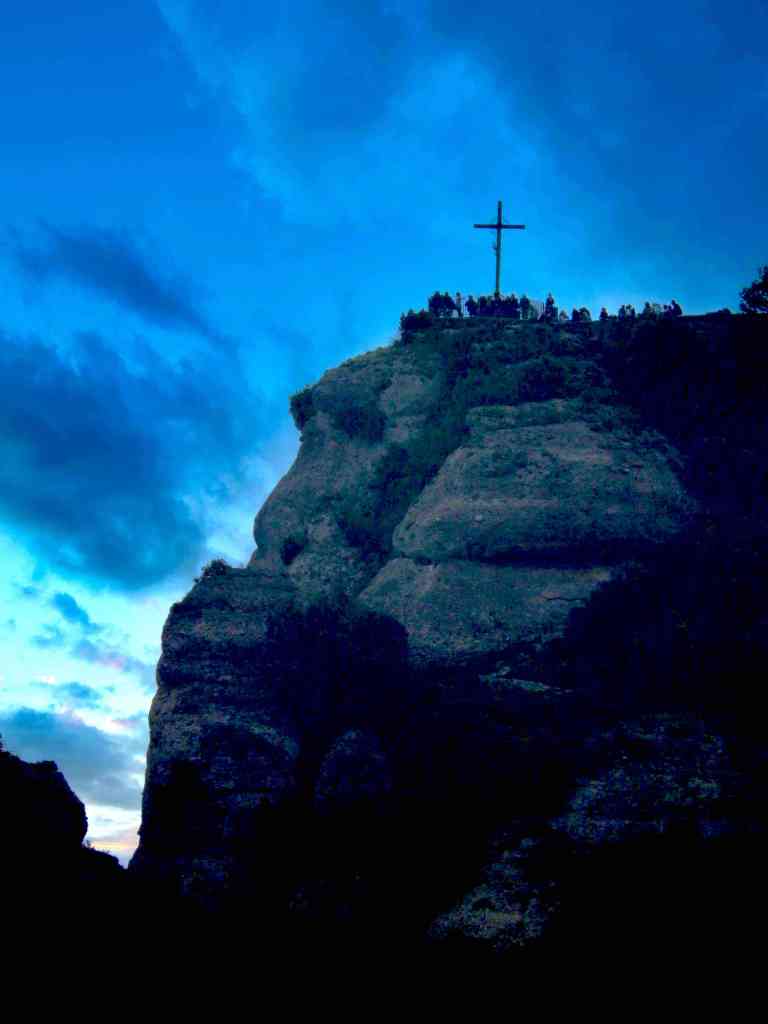
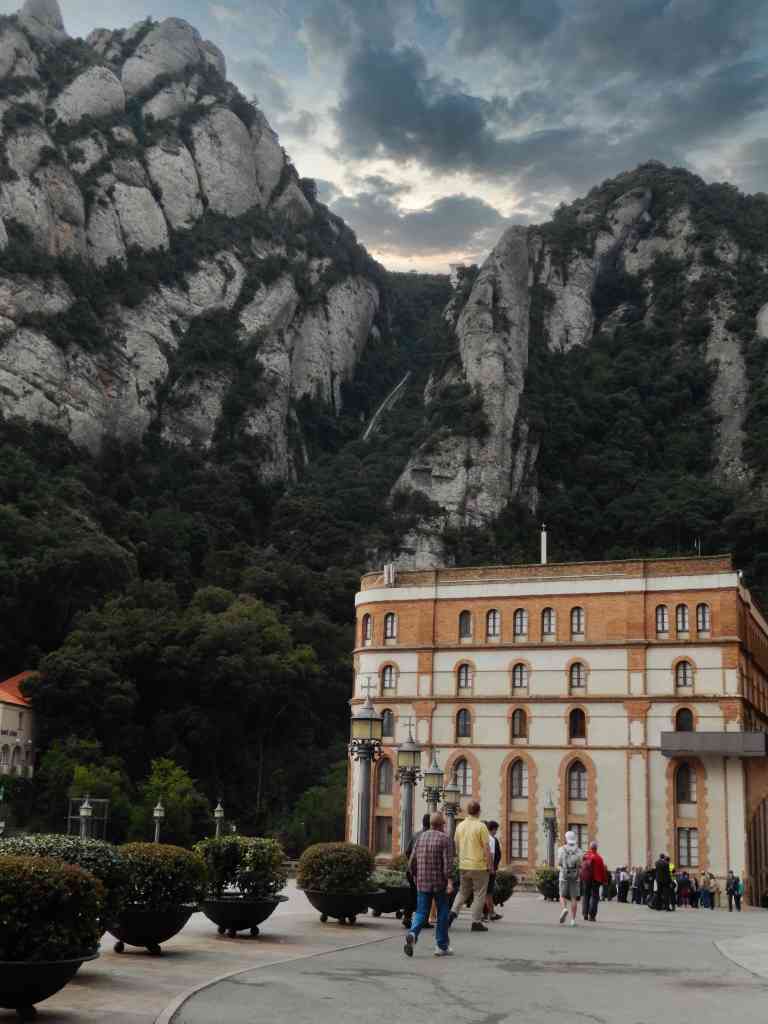
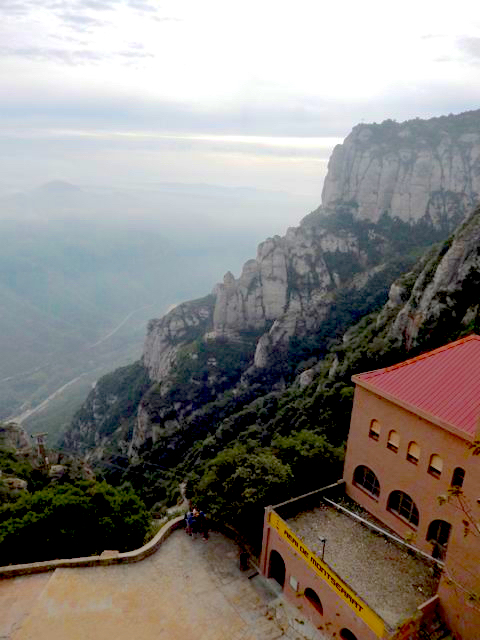
A short trip out of Barcelona, Spain is to the mountain of Montserrat. It is a mountain famous for rock climbing, great hiking trails, grand vistas and is a religious site with a Basilica, monastery, convents and a number of shrines.

Getting To The Mountain From Barcelona

From Barcelona it is not difficult to plan a trip for a day on your own. Start at the Plaza Espanya train station in Barcelona. The train station is in the same building as a metro station so it’s easy to get to from anywhere in the city. Follow signs for the R5 train which runs about every fifty minutes. The train will take you to stations at the foot of the mountain but, before buying tickets, you will need to decide whether you would like to travel up Montserrat Mountain by Cable Car or by the Rack Railway. There are agents selling these combination tickets who can help you decide, so ask for advice. You will also need to confirm which station to exit based on your choice.

Cable Car

Montserrat mountain is a collection of massive rock formations, miles of great hiking trails and remarkable vistas. The mountain would be worth a visit if it was only a geological spectacle and that alone draws hikers and rock climbers from all around the world. It is also a religious site dating from the days of the Roman Empire with a temple to Venus having been built there more than two thousand years ago. Since 888 AD there has been the Christian sanctuary of the Virgin Mary of Montserrat and, in 1025, Oliba, Bishop of Vic, founded a larger monastery at the hermitage of Santa Maria de Montserrat. The monastery received pilgrims and visitors who contributed to the spread of stories of miracles and wonders performed by the Virgin. In 1409 the monastery of Montserrat became an abbey and from 1493 to 1835, the monastery underwent numerous improvements, expanding and increasing in splendor.


During the seventeenth and eighteenth centuries, the Monastery of Montserrat became a cultural centre with The Montserrat Music School producing a number of significant composers. From the early nineteenth century on, the Monastery was abandoned, rebuilt and restored a number of times because of the French War and the Spanish Civil War. Today, Montserrat is again a cultural and religious center playing host to pilgrims and tourists alike.

If you find yourself spending time in Barcelona we recommend setting a day aside for a trip to Montserrat Mountain.