Three Coins In The???

Back in the late sixties while in the Navy, I was in and out of Italy a lot. On a number of port calls I put in for two day leave to travel around the country and on one trip I managed to spend a couple of days in Rome again. I had been friends with a girl from Florence and we arranged to meet in Rome. I stayed in a hostel while she stayed with an aunt who lived in Rome. Back in those days young Italian girls had to be chaperoned, at least in the evenings.
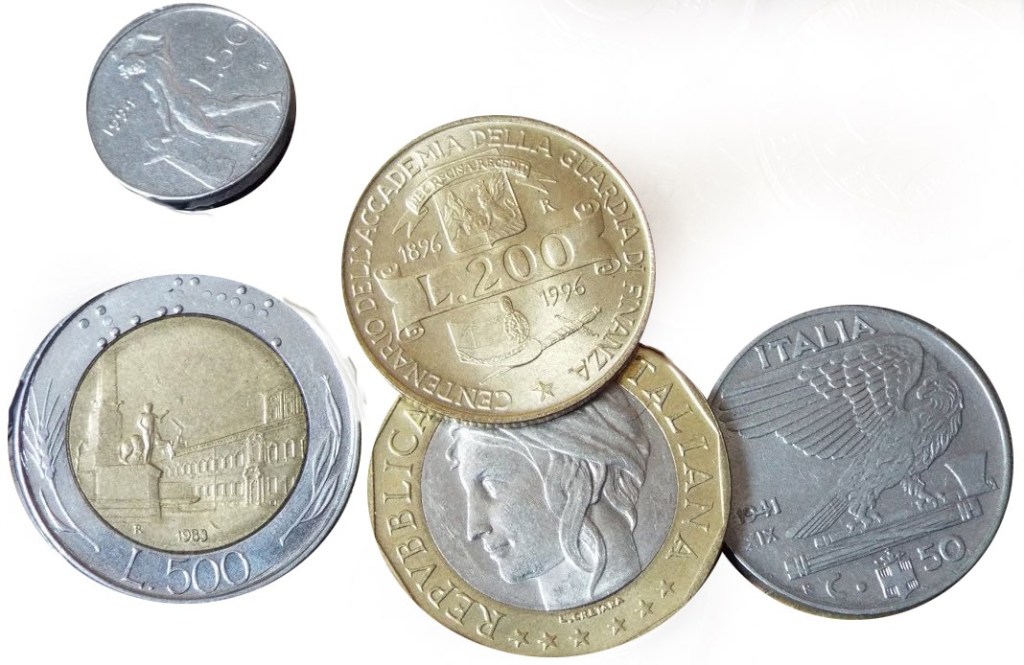
Before the Euro the Italian currency was the Lira and the exchange rate to the U.S. Dollar ranged between 600 to 800 Lira (₤) to a dollar and it was common to carry around 5,000 and 10,000 Lira notes. The smallest Italian coin was a 10 Lira and the Italians had lots of uses for those 10 Lira aluminum coins. Need to use a public restroom 10₤, ride an elevator 10₤ and they were more common than pennies in America.

Back in the fifties a popular movie came out called Three Coins In The Fountain about three American roommates working in Italy who wished to meet the man of their dreams by throwing coins into Rome’s Trevi Fountain. Before that movie it wasn’t a practice to throw coins in Trevi and over the years that movie scene has morphed into a tradition. Now it’s throwing a coin over your right shoulder into Trevi Fountain to guarantee that you’ll come back to Rome.
Trevi Fountain (Fontana di Trevi) is the most famous fountain in Rome and is considered a Baroque masterpiece and is on most tourist’s list of sights in the Eternal City. It was designed by Nicola Salvi and completed by Giuseppe Pannini in 1762.

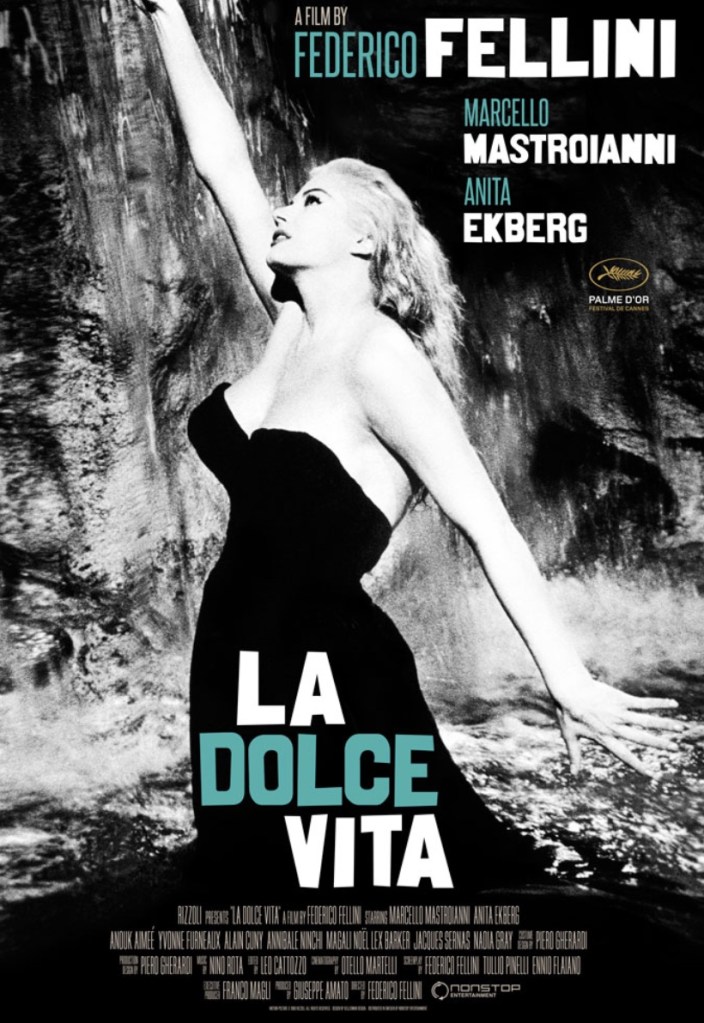
In the mid sixties Trevi Fountain again became the center of attention when Federico Fellini’s movie La Dolce Vita staring Marcello Mastroianni and Anita Ekberg was released. Trevi Fountain is the night scene of Anita Ekberg in a strapless black dress dancing and wading through the fountain.
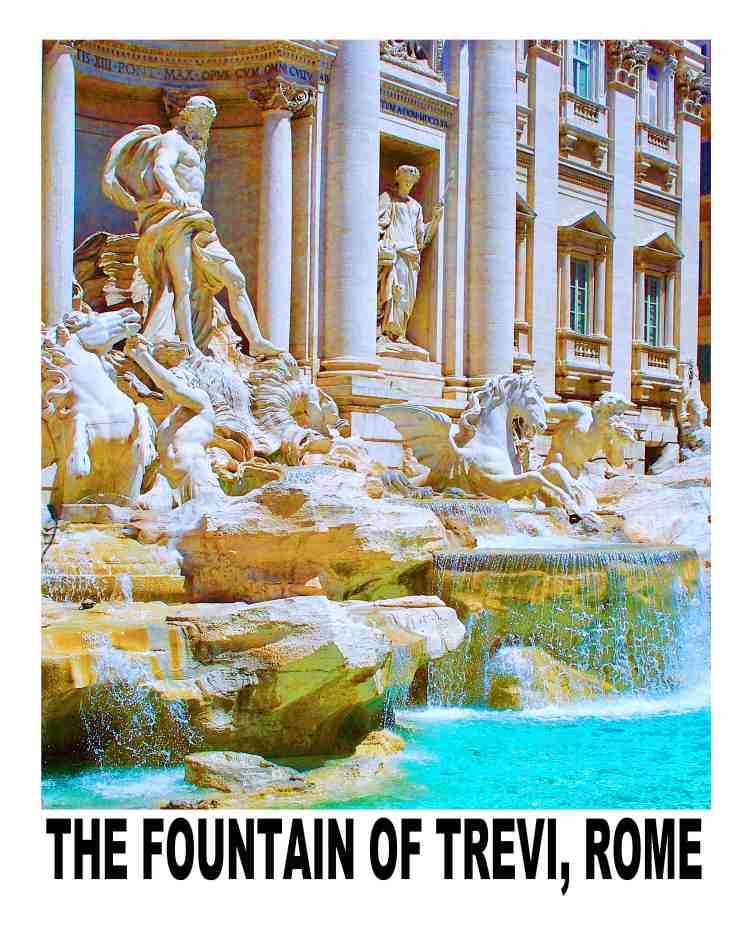
Throwing coins into water isn’t new and probably can be traced back to the time of Germanic tribes when they made offerings to gods in springs. From that came the more modern tradition of wishing wells but filling public fountains with coins probably has its beginnings with that 1950’s movie.
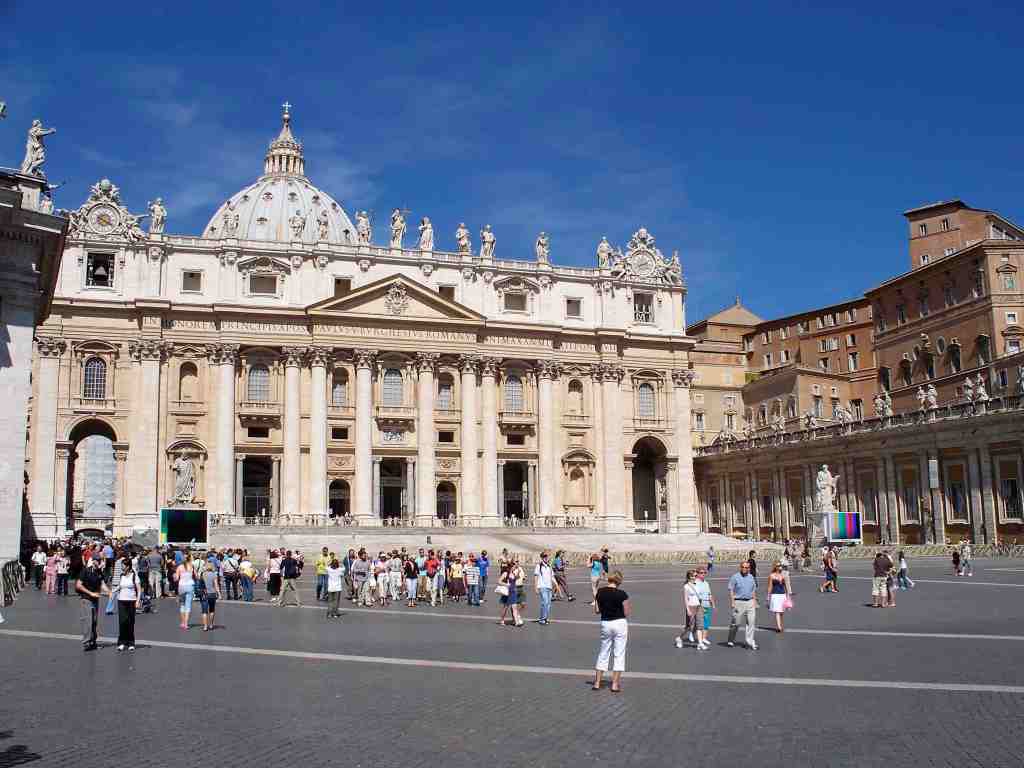
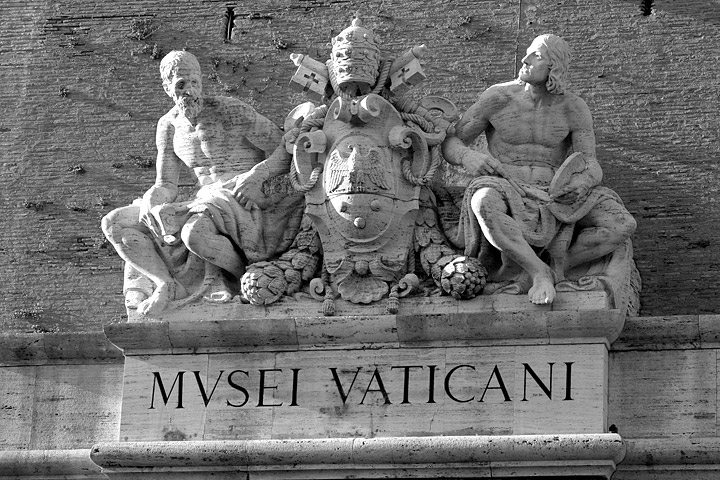
Getting back to the point of the story, my Italian friend and I visited the Vatican Museum on that Rome trip. In the sixties the attractions in Rome weren’t the mob scenes they are today. The Coliseum was in the middle of a traffic circle with no barriers, or admission tickets – you just walked in through one of its many arches. Likewise the Vatican and Saint Peters where just open with not any mobs of people except on Sundays when the Pope offered his blessing over St. Peters Square.

In the Vatican Museum there is a grand marble spiral staircase that goes to the upper floors. Sitting at ground level in the middle of the staircase was (still is) a marble urn on a pedestal that stands about five feet tall. Somewhere between the second and third floor we got the notion of trying to throw a 10₤ coin into the urn – you always had a pocket full of those coins and after about five or so tosses we got one in and moved on to the art galleries.

After we spent some time visiting the exhibits we returned to descend that spiral stairs and discovered that we had started something. Two guards were on the ground floor sweeping up coins as dozens of people on the stairs were still tossing coins trying to fill the urn. It was a comic scene and nobody seemed to be getting upset.

Looking back I don’t think three coins in the urn caught on like Trevi fountain and probably didn’t last beyond that one day at the Vatican Museum. I still believe that the Catholic Church missed out on a money-making opportunity with that one.


Planning A Cruise? Start With The Intentional Travelers Port Guides

More Stories From The Road

Memories, odd moments and interesting discoveries. Click the banners below to read.

changing the guard in copenhagen
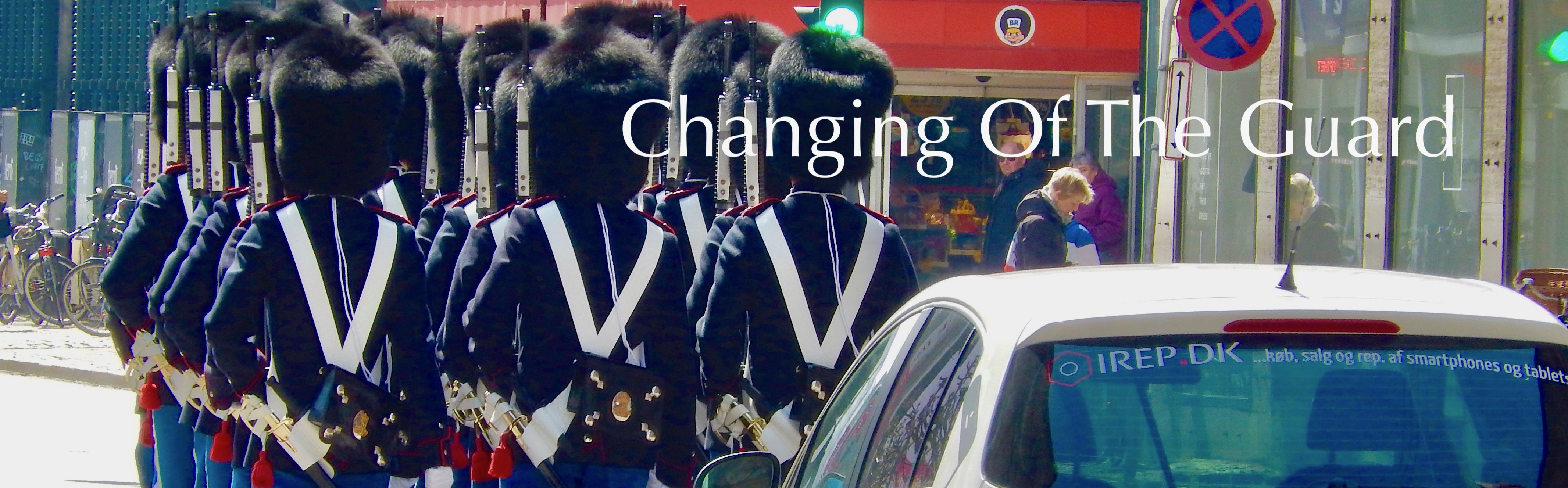
Rush hour traffic in Copenhagen and The Changing Of The Guard

A Rainy Day Adventure In Blarney

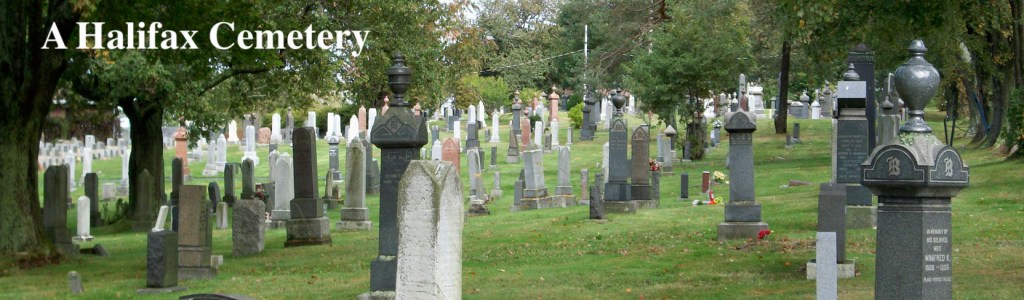
In A Cemetery In Halifax
Once Upon A Time In Rome
A Day at Icy Straight Point
Bastille Day in Paris
While on a Bus in Brunei
worlds smallest drawbridge
An afternoon looking for the worlds smallest drawbridge
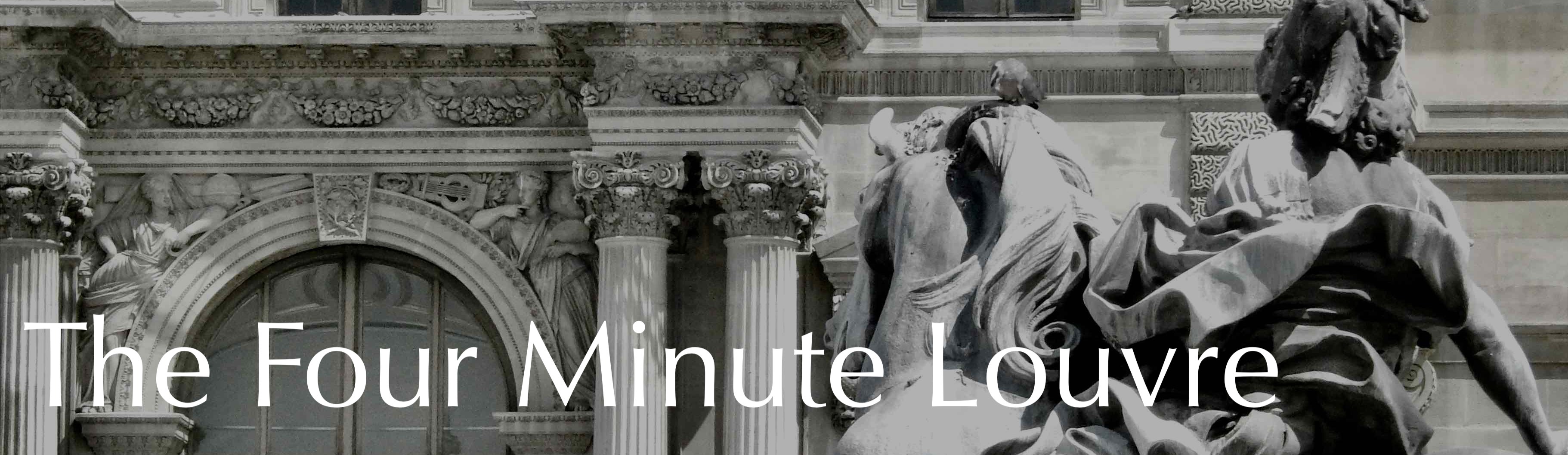
racing through the louvre
Three teens loose in Paris in 1965 and a famous columnist
A lost opportunity in Key West

A day of protests in Valencia Spain

lovelocks
There everywhere and I would guess the padlock makers love it…
The famous Gibraltar apes have gotten lazy
jerusale, a church and a ladder
For decades a left behind ladder sits at a window in Jerusalem
hogsback route 12 utah
Probably the scariest road I’ve ever driven Rt. 12 Utah
October 23rd 1956 and a Hungarian holiday

Love Locks Continue To Spread

Is It A Statement of Love or Vandalism?

Wurzburg, Germany

A SHORT STORY

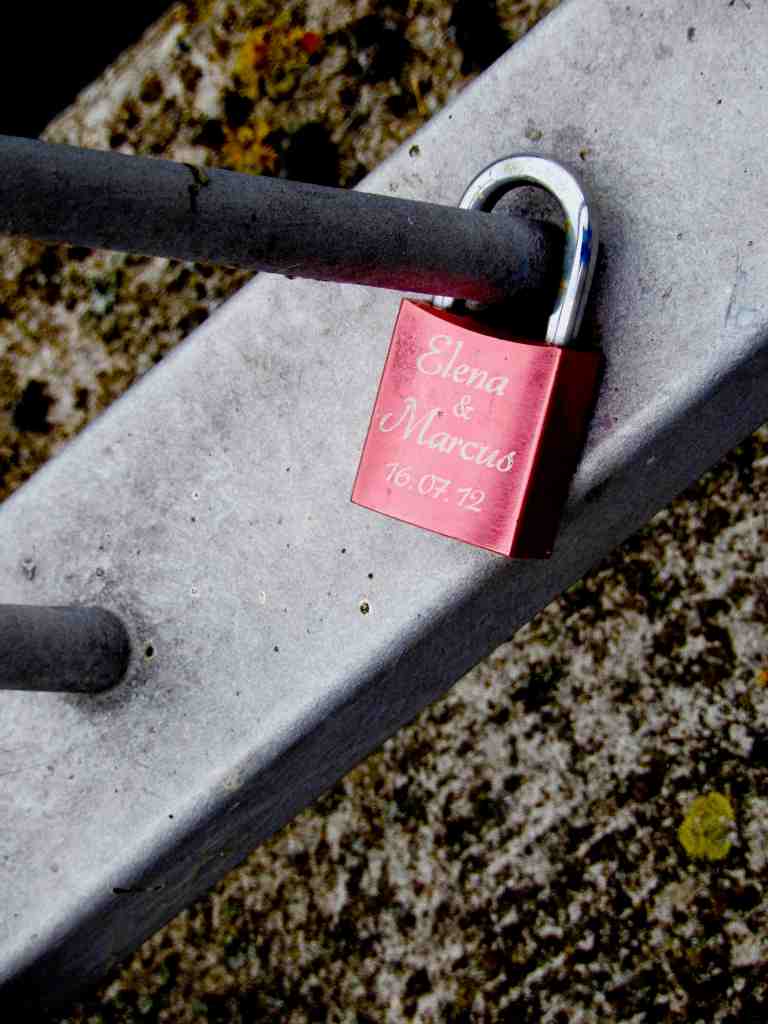
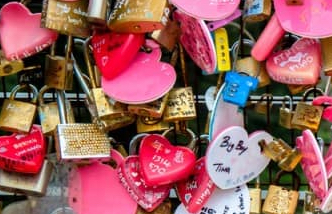
We weren’t aware of love locks before about a decade ago but recently as we travel we often come across collections of padlocks attached to bridges, fences and other public structures. It wasn’t difficult to figure out what was going on by all the couples names engraved on the locks. In the last five years or so it is becoming difficult to not notice these collections, they’re popping up everywhere.

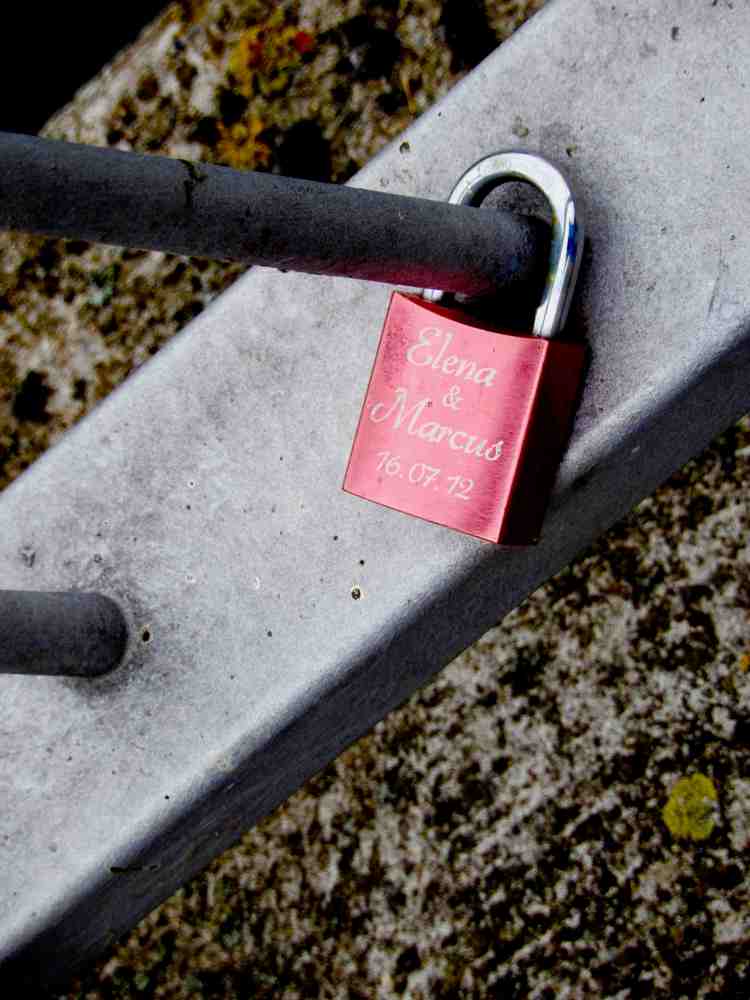
The practice isn’t new but was virtually unheard of outside of a few cities, mostly in Eastern Europe until recent years. Early in the twenty-first century the practice has exploded worldwide. A love lock is a padlock which lovers lock to a bridge, fence, gate or monument to symbolize their undying love. In recent years the lovers’ names or initials, and the date, are engraved on the padlock, and its key is thrown away, usually into the river under the bridge, to symbolize the couples love for each other.

This simple and romantic practice seems innocent enough, but more and more it’s being treated by authorities as litter or vandalism, and there can be serious costs associated with damage caused and their removal. But we’ve also learned that there are places where authorities are embracing lovelock places as a tourist attraction.

Paris

A little research will find that love padlocks date back at least 100 years to a Serbian tale of World War I. It involves the bridge Most Ljubavi or the Bridge of Love in the town of Vrnjačka Banja*. A local schoolmistress named Nada, who was from Vrnjačka Banja, fell in love with a Serbian officer named Relja. He went off to war in Greece, where he fell in love with a woman from Corfu. Heart broken Nada broke off their engagement and after some time died from heartbreak. As the tragic love story circulated, young women from Vrnjačka Banja wanted to protect their love and started writing down their names, with the names of their loves, on padlocks and attached them to the bridge where Nada and Relja used to meet.

Savannah, Georgia
Ha’penny Bridge, Dublin

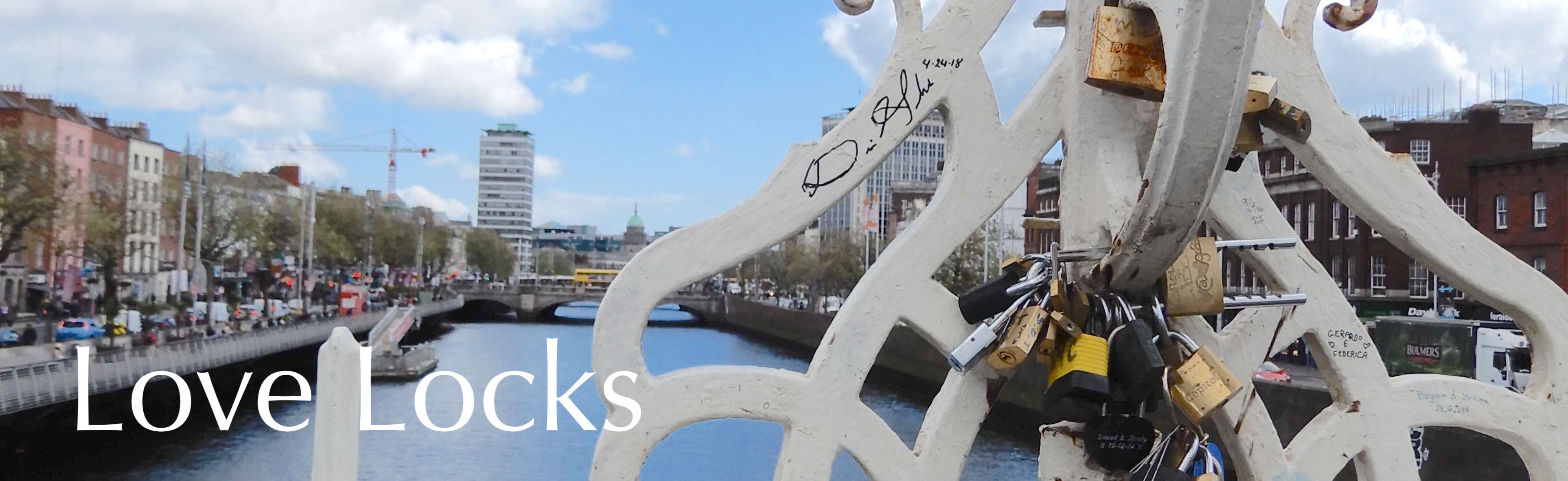
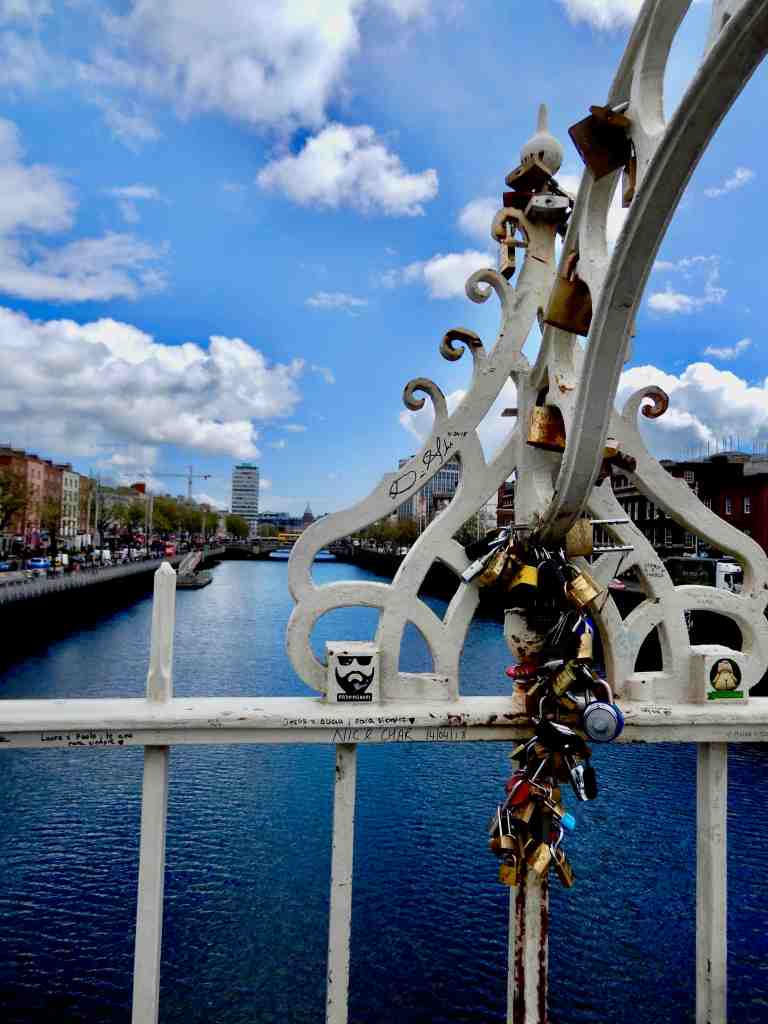
In Dublin there is a famous pedestrian bridge called the Ha’penny Bridge. It is one of the more famous symbols of Dublin. Nearly 200 years old (1816) it is a protected structure, but in recent years Dublin City Council have had to remove thousands of padlocks from the bridge on a regular basis. They are considered unsightly and are causing damage by chipping paint and adding considerable weight to the historic bridge. Engineers have estimated that at some point, if not removed, they could cause the bridge to collapse.

Today the key to many an Irish heart now sits at the bottom of the River Liffey where couples in love have thrown them after securing their love locks to Dublin’s historic Ha’penny Bridge. Today there is a group dedicated to breaking that bond. Shortly after the lovers have left, an expert lock-picking group arrives to tear these bonds of love apart and stop the locks from making the bridge structurally unsafe.

River walk Wurzburg, Germany

“It’s a fairly constant churn,” said Seán Nicholls, who set up the group when he was on his way to a professional lock-picking meeting. “I was heading to the meeting one day and I walked over the Ha’penny Bridge and noticed all the locks. In my mind it was defacing a city treasure. That’s kind of where the idea came from,” he said.

Dublin City Council embraced the group in the aftermath of a love-lock situation in Paris where the locks caused a section of the Pont des Arts bridge to collapse. The bridge in Paris had become famous for “love locks,” but the locks became too heavy and a two-meter segment of the bridge and railing buckled under the pressure of so many romantic symbols falling into the Seine.

Just recently the practice has come to America and is growing in Savannah, Boston, St. Louis and a number of other cities. Not to walk away from a business opportunity many locksmiths are now offering professional engraving on their padlocks and a number of manufacturers are offering heart shaped padlocks, likely to cause the new tradition to grow and spread even more.

Ha’penny Bridge, Dublin
Savannah

  • Mt. Huangshan, China – Adding love locks Legal: Encouraged
  • Brooklyn Bridge, New York – Adding love locks Legal: No
  • Hohenzollern Bridge, Germany – Adding love locks Legal: Yes
  • Seoul Tower Seoul, South Korea – Adding love locks Legal: Encouraged
  • Massachusetts Avenue Bridge, Boston United States – Adding love locks Legal: No
  • Butchers Bridge, Slovenia – Adding love locks Legal: Yes
  • Penang, Malysia – Adding love locks Legal: Encouraged
  • Tamuning, Guam – Adding love locks Legal: Yes
  • Vrnjacka Banja in Serbia* – Adding love locks Legal: Yes
  • The Distillery District, Toronto, Canada – Adding love locks Legal: Yes
  • Ponte Milvio Bridge, Rome – Adding love locks Legal: No
  • The Flame of Liberty, Paris – Adding love locks Legal: No
  • Stab Musial Veterans Memorial Bridge, St. Louis – Adding love locks Legal: Yes
  • Fountain of Locks, Montevideo, Uruguay – Adding love locks Legal: Yes
  • The Casa Di Guilietta, Verona, Italy** – Adding love locks Legal: Yes

*This bridge “Most Ljubavi” is a pedestrian bridge known as the Bridge of Love in the town of Vrnjačka Banja and is the location where the legend of the love locks began.

**The Casa Di Guilietta is a particularly popular location for adding love locks as it is supposed to have been the home Juliet Capulet from Shakespear’s Romeo And Juliet.

Are there any love locks near you? Let us know where and we’ll add the locations.

Todays Featured Poster • Belogradchik Fortress And Rocks, Bulgaria

Belogradchik Fortress and Belogradchik rocks are the best-preserved ancient castle in Bulgaria. Located on the north-western slopes of the Balkan Mountains near to the town of Belogradchik is the Belogradchik Fortress. The strategic location of this castle takes advantage of the incredible rock formations in the area. Namely, the Belogradchik Rocks, which are a significant natural site.

These giclée prints are available in several sizes, custom printed for each individual order on archival, museum grade paper using fade resistant inks.

Join us as we visit historic treasures, natural wonders and vibrant cities set against backdrops that are endlessly changing and visually magnificent. Celebrate a world of travel experiences with these decorating accessories that are perfect for framing.

Todays Featured Poster • Hong Kong Sunset

Sunset over the high rise buildings surrounding Hong Kong Harbor. One of Asia’s first miracle cities, Hong Kong is an amazing place featuring a large natural harbor, one of the worlds best mass transit systems and an incredible cultural experience.

These giclée prints are available in several sizes, custom printed for each individual order on archival, museum grade paper using fade resistant inks.

Join us as we visit historic treasures, natural wonders and vibrant cities set against backdrops that are endlessly changing and visually magnificent. Celebrate a world of travel experiences with these decorating accessories that are perfect for framing.

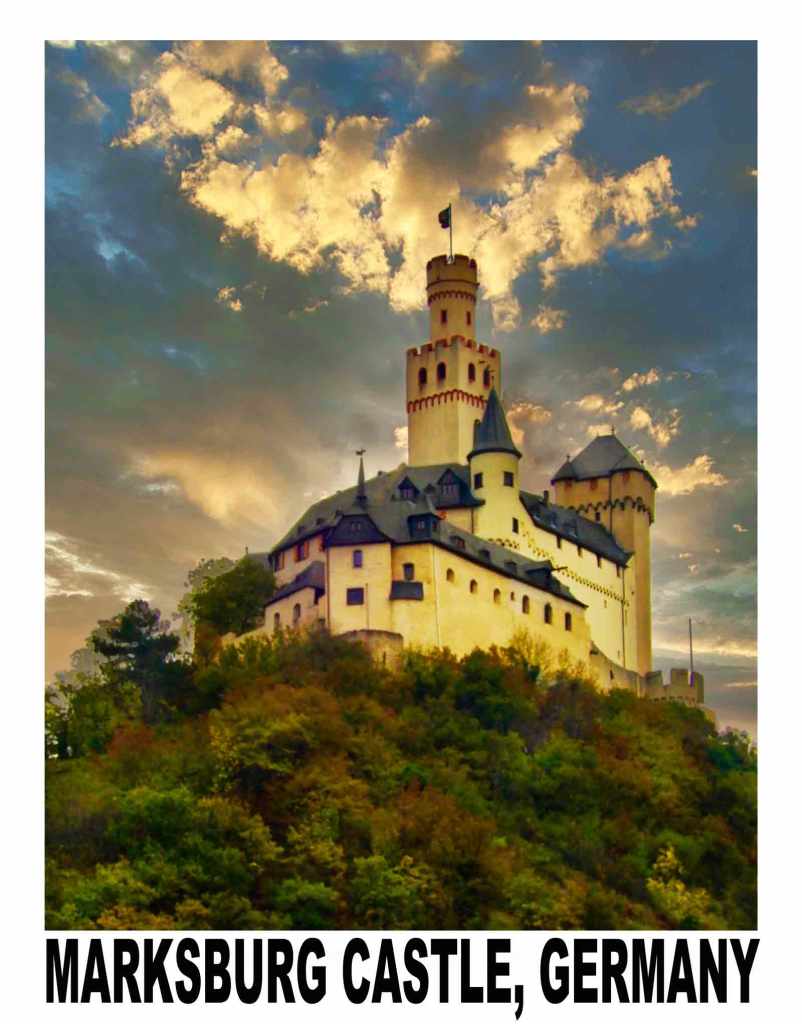
Todays Featured Poster • Marksburg Castle, Germany

Marksburg castle stands above the town of Braubach in Rhineland, Germany. It is one of the central sites of the Rhine Gorge UNESCO World Heritage Sites. The fortress was used for protection rather than as a residence for royal families and throughout several centuries was never conquered.  

These giclée prints are available in several sizes, custom printed for each individual order on archival, museum grade paper using fade resistant inks.

Join us as we visit historic treasures, natural wonders and vibrant cities set against backdrops that are endlessly changing and visually magnificent. Celebrate a world of travel experiences with these decorating accessories that are perfect for framing.