Across the Potomac River from Washington is the historic city of Alexandria, Virginia. The city was an active and important seaport in the colonies from the early eighteenth century and has buildings dating back to the seventeenth century. It was originally part of the land ceded to the Nation’s Capital but was later reclaimed by Virginia and is home to a number of historic colonial buildings. Just north of George Washington’s Mt. Vernon it includes his church, Christ Church. The city has a Sea Captain’s Row, the Lee-Fendall House constructed in 1785 and home to thirty-seven members of the family of Robert E Lee. It is also home to a historic 18th century pharmacy and fire house and is also famous for the Carlyle House, a mansion built by Scottish merchant John Carlyle in 1751 situated on North Fairfax Street. At 228 South Pitt Street is also the historic St Paul’s Episcopal Church and the home of a legend that still receives significant attention even today.
I was born in Washington D.C. but was raised in Alexandria, Virginia. I was Baptized at St Paul’s Episcopal Church in Alexandria, Virginia. The church is a landmark in the historic area of Alexandria and was founded in 1809 and consecrated in 1818. It was designed by one of the architects of the U.S. Capital and is the earliest example of Gothic Revival architecture in the United States. It served as a hospital during the Civil War but its biggest claim to fame is a gravestone in its cemetery. The Grave of the Female Stranger is a famous historical landmark and visitor’s attraction in the historic Old Town.
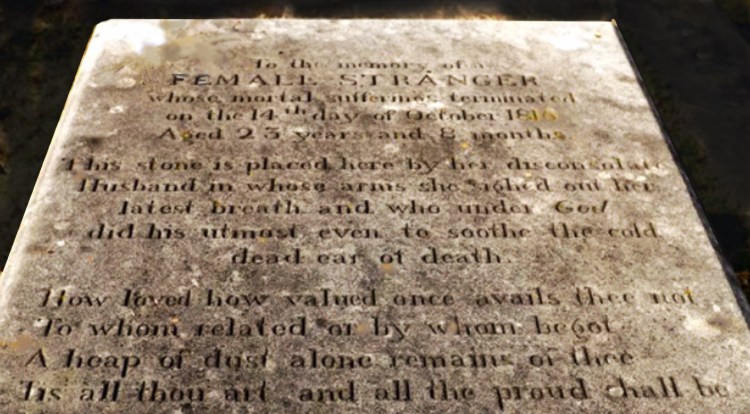
The grave is the resting place of an unnamed woman who died in 1816. Historical accounts say the young woman died in room 8 at the famous Gadsby’s Tavern where supposedly her ghostly visage can be seen standing at the rooms window late at night. Stories have spread widely and been romanticized because of the mysterious headstone in the church’s graveyard that bears the following inscription:
To the memory of a
FEMALE STRANGER
whose mortal sufferings terminated
on the 14th day of October 1816
Aged 23 years and 8 months
This stone is placed here by her disconsolate
Husband in whose arms she sighed out her
latest breath, and who under God
did his utmost even to soothe the cold
dead ear of death
How loved how valued once avails thee not
To whom related or by whom begot
A heap of dust alone remains of thee
Tis all thou art and all the proud shall be
To him gave all the Prophets witness that
through his name whosoever believeth in
him shall receive remission of sins
Acts. 10th Chap. 43rd verse.
There seems to be no records about the name of the husband or companion, how or why they came to Alexandria or who ordered the headstone. But there are lots of myths.
The numerous legends include stories of an English aristocratic couple bound for New Orleans that were left in Alexandria because the wife became ill and include a number of claims the young lady was Aaron Burr’s daughter who was either captured by pirates or lost in an accident at sea. Over the two centuries, accounts have been published in newspapers all over the United States and England. A story with a large spread, including a dramatic illustration, was featured in the Ladies’ Home Journal for January 1913 and there have been at least 2 books published on the legend.
The fact is – nobody really knows the truth of the story. The church is located at 228 South Pitt St, Alexandria, VA 22314 in case you find yourself in the neighborhood.
Memories, odd moments and interesting discoveries. Click the images below access our short stories.
Rush hour traffic in Copenhagen and The Changing Of The GuardA Day at Icy Straight PointAn afternoon looking for the worlds smallest drawbridgeThree teens loose in Paris in 1965 and a famous columnist A lost opportunity in Key WestThere everywhere and I would guess the padlock makers love it…The famous Gibraltar apes have gotten lazyFor decades a left behind ladder sits at a window in JerusalemProbably the scariest road I’ve ever driven Rt. 12 Utah October 23rd 1956 and a Hungarian holiday
Our first line of defense is improving our immune system before we get sick and that starts with vitamin C. Several weeks before a trip we start taking it.
Around 1970, Nobel prize winner Linus Pauling (chemistry and the Peace Prize) popularized the theory that vitamin C helps treat colds. He published a book about cold prevention using megadoses of vitamin C. Multiple controlled studies have examined whether vitamin C had any effect after coming down with the common cold and, while the results have been fairly disappointing, it has been established that a regular supplemental regimen of vitamin C has several benefits. It includes reducing the symptoms of a cold and making it less severe. It also reduced duration and increased recovery time by about 8% in adults and 14% in children. Some studies also indicated a supplemental dose of 1–2 grams was enough to shorten the duration of a cold by 18% in children. Other studies with adults found 6–8 grams per day to be effective. Vitamin C in large doses comes packaged as Emergen-C and Airborne.
Another item we carry with us is zinc. One popular form is Cold-Eeze and, while it hasn’t been found to be a preventative, it has been shown that zinc lozenges can reduce the duration of a cold, perhaps by a day or more and also reduce its’ severity.
Sucking on zinc within the first 24 hours after symptoms start and continuing to take it as long as your cold lasts will help shorten your cold and often a flu. According to the Mayo Clinic, zinc may keep cold viruses from multiplying and taking up residence in your nose and throat but there’s no evidence it’ll actually prevent getting a cold.
Two Prescription Medications
While we haven’t been very successful in convincing our doctors to provide us with prescriptions just in case, we’ve met a number of people that have. There are two specific prescriptions that can be helpful if you do come down with something but there are serious cautions in their use. The major issue is understanding when their use applies. Is the illness viral or bacterial is the biggest question to answer because antibiotics are of no use against a virus.
Determining Who The Culprit Is
Viral and bacterial upper respiratory infections have very similar symptoms. Lab testing or a clinical diagnosis is the only way to know for sure, but this can be costly, time consuming and at times not available on a cruise ship. Some symptom differences can help alert you to whether you have a viral or bacterial infection, so pay attention to a number of things.
First be informed about what is “going around”. Flu outbreaks sweep the country in waves so it isn’t uncommon to have them show up on your cruise. Usually the news will provide clues to what the current contagion is. Also you may hear that a couple of other passengers have been specifically diagnosed with the flu or a cold.
2. Viral infections are milder than bacterial infections, and they tend to last longer. With a virus you will usually feel very sick for 1 to 3 days and then you will start to feel better, though some of your symptoms may linger. Symptoms that linger for ten days or more are likely to be a virus. Over time, viruses can also lead to things like sinus infections or increased risk of middle ear infections which result from developing an additional bacterial infection.
3. When you blow your nose or cough up mucus, pay attention to the color. While it may be indelicate, color can be an indicator of whether you have a viral or bacterial infection. Thin and clear mucus is more likely to be a viral infection. Greenish mucus is more likely to be a bacterial infection. Keep in mind mucus color is not a completely accurate indicator of a viral or bacterial infection. Make sure you consider additional factors.
4. Pay attention to your throat. A sore throat is common for both viral and bacterial infections and checking for a sore throat is the most common thing a doctor will evaluate to determine if you need antibiotics. Certain types of sore throats can indicate a bacterial infection. For example, white spots are generally caused by bacteria as well as a sore throat without other symptoms such as a runny nose or sneezing, often indicating a strep throat.
5. Fevers can present in both viral and bacterial infections but fevers differ with different types of infections. In bacterial infections, fevers tend to go higher quicker. Also, with a bacterial infection, fevers often get worse after a few days but if you improve in a few days it’s likely a viral infection.
Medications
The two prescription medications most often carried when traveling are Z-Packs and Tamiflu® with one used for bacterial infections and the other for virus.
The Z-Packs
First, Z-Packs are easy to use and they’re cheap. They come as a pack of five pills, which you take daily over the course of five days, and they’re highly effective. Azithromycin is well-absorbed when you take it orally, easily enters your body tissues, so it can fight the bacteria causing your infection, and stays active for a long time. Z-Packs have no effect on virus infections but are highly effective against:
Strep throat. Azithromycin is approved for treatment of strep throat. If you are allergic to penicillin, which is usually the first choice of treatment, a Z-Pack is still a good option.
Skin and soft tissue infections. Infections of the skin or soft tissues — like muscles and tendons — commonly caused by Staph and Strep bacteria can be treated with Zithromax. A typical prescription consists of either 500 mg daily for five days or a single dose of 2 grams.
Community-acquired pneumonia. For mild to moderate cases of pneumonia that are acquired outside a hospital, Z-Packs are a useful option.
Acute bacterial bronchitis. In folks with chronic bronchitis or other underlying lung disease, acute bacterial bronchitis can be treated with a Z-Pack.
Chlamydia. For the sexually transmitted disease, Chlamydia, a single one-gram dose of azithromycin is the recommended treatment. Just one dose and done.
Traveler’s diarrhea. Azithromycin can effectively treat traveler’s diarrhea, aka dysentery or bloody diarrhea, caused by the Shigella and Campylobacter bacteria. This makes the Z-Pack a handy companion to bring along on international travel.
Nongonococcal urethritis in men. A single 1-gram dose of azithromycin can treat certain urethra infections in men. Again, one and done!
Tamiflu
The antiviral drug oseltamivir (Tamiflu®), helps your body bounce back faster from the flu.
Researchers find that taking oseltamivir within 48 hours of symptom onset can shave approximately one day from a typical seven-to-10-day illness. A more recent study showed that in patients 65 years old and older without other health conditions, up to two to three days could be shaved off using oseltamivir.
Oseltamivir interferes with the proteins the flu virus uses to reproduce, giving your immune system time to destroy it.
If You Don’t Have Medications (Or Even if You Do)
If you come down with something and don’t have access to those prescriptions, here’s your best course of treatment:
Stay hydrated.
Drinking water and juice to stay hydrated can help cut down on symptoms like a sore throat and stuffy nose. Steer clear of alcohol and super-sugary drinks to help prevent dehydration.
Gargling with salt water.
To combat a scratchy throat add half a teaspoon of salt to a glass of warm water. The salt draws out excess water in your throat’s tissues, reducing the inflammation, and clears mucous and irritants from the back of the throat. The rinse also flushes out bacteria and viruses, which may help whether you’re getting a cold or want to prevent one in the first place.
Keep your nose clear.
Using a sterile saline nasal spray right after cold symptoms first appear may reduce their impact by moisturizing dry nasal passages and loosening mucous caused by colds. Taking a hot shower allows the warm moisture to clear nasal passages.
OTC Medications
Theraflu
Theraflu is basically a dose of acetaminophen along with several other anti-cold ingredients. It does carry a warning about the risk of liver damage if you take more than the recommended dose or mix with alcohol or other acetaminophen-containing products. Maybe take ibuprofen or acetaminophen alone and brew yourself a hot cup of tea. You’ll get the warm, soothing fluids without the risk of those extra drugs.
Pain Relievers
A pain reliever may be the first thing you reach for when you come down with a cold. Pain relievers for coughs and cold can be very effective. They can help with fever. Anti-inflammatory meds like Advil or Motrin (ibuprofen) or Aleve (naproxen) have the advantage of reducing tissue inflammation, but you should take Tylenol (acetaminophen) instead if you’re taking blood thinners
NyQuil And Other Cold & Flu Drugs
This is one of the more popular OTC drugs but it is also one of the most dangerous when abused. Check the indications, side effects and warnings. You need to check to make sure that it is safe for you to take NyQuil (acetaminophen, dextromethorphan, doxylamine, and pseudoephedrine liquid).
Other choices with similar cautions include:
Some are usually available in the ships store and a trip to a pharmacy when in port can also provide something suitable. Read the recommendations and watch out for high blood pressure cautions regarding other conditions.
It’s not just cruise ships that provide an environment that allows for the spread of disease. Any public space that brings large numbers of people together in close quarters offers an increased chance of getting sick. Anyone who has had young children go off to school knows about those years of viral and bacterial infections brought home and spread through the entire family. It’s just one of life’s cycles and, while there is little you can do about those episodes, you can take action to reduce your risks while traveling.
The first area of increased risk encountered by the traveler is usually the airplane. Packing a few hundred strangers into a compact environment for one and a half to seventeen hours is an invitation to spread disease. One study discovered that, on average, 20% of your fellow passengers are probably sick. Here are steps you can take to reduce your risk while flying:
1. Select the right seats – The most likely people that will infect you are those sitting next to you, in the row ahead of you and behind you. For that reason, the safest seat is the window and the least desirable seat is on the aisle.
Disinfect your space – Armrests, tray tables and those seat-back screens and controls have been found to be a serious source of infectious agents and the airlines do almost nothing to them during the cleaning of a plane. Get in the habit of carrying TSA sized bottles of disinfectant spray and/or wipes. Purell, Clorox and GermX are a few effective brands. Disinfecting wipes will usually kill 99.9% of viruses and bacteria, including staph, E. coli, MRSA, norovirus, salmonella, strep and even the new threat of coronavirus.
Watch out for surfaces at lavatories – Another study found airplane lavatory surfaces, especially door handles, are a major hotspot for pathogens. Sadly, too many people don’t wash their hands. For that reason, avoid touching surfaces with a bare hand – use a paper towel to open doors and wash your hands thoroughly.
Keep your hands away from your eyes, nose and mouth – The primary entry points for disease agents are your body’s mucus membranes (those moist areas) and the best way to avoid infection is to avoid transferring them from your hands. So, wash or disinfect your hands often.
Face-masks? – Evidence suggests that airborne infections, while possible, are actually rare. Disinfecting your space, washing your hands and avoiding likely infected surfaces are hundreds of times more effective than face masks. In most situations, face-masks won’t hurt but are probably unnecessary.
Next, there are steps you can take to avoid getting sick on a cruise ship. The risk on a ship is very similar to that on an airplane. While you do have a lot more space to try and stay away from people that are ill, you will be in that environment for much longer periods. The basic steps to avoid picking up an infection are the same:
Disinfect your hands often – most cruise ships are now reasonably aggressive with hand sanitizers, usually providing Purell dispensers all over the ship.
Avoid touching surfaces in lavatories and, again, wash your hands often.
Keep your hands away from your eyes, nose and mouth. This is a hygiene practice that would be good to adopt everywhere in life.
Avoid contact with obviously ill people – We can’t count the number of times we have gotten sick on a cruise because people that are sick make no real effort to isolate themselves from the other passengers. We believe this is an area where cruise ships should become even more aggressive. On several occasions we’ve had seriously ill people that kept coming back to the dinner table each night. Our new policy leans toward “would we rather be thought rude or would we prefer getting sick?” If they won’t leave the table – you should.
Avoid elevators if at all possible. The small enclosed spaces are a breeding ground for germs even though the ship’s personnel work hard at keeping the spaces clean.
Carry your own emergency medications – More on this part III.
Looking For Something Special? Search this site to find travel inspiration, tips and more.
The saying is “See Venice and die” meaning that after such a peak experience, there’s nothing left to do but die. Maybe we wouldn’t go that far, but this city belongs on every bucket list.
A common sight around the world are still food halls, street markets and open-air markets. From France to Italy, Thailand to Budapest, almost everywhere you travel you will find people celebrating food in all its variety by shopping these small, specialized merchants in outdoor markets and city food halls.
Looking For Something Special? Search this site to find travel inspiration, tips and more.






















 The Intentional Travelers