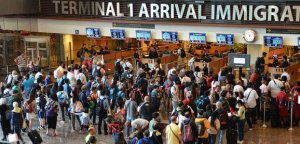
I don’t even want to get into telling stories about coming home and getting delayed in Customs and Immigration. I’m sure we all have our stories.
We were excited some time ago with the self-service kiosks that were being installed at a number of locations. After a few times thru that system we realized this wasn’t the answer to our prayers. It just didn’t happen that fast. You had to scan your passport and everyone had to – not just the head of household. You had to get your picture taken by the kiosk than respond to CBP inspection questions and submit biographic information, whatever that was. After that you were given a printout strip and than you went and stood in line again.
While traveling we have come to realize that some other countries have figured out how to get people thru the process. Our favorite is Australia – scan your passport at a kiosk, tick off a couple answers and show the receipt to the nice person as you exit. Maybe the online visa Australia makes you get helps them with the process? Somehow going thru our CPB process doesn’t make me feel any safer coming into the U.S.
Recently we’ve read a couple of articles about the U.S. CBP App and so far the reviews are positive. First you have to download the Mobile Passport App on your iPhone or Android device, it’s free. Use the App to scan your passport and save the information.
Here’s what to do when you arrive back in the U.S. from the Mobile Passport website. Once you are at your port of entry (airport or sea port), connect to wireless or wi-fi and submit your data to CBP. Remember: when you submit, you are confirming under penalty of law that your information is correct. Within a few seconds, you will receive a CBP receipt with an encrypted barcode. Your receipt will be valid for 4 hours.
No more customs forms!
Next follow the Mobile Passport Control signs to the designated Mobile Passport Control line. Show your passport to the CBP officer and scan back the barcode on the digital CBP receipt. And that’s it!
The system is currently active at twenty-four U.S. airports and Ft. Lauderale’s, Port Everglades, with more coming soon.
We have one report that the system is a breeze. That may be because there aren’t that many users yet but hopefully CBP will expand to keep up.
For a refresher on the Jones Act see Cruising and the Jones Act Here.
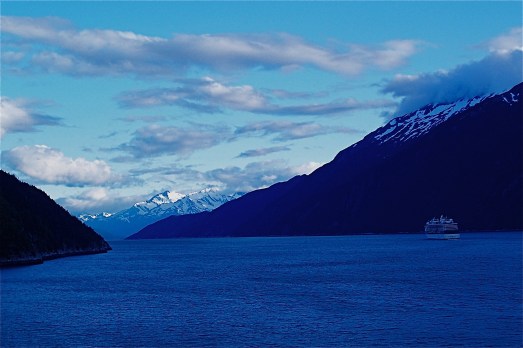
Back in 2016 we booked a back-to-back set of cruises with Celebrity. The first cruise was an Alaska cruise starting in Seattle and finishing in Vancouver. The second cruise continued on from Vancouver and finished in Honolulu. It took a little while but Celebrity came back and said we could not book this as it violated the Jones Act.
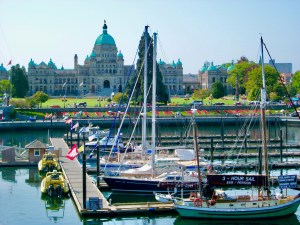
Cruising AlaskaVictoria, Canada
After reviewing the itineraries we realized that the Alaska cruise stopped in Victoria, Canada the day before arriving in Vancouver. We went back to Celebrity and asked that if we disembarked the ship in Victoria could we overnight there and rejoin the ship the next day in Vancouver therefore avoiding the Jones Act?
Vancouver, Canada
Asking a large organization with many layers of management to do something that hadn’t been considered before is usually a daunting task and this was no exception. Celebrity said they would look into it. Later when asked again Celebrity said they would look into it. Somewhat later when asked Celebrity said maybe it would be possible and they would get back to us. Following up on that hopeful news we were told probably not. Later we enlisted the help of our travel agent who got higher up the chain of command. The response she got was that they didn’t see why not but would look into it. A couple of months later Celebrity got back and said it was okay with them but that they needed to get permission from the Canadian Immigration.
Finally everything was cleared for us to stay on this back-to-back. We asked if we could just leave our things in the stateroom when we got off in Victoria? The response was – don’t ask and we won’t tell.
One interesting thing was that when we got off the ship in Victoria we were joined by eight other couples with some doing just what we were. Celebrity now has a process for accommodating cruisers wanting to do this back-toback.
Canada Place, Vancouver
Everything on this trip went very well. The one issue was a lack of planning on our part. We knew that a ferry went from Victoria to Vancouver at a nominal price but we failed to look up the actual terminal locations. It seems that the Vancouver Island terminal is a good distance outside of Victoria and the ferry docks a long way from Canada Place (the cruise ship dock) in Vancouver. Fortunately we found a bus service (The BC Connector) that left from only four blocks from our Victoria hotel, went onto the ferry and than delivered us right to Canada Place all for a reasonable fare.
We have returned to Rome a number of times usually staying a few days with each visit. On a Mediterranean cruise a few years ago it was our sons first trip to Europe. The cruise originated and ended in Barcelona and the ship docked for one day in Civitavecchia the port servicing Rome. With the trip to Rome an hour plus each way that left about seven hours to actually see the city.
Rome is one of the world’s great cities. It is packed full of thousands of years of historic sites. It is home to one of the world’s major religions (yes, I know the Vatican is actually a different city/country). In addition Rome has some of the best food and shopping in Europe and then there are the concerts and opera…
So the challenge is what to do with seven hours in Rome? Since this day is focused on a first timer who probably isn’t real keen on shopping and the symphony and opera are out, that leaves historical highlights. Our seven hours in Rome started and finished at Vatican City where the bus stopped.
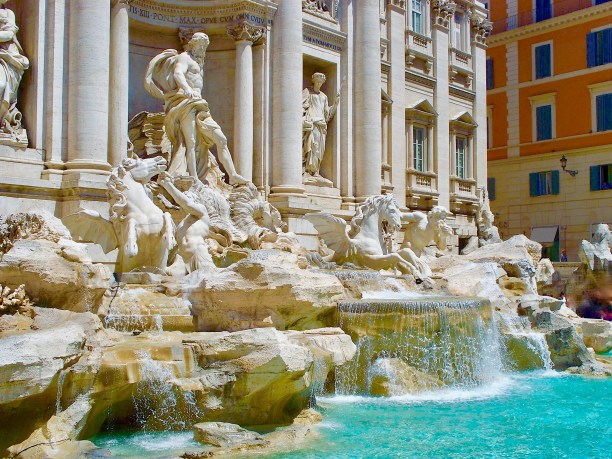
Throwing coins in Trevi
The first time hurdle you will have to deal with in visiting the major sites in Rome, particularly in the summer, are the crowds. As hard as it is to believe, even the outdoor Fountain of Trevi, in the summer, has huge crowds you need to navigate thru. Many of other sites need tickets or hours waiting in line or both.
The Vatican Museum and Sistine Chapel – direct purchase tickets thru the Vatican are 17 Euros and it will still require a fair amount of time in line. You can get Skip-the-Line Tickets to the Vatican Museums & Sistine Chapel thru an agency for about 30 Euros but it requires doing this in advance. Without being aware of this Vatican Museums & Sistine Chapel are out.
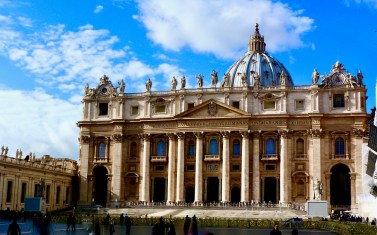
St. Peters Basilica
Getting into St. Peters is free but the lines usually will take up to an hour or more. Since the lines were already long we decided to try later when we returned to the Vatican.
Interior of the Pantheon
From Vatican City we took a taxi over to the Pantheon, which is the oldest intact domed structure in the world and really deserves a look. Unfortunately even the Pantheon now requires admission tickets, instituted to primarily to better control the crowds.
The Fountain of Trevi
For the next stop it is important to have a really good sense of direction and a map or the use of the GPS on your smart phone because the next stop is only a modest walk away. Everyone has to put in an appearance at the Fountain of Trevi. Remember Anita Ekberg’s famous Trevi Fountain bathing scene from “La Dolce Vita,” and the tradition of throwing coins into the Trevi from “Three Coins in the Fountain”? Stand with your back to the fountain and throw a coin over your right shoulder and you will always return to Rome.
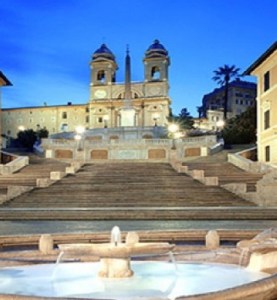
The Spanish Steps
From Trevi still walking, head for the Spanish Steps another must do iconic site. While I’ve been there dozens of times I’ve never been sure what you’re supposed to do. Walk up and down? Sit and play an instrument (many do)? At least take a selfie that proves you were there.
From the Steps another fifteen or twenty minutes walking will get you to the Via Veneto where, if you’re not into shopping at least sit at a café, have lunch or drink an espresso and watch the people.
Via Veneto
An option from the Steps is to head off in the opposite direction thru the Piazza Spagna. This is also a great area for strolling and lunch or perhaps a cappuccino as you take in the sights around the piazza.
If you are on the Via Veneto and enjoy walking you can walk the dozen blocks over to the Piazza Republica and head down the Via Nazionale toward the Roman Forum. You can also catch the Metro at the nearby Barberini Metro Station and exit at the Piazza Republica.
Piazza Republica
If you are at the Piazza Spanga you can walk to the Roman Forum in about a half hour or catch a metro at the Spanga/Trevi station and take the A line and get off at the Piazza Republica station. From there you can walk or take a bus down the Via Nazionale to the area of the Roman Forum and the Coliseum.
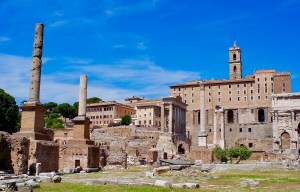
The Roman Forum
Of course you can take taxis between the various locations. You should expect to pay 15 to 20 Euros per ride between the locations discussed. A better option is rapid transit but in Rome it is somewhat fragmented. The fare system is totally integrated though, so you can pay and use the Metro trains and buses on the same ticket. A minimum fare is a BIT Standard ticket for one ride and costs about $2 per person. Our recommendation is a 24 hour pass for about $9. There are ticket machines at all Metro stations and they take major credit cards.
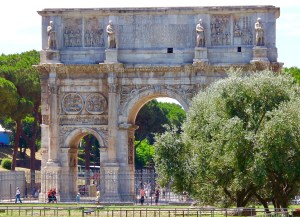
Once in the area of the Roman Forum you can walk thru the Forum, visit the Colisseum and Palitine Hill. The Colisseum requires admission tickets and you can expect the line to take up to an hour in Summer.
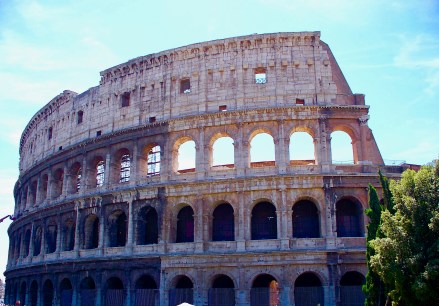
The Colosseum
Getting from the area of the Forum back to Vatican City by walking or by bus will take about an hour so this is where we would recommend a taxi (about 20 minutes and $25).
Highlights:
St. Peters Basilica
Vatican Museum– A collection amassed by Popes throughout the centuries including some of the most renowned classical sculptures and most important masterpieces of Renaissance art.
Sistine Chapel – A large papal chapel built within the Vatican between 1477 and 1480 by Pope Sixtus IV, for whom the chapel is named. The ceiling along with a large fresco The Last Judgment on the sanctuary wall were painted by Michelangelo between 1508 and 1512.
St. Peters Basilica – Is an Italian Renaissance church in Vatican City, the papal enclave within the city of Rome. It was designed principally by Donato Bramante, Michelangelo, Carlo Maderno and Gian Lorenzo Bernini, St. Peter’s is the most renowned work of Renaissance architecture and the largest Christian church in the world.
Pantheon Exterior
Pantheon – meaning “[temple] of every god”) is a former Roman temple, now a church, on a site of an earlier temple commissioned by Marcus Agrippa during the reign of Augustus (27 BC – 14 AD). The present building was completed by the emperor Hadrian in 126 AD. Almost two thousand years after it was built, the Pantheon’s dome is still the world’s largest unreinforced concrete dome and one of the worlds oldest complete structures.
Fountain of Trevi – Is a fountain in the Trevi district. Commisioned in 1629 by Pope Urban VIII. Designed by Italian architect Nicola Salvi and completed by Pietro Bracci. It is the largest Baroque fountain in the city and one of the most famous fountains in the world.
Spanish Steps – This monumental staircase of 135 steps was built with 20,000 scudi bequeathed by French diplomat Étienne Gueffier’s in 1723–1725, linking the Bourbon Spanish Embassy, and the Trinità dei Monti church that was under the patronage of the Bourbon kings of France to the Holy See in Palazzo Monaldeschi.
Piazza Spanga – Is one of the most famous squares in Rome. It owes its name to the Palazzo di Spagna, seat of the Embassy of Spain to the Holy See. Nearby is the famed Column of the Immaculate Conception of the Blessed Virgin Mary.
Via Veneto – Is one of the most famous, elegant, and expensive streets in Rome.
The Arch of Titus c. AD 82 near The Forum
The Roman Forum – A rectangular plaza containing the ruins of several important ancient government buildings. Originally a marketplace, the Forum became the center of the Roman Republics government and was the heart of ancient Rome.
Colosseum – Originally known as the Flavian Amphitheater it is an oval amphitheater in the centre of the city. Built of travertine and brick-faced concrete, it is the largest amphitheater ever built. commissioned in A.D. 71 by Emperor Vespasian as a gift to the Roman people. In A.D. 80, Vespasian’s son Titus officially opened the Colosseum.
There is a lot of confusion about bringing back purchases from foreign countries duty free, especially liquor and tobacco, how much and from where. The following is from the web site of U.S. Customs:
Duty-Free Exemption
The duty-free exemption, also called the personal exemption, is the total value of merchandise you may bring back to the United States without having to pay duty. You may bring back more than your exemption, but you will have to pay duty on it. In most cases, the personal exemption is $800 ($1,600 from U.S. Virgin Islands, American Samoa, or Guam). There are limits on the amount of alcoholic beverages, cigarettes, cigars, and other tobacco products you may include in your duty-free personal exemption. The differences are explained in the section below regarding alcohol.
The duty-free exemption (Generally $800) applies if:
– The items are for your personal or household use or intended to be given as gifts.
-They are in your possession, that is, they accompany you when you return to the United States. Items to be sent later may not be included in your $800 duty-free exemption. (Exceptions apply for goods sent from Guam or the U.S. Virgin Islands.)
– They are declared to Customs and Boarder Patrol CBP. If you do not declare something that should have been declared, you risk forfeiting it. If in doubt, declare it.
– You are returning from an overseas stay of at least 48 hours. For example, if you leave the United States at 1:30 p.m. on June 1, you would complete the 48-hour period at 1:30 p.m. on June 3. This time limit does not apply if you are returning from Mexico or from the U.S. Virgin Islands.
– You have not used all of your exemption allowance, or used any part of it, in the past 30 days. For example, if you go to England and bring back $150 worth of items, you must wait another 30 days before you are allowed another $800 exemption.
How much alcohol can I bring back?
How much alcohol can I bring back from a U.S. insular possession (U.S. Virgin Islands, American Samoa, or Guam) duty-free?
As long as the amount does not exceed what that state considers a personal quantity*, Customs and Border Protection (CBP) will allow you to enter the U.S. with up to five liters of alcohol duty-free as part of you exemption – as long as at least four liters were purchased in the insular possession (U.S. Virgin Islands, American Samoa or Guam), and at least one of them is a product of that insular possession. Additional bottles will be subject to a flat duty rate of 1.5% and subject to Internal Revenue Service taxes.
Please note, only one liter of alcohol purchased in a cruise ship’s duty-free shop is eligible for a duty-free exemption. If at least one bottle purchased on board is the product of an eligible Caribbean Basin country**, then you will be allowed two liters duty free. If you buy five liters of alcohol in – say – the U.S. Virgin Islands (USVI), and one of them is the product of the USVI, then you would have reached your duty-free limit. Any additional purchases made on board in a duty-free shop would be subject to CBP duty and an IRS tax.
If you buy four bottles in the USVI, one of which is a product of the USVI, then you could purchase one additional bottle from the onboard duty-free, and it would be eligible for duty-free entry.
If you have not exceeded your duty free exemption, you are no longer required to complete a customs declaration. As you pass through immigration you will be questioned about your purchases. If they include alcohol, be sure to have your purchase receipts readily available. The Officer may want to see them as proof of where the purchases were made. Place of purchase as well as quantity determine whether duty and taxes will be charged.
* Most States restrictions on the amount of alcohol that can be brought into that State apply only to residents of that State. Usually people transiting a state are not subject to those restrictions, but sometimes regulations change, and if this is a matter of utmost importance to you, you can check with the state Alcohol Beverage Control Board where you will be arriving to find out what their policies are.
** Most Caribbean Basin countries are considered beneficiary countries for purposes of this exemption. (Anguilla, Caymen Islands, Guadeloupe, Martininque and Turks and Caicos are not eligible)
Tobacco products allowance
In accordance with 26 U.S.C. § 5702(c), “tobacco products” means cigars, cigarettes, smokeless tobacco (snuff or chewing tobacco), pipe tobacco, and roll-your-own tobacco.
Returning resident travelers may import tobacco products only in quantities not exceeding the amounts specified in the personal exemptions for which the traveler qualifies (not more than 200 cigarettes and 100 cigars if arriving from other than a beneficiary country and insular possession).
Once every 31 days, a resident returning from travel from American Samoa, Guam, the Commonwealth of the Northern Mariana Islands (CNMI), or the Virgin Islands of the United States may import 1,000 cigarettes (5 cartons), not more than 200 of which acquired elsewhere than in such locations, within the returning resident’s $1,600 exemption from duty and taxes.
When we visited Yellowstone last summer we had a couple of advantages. First we came on a land tour that included nights at the Old faithful Lodge, which is a difficult reservation to get on your own. We were also in the company of an experienced guide that knew where to go and more importantly, when to get there.
With the summer National Park season quickly approaching and Yellowstone being a favorite destination this is a good time to revisit our experiences.
A number of times as we traveled thru Yellowstone we passed parking areas that were in total gridlock. We saw any number of lines of cars that were just not going anywhere. Following are some thoughts to getting the most out of your park visit.
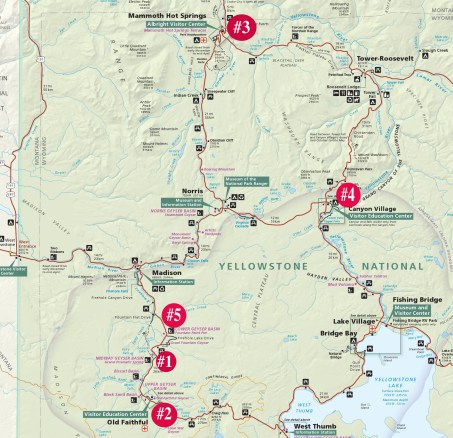
First you should do some research and make a list of those places you really want to get to. This is our recommendation of the top five locations and how to approach visiting them:
Grand Prismatic
#1 Grand Prismatic Spring – Located in Midway Geyser Basin. This area may be small, but it leaves a lasting impression. In addition to Grand Prismatic Spring, there’s Excelsior Geyser, an enormous geyser crater, and the Turquoise and Opal Pools. You reach the field by a bridge across the Firehole River where boiling water flows into the river and steam rises from around the field. This location is very popular and the secret is to get up early and making this your first stop. On most days gridlock begins to set in around noon.Go to High Resolution Yellowstone Map
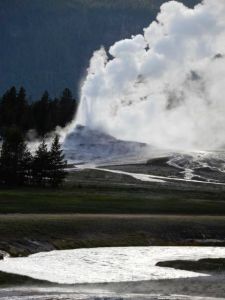
Old Faithful geyser
#2 Old Faithful – Located in the Upper Geyser Basin. The area is the largest concentration of geothermal features on Earth. Though the basins other geysers are less predictable than Old Faithful there is one literally going off all the time. There are also miles of walkways and trails thru the basin that need exploring. The Old Faithful geyser is only a short walk from The Old Faithful Lodge with easy access for the handicapped. With the lodges plentiful parking this a great stop anytime of the day and with a number of good restaurants its a great place for lunch or dinner.
Mammoth Hot Springs, Yellowstone
#3 Mammoth Hot Springs – The springs is a large complex of hot springs on a hill of mineral deposits that look like an inside out cavern. It was created over thousands of years as hot water from the springs cooled on the surface and deposited calcium carbonate on the hillsides as it flowed. Mammoth Hot Springs Historic District in Yellowstone National Park is a large complex with a good hotel, restaurants and shops and is a good choice as a base for visiting the park.
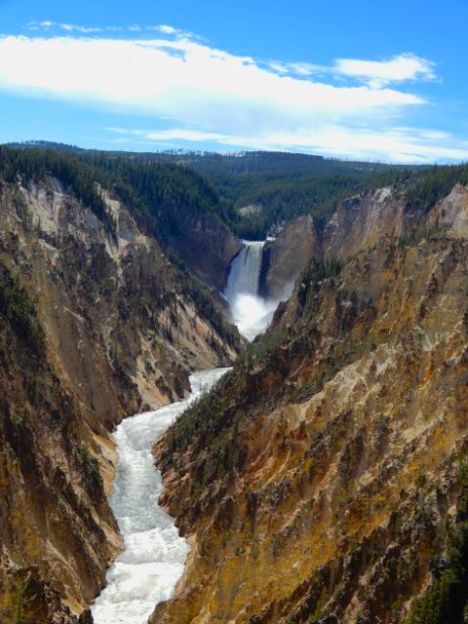
Yellowstone Canyon & Falls from Lookout Point
#4 Lookout Point (Yellowstone Grand Canyon) – The iconic landscape image of Yellowstone is taken from Lookout Point. Only a short walk from the parking area the trail provides spectacular views up the Yellowstone Grand Canyon to the Lower Yellowstone Falls. This is a must see place but can turn into a traffic jam early in the day. Like Grand Prismatic Spring it is highly advisabe to put this on the list of visits early in the morning.
#5 Lower Geyser Basin – This is the largest geyser basin in Yellowstone National Park. It covers an area of over ten square miles compared to the Upper Geyser Basin one square mile. With its large size, the thermal features in the Lower Geyser Basin tend to be in widely spaced groups. Because of the large area and the number of parking facilities and trails it is much easier to visit and find parking at any time of day. In the Lower Basin probably the easiest to get to and most interesting to hike is the Fountain Paint Pot area which features pools, geysers and bubbling mud pots of different colors.
To round out Yellowstone’s list of favorite sights here are another five.
#6 Hayden and Lamar Valleys – Expansive valleys of open meadows excellent for watching animals. Plenty of parking spots throughout both.
#7 Yellowstone Lake – Home to The historic Lake Yellowstone Hotel featuring fishing and tours of the park, Fishing Bridge and visitors center.
#8 Norris Geyser Basin – This Basin is the hottest, oldest, and most dynamic of Yellowstone’s thermal areas.
#9 Tower Falls– This fall on Tower Creek in the northeastern region of Yellowstone National Park plunges 132 feet before joining the Yellowstone river.
#10 West Thumb Geyser Basin – This small, colorful geyser in Yellowstone National Park also features scenic lake views.
The real secret to getting to see what you want is to get up early and know your destination. Also since Yellowstone is the size of Delaware it helps to select accommodations convenient to getting into the park or better yet stay at one of the parks lodges.
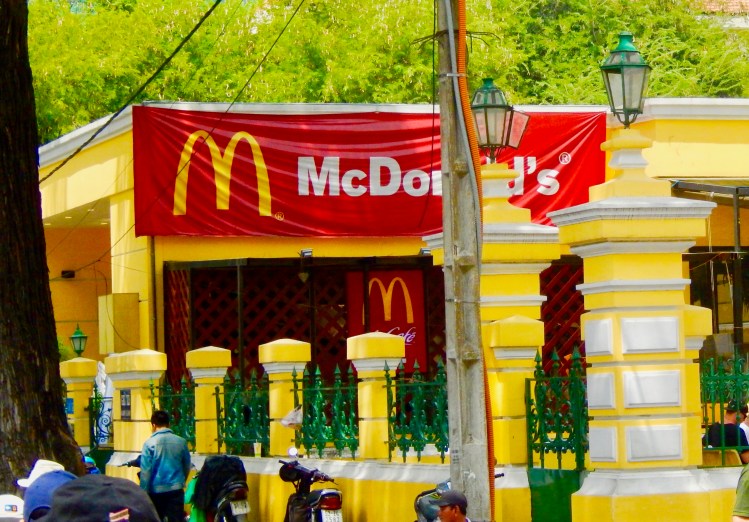
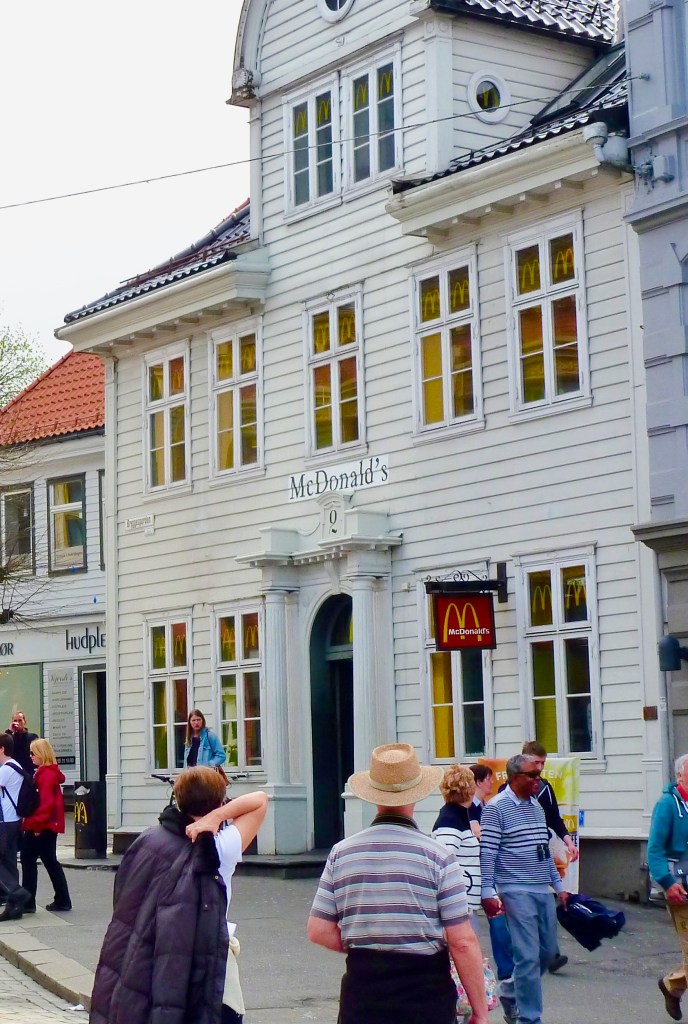
Sometime you just want a good burger. We’ve seen fast food chains in places all around the world including Ho Chi Minh City (McDonalds and Carl’s Jr) Bergen, Norway (McDonalds and Burger King) Barcelona (McDonalds), Copenhagen (McDonalds), Thailand (Burger King and McDonalds).
Thailand
Amsterdam
Saigon
Bergen, Norway
Norway
While having taken advantage of fast food while traveling we prefer non-chain restaurants and we’ve satisfied our craving for a good old American cheeseburger in a number of locations as well. We’ve had burgers from Barbados (Bubba’s, pretty good), to Barcelona (so, so), to Honolulu (a monster concoction at Teddy’s) to St. Croix (at Cheeseburgers, simply a real good burger).
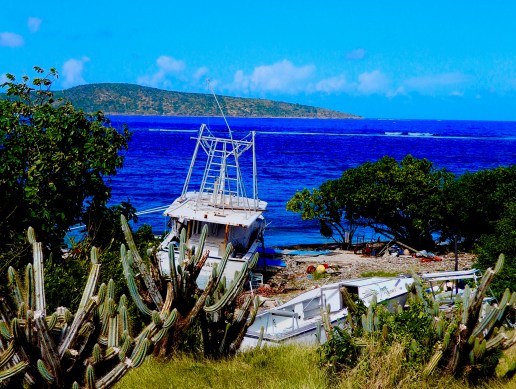
East end St. Croix with Buck Island in the distance
Even the concept of McDonalds style fast food is no longer exclusive to America as more and more chains spring up. Jollibee features burgers and
Manila
chicken and started over forty years ago in Manila. It has spread over Asia and is now well establish in the United States. Quickly growing is SuperMac’s in Ireland that features only Irish beef and serves a menu of french fries, including curry as well as covered in slaw and taco filling.
St. Croix
We first visited Cheeseburger In America’s Paradisein St. Croix after hurricane Hugo in 1990 and the place hasn’t changed at all since. It’s an outdoor place under tents out on the eastern north shore on East End Road. Back then the radio played country western in honor of the Texan linemen that were rebuilding the island and had live music at times in the evening. It was becoming the place for happy hour for East Enders and probably will again as the island recovers. It offers a simple menu that mostly features really good open-flame cooked hamburgers and beer. On this visit it really did take us back as the radio was playing a C&W station.
The bottom line is if you are visiting St. Croix and want a reasonably priced, really good burger, drive on out to Cheeseburger In America’s Paradise.
 fast. You had to scan your passport and everyone had to – not just the head of household. You had to get your picture taken by the kiosk than respond to CBP inspection questions and submit biographic information, whatever that was. After that you were given a printout strip and than you went and stood in line again.
 Recently we’ve read a couple of articles about the U.S. CBP App and so far the reviews are positive. First you have to download the Mobile Passport App on your iPhone or Android device, it’s free. Use the App to scan your passport and save the information.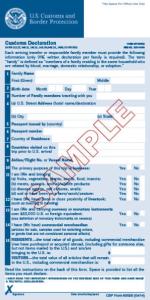

 months later Celebrity got back and said it was okay with them but that they needed to get permission from the Canadian Immigration.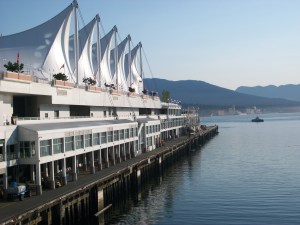







 ** Most Caribbean Basin countries are considered beneficiary countries for purposes of this exemption. (Anguilla, Caymen Islands, Guadeloupe, Martininque and Turks and Caicos are not eligible)
 Go to
Go to 

 #5 Lower Geyser Basin – This is the largest geyser basin in Yellowstone National Park. It covers an area of over ten square miles compared to the Upper Geyser Basin one square mile. With its large size, the thermal features in the Lower Geyser Basin tend to be in widely spaced groups. Because of the large area and the number of parking facilities and trails it is much easier to visit and find parking at any time of day. In the Lower Basin probably the easiest to get to and most interesting to hike is the Fountain Paint Pot area which features pools, geysers and bubbling mud pots of different colors.
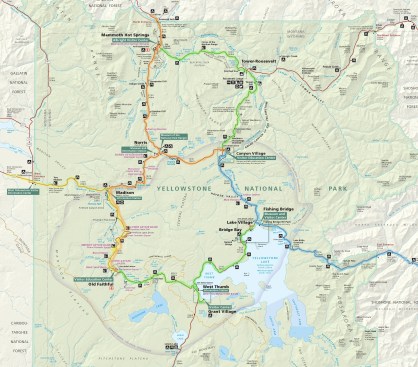 Recommended routes into and thru Yellowstone National Park from each entrance for earliest access to primary locations.




 The Intentional Travelers