Port of Call Ravenna, Italy

Ravenna, A Jewel On The Northern Adriatic

Ravenna in the northern Italian province of Emilia Romagna is a bit off usual cruise itineraries but is gaining in interest. Located only two and a half hours from Venice by train and with frequent service starting at €12 it is a popular day trip for people visiting Venice. Ravenna, often overlooked is an incredible treasure trove of art and history with its basilica containing the worlds most extensive collection of Byzantine mosaics. The city was the capital of the Western Roman Empire from 402 AD until the Western Empires collapse in 476. Today, Ravenna is home to eight world heritage sites, is known for its great food and is located on good beaches on the Adriatic coast that include some world class beach resorts.

Where Your Ship Docks – The Ravenna pier capable of accommodating large cruise ships is about 5 miles outside the city and shuttles are usually provided. To catch a train to Venice you also need to get into the central station located in the center of town. There is no cruise terminal or facilities near the pier.

Old city gate

Transportation – Getting into Ravenna usually is by a shuttle bus and there will probably be very little in the way of taxis available at the pier. With the likelihood of Venice no longer providing access for cruise ships Ravenna could become the gateway port for visiting Venice. Expect bus tours to Venice to become common and train service takes about 2 to 3 hours.

Currency – Italy uses the Euro and Ravenna requires you to change some money as Pounds, US and Canadian Dollars are not usually accepted. The are ATM’s readily available and credit cards are welcome.

Eight Unesco World Heritage Sites

  1. The Mausoleum of Galla Placidia meant to be the resting place of Galla Placidia, the sister of the Roman Emperor Honorius who had transferred the capital of the Western Roman Empire from Milan to Ravenna in 402 AD.
  2. The Neonian Baptistery and…
  3. Arian Baptistery with both including plain octagonal shaped brick exteriors with lavish interiors.
  4. The Basilica of Sant’ Apollinare Nuovo with its 26 mosaic scenes from the New Testament, the oldest mosaics in the world. It is the the only chapel of the early Christian era that is still fully preserved.
  5. The Mausoleum of Theodoric built in 520 AD by Theodoric the Great, King and unifier of the Ostrogoths.
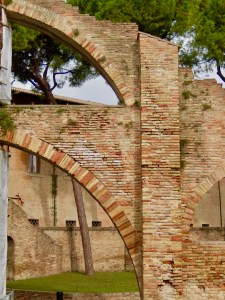
Flying buttress on the Basilica of San Vitale
Dante’s Tomb

The city is also the site of the Tomb of Dante Alighieri the author of The Divine Comedy. He was exiled from his native Florence to Ravenna in 1318, where he completed Paradise, the final section of his famous three part work. Dante is buried in the graveyard beside the San Francesco Basilica.

The jewel of the city is the “Basilica of San Vitale” in Ravenna, one of the most important examples of early Christian Byzantine art and architecture in Europe. Built in the 6th century it is especially noted for the colorful mosaics of Christian icons that decorate the interior walls and ceilings.

The Roman Catholic Church has designated the building a “basilica”, the title bestowed on church buildings of exceptional historic and ecclesiastical importance, although it is not an architectural basilica form.
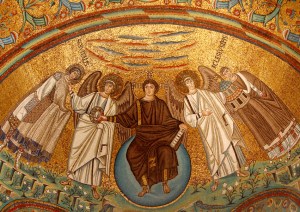
The Basilica of San Vitale was begun by Bishop Ecclesius in 526, when Ravenna was under the rule of the Ostrogoths and completed by the 27th Bishop of Ravenna, Maximian, in 547.
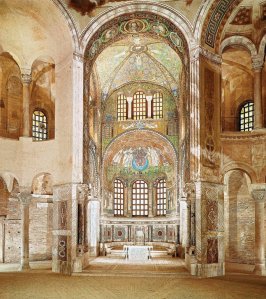
The church has an octagonal plan with the building combining Roman elements: the dome, shape of doorways, and stepped towers; with Byzantine elements: polygonal apse, capitals, narrow bricks, and one of the earliest examples of the flying buttress. The church is most famous for its collection of Byzantine mosaics, the largest and best preserved outside of Constantinople. The church is of extreme importance in Byzantine art, as it is the only major church from the period of the Emperor Justinian I to survive virtually intact to the present day. Furthermore, it is thought to reflect the design of the Byzantine Imperial Palace Audience Chamber, of which nothing at all survives. The Church also inspired the design of the church of the Saints Sergius and Bacchus in Constantinople, and also was the model used by the Emperor Charlemagne for his Palatine Chapel in Aachen in 805. Centuries later the San Vitale dome was the inspiration for Filippo Brunelleschi in the design for the dome of the Duomo of Florence, Italy.
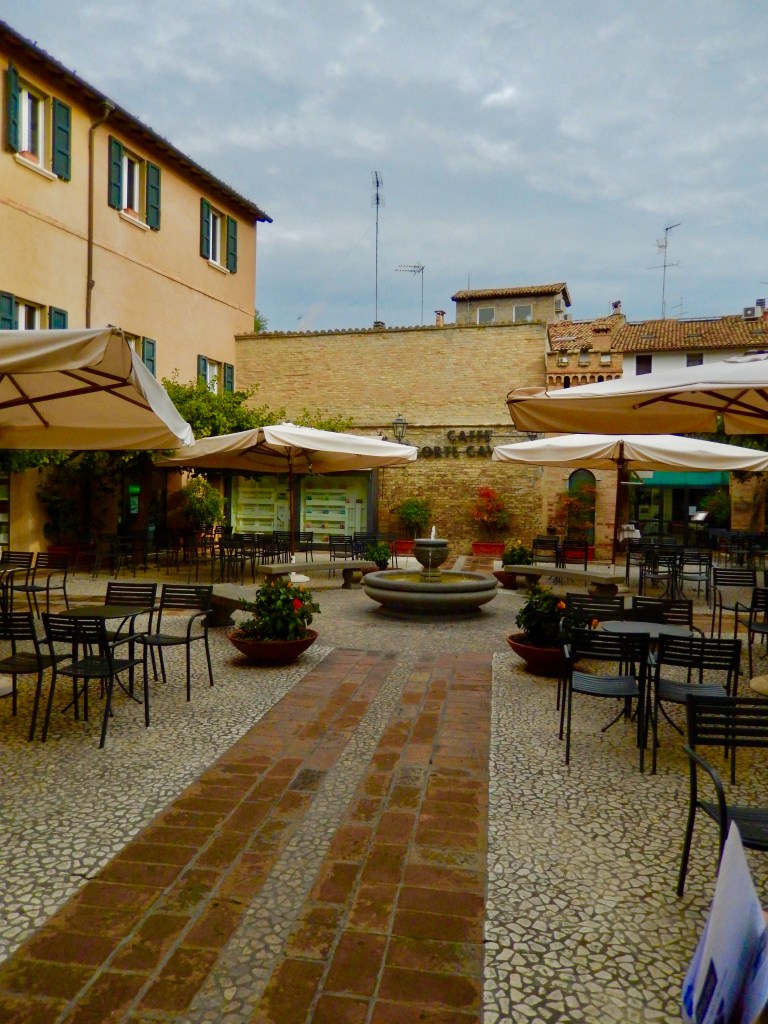
Besides the history and good food the city is also a very easy place for walking. It features a number of wide pedestrian malls lined with good shops, cafes and restaurants.
Outside the city towards the Adriatic beaches you will pass a number of canals dotted with interesting fishing huts with huge and elaborate fishing net contraptions that don’t seem a very sporting way of fishing. Even at the beach there is a long pier also with a number of these fishing huts and nets.

Of additional historic interest is the lagoon just north of the Ravenna pier. At the time that Ravenna was the capital of the Western Roman Empire the lagoon was the home port of the Roman fleet, the largest navy in the Mediterranean at the time. Excavations are exposing piers, shipyards and associated ruins from the period.

Ravenna Beach

Minerva’s Pencil Case has a great  post HERE with some breathtaking interior photography.
Pub Hopping & More in Dublin

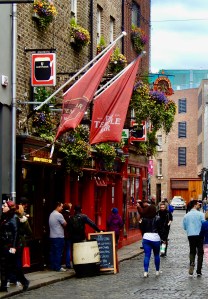
The Temple Bar Pub

Temple Bar in Dublin is famous. Many people mistakenly think it actually as a bar and while there is a Temple Bar Pub the whole area is actually Temple Bar. The origin of the name is in the seventeenth century with a famous Dubliner, Sir William Temple who was the provost of Trinity College. Sir Temple owned property along the bank of the river Liffey. In the river in front of his land was a sand bar and around that time a breakwater was built down at the mouth of the river. That resulted in the sand bar growing and as it built up it became part of the real estate of the city. Locals began to refer to this land as the “Temple Bar” and the districts name survives today.
Live music at the Temple Bar Pub

The Temple Bar neighborhood today is an area famous for its nightlife with dozens of pubs and bars. In 1840 an establishment opened named Temple Bar Pub and today it is still a popular and iconic institution. It features good food, libations and live music. Every new visitor to Dublin should put a stop at the Temple Bar Pub on their list of destinations. From early in the day to late at night it is full of energy, serves good, moderately priced fare and features authentic live Irish music. If you need a T-shirt to memorialize your trip you must buy a Temple Bar Pub tee, nothing says Dublin better.

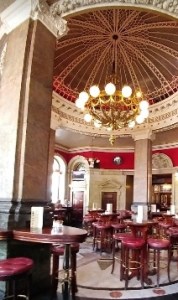
Dining room at The Bank

Dublin has a reputation for good food and we lean strongly toward pub fare. Corned beef sandwiches, fish n’ chips, Oysters & Guinness, Irish stew to name a notable few.

Anywhere you walk in this marvelous city you probably won’t be very far from a good Irish pub.

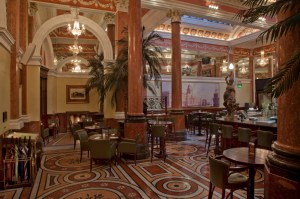
The Bank Bar and Restaurant opened in 2003 and located on College Green next door to H&M in the heart of Dublin. The name comes from the building originally being a bank and it still has its original character with lots of brass railings, tiles, and an ornate ceiling. It offers primarily a pub menu and features a live piano player to add to the atmosphere. The food deserves high marks.

The Grand Central Cafe

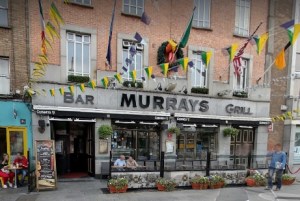
Murrays Pub located on O’Connell Street just north of the Spire. This pub has a good reputation for food and features live music and Irish dancers in the evening. It has a welcoming, comfortable feeling and they make a good Irish Coffee which is just the thing on a wet afternoon.

Grand Central Café Bar is also on O’Connell Street just south of the Spire. Located in a historic building that was shelled during “The Rising”, it offers a large collection of local beers and cocktails and an extensive menu of dishes, prepared in front of you in an open plan kitchen. It features music and dancing in the evening. Good food and attentive service at reasonable prices.

Dining room at The Bank

Dublin has a reputation for good food and we lean strongly toward pub fare. Corned beef sandwiches, fish n’ chips, Oysters & Guinness, Irish stew to name a few. During our recent visit we took advantage of a few and were pleased with them all.

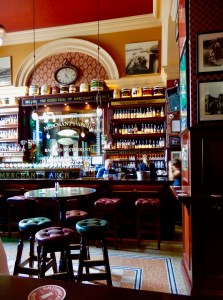
Directly across the street from the Ha’penny Bridge on the south side is The Merchant’s Arch Bar which features live music and good bar snacks. Plan on a happy hour visit and join in on a few Irish songs and a pint of Guinness. The atmosphere is lively and the staff is friendly and efficient.

The Merchant’s Arch Bar


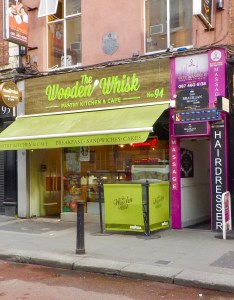
For dessert and coffee look up The Wooden Whisk at 94 Talbot Street just a few blocks east of the Spire on O’Connell Street. It has a small deli and coffee shop vibe but if you’re looking for pastries and coffee around the city this is a real find with prices that are more than fair.


A Word On Starbucks. Traveling the world in recent years there is an American establishment that has become as ubiquitous as McDonalds – Starbucks! From Australia to Thailand to Dublin you will probably walk past several Starbucks in a day. While we prefer local we now carry our Starbucks card with us when we travel, often because we know we can access free wifi. You can pay with funds on our card at any Starbucks in a number of countries so check the website before you travel. For medical reason I need to avoid caffeine and in much of the world that’s difficult to do in coffee but there are two reliable outlets fo decaf – Starbucks and McDonalds. In Dublin I needed a decaf and to reload a Google map on my cell and were surprised at the transaction. First it was instant. Second the receipt spelled out the transaction in Euros as well as the US dollars used and the exchange rate was exactly what the mornings quote showed. Lastly it also showed the balance on the card in Euros as well as dollars. Two big thumbs up for Starbucks.


Cruise Ports Of Call In French Polynesia

Adventures in Paradise

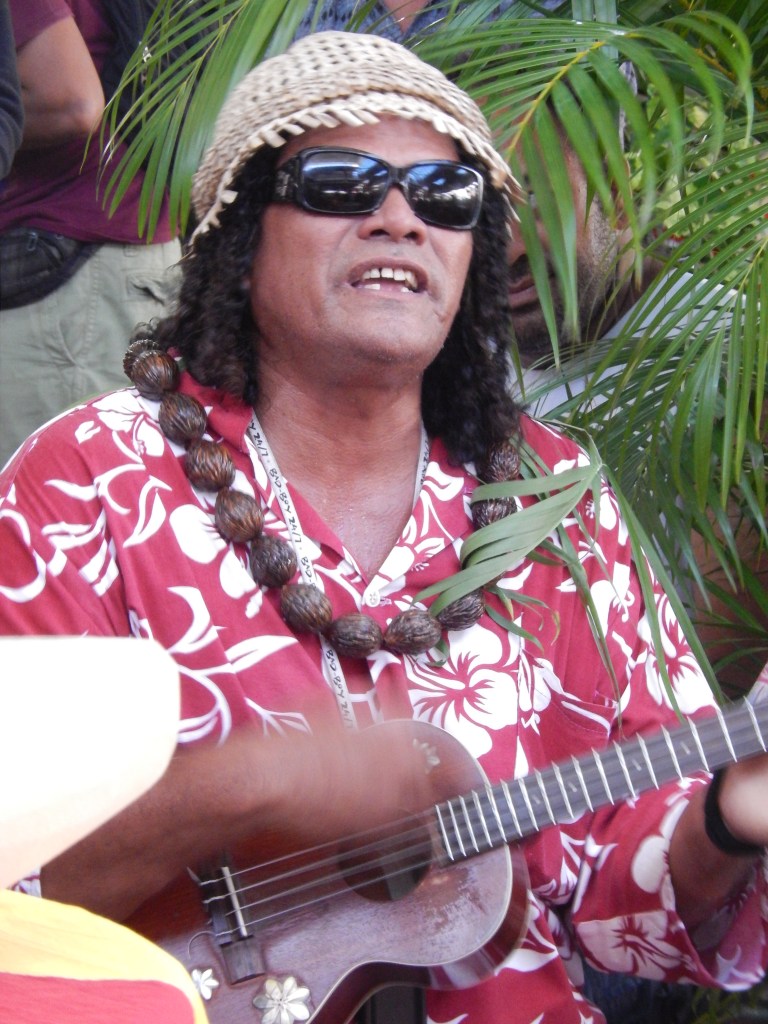
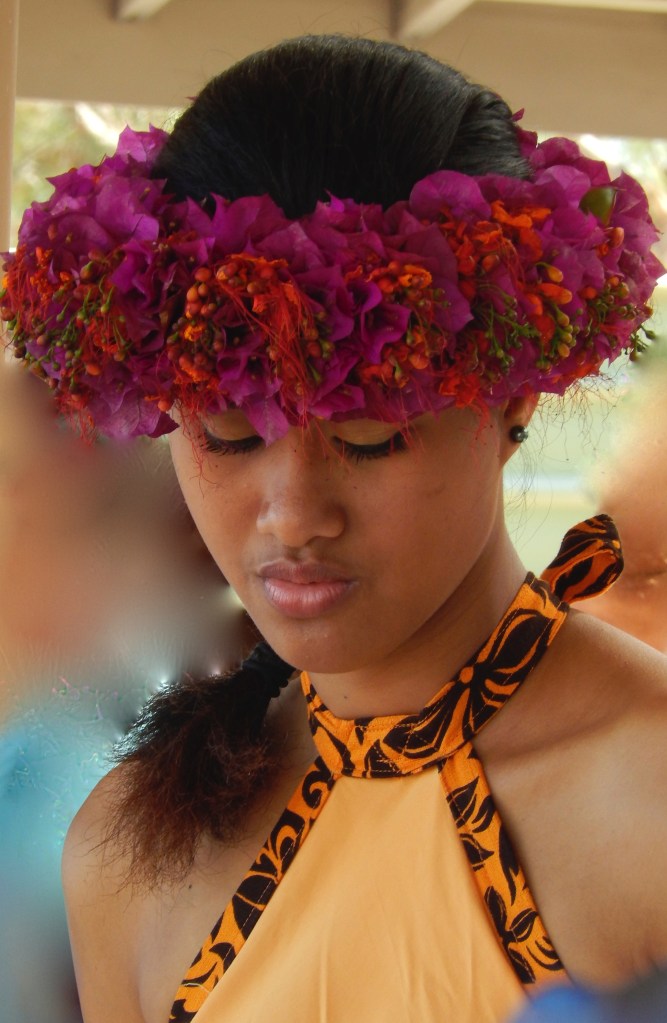
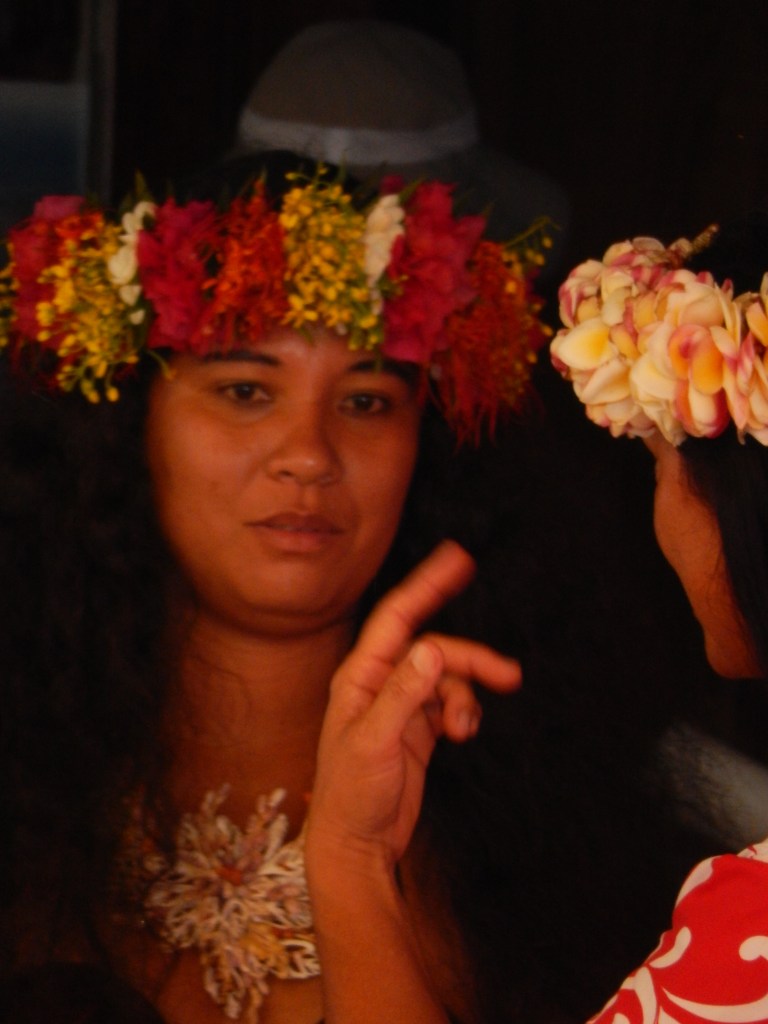
Called the French Society Islands they are better known by the individual island names of Tahiti, Bora Bora and Moorea with Tahiti being the largest. The islands are due south of Hawaii on the other side of the equator.

Tahiti is part of a volcanic chain formed by the northwestward movement of the Pacific Plate over a fixed hotspot similar to the process that formed the Hawaiian Islands. Tahiti consists of two old volcanoes—the larger Tahiti-Nui in the northwest and Tahiti-Iti in the southeast connected by an isthmus. Tahiti-Nui was the first eruption that formed Tahiti as a volcanic shield cone between 1.4 million and 900,000 years ago. Tahiti-Iti probably formed about 250,000 years later.

Where Your Ship Docks – In Papeete, Tahiti there are piers capable of docking large cruise ships right in the center of Papeete’s waterfront. Within a couple of blocks there are public facilities an outdoor market building and numerous shops.

Visiting Bora Bora and Moorea ships anchor out and use tenders to take passengers ashore. While both of these islands are famous for their resorts they are still significantly rural without much of a central town. Near the tender docks on both islands there are some shops and facilities and usually craft stalls are set up nearby when cruise ships are visiting

.

Tahiti has a long and rich history. The islands were first settled by migrating Polynesians as early as 500 BC. They were later discovered by European explorers during the 16th century but there is controversy over who was the first. The islands were eventually colonized by France and remain French today. In August 1768, Captain James Cook set sail from England to visit Tahiti to observe the Transit of Venus across the Sun and mapped several island groups in the southern Pacific that had been previously discovered.

Jardin de l’Assemblée de la Polynésie Francé

Getting Around – Except for taking a ships tour, the best way to see these islands is to rent a car. There are several major rental companies and day rates are moderately priced.

Language – The islands language is French and few locals speak English so you may have issues being understood.

Money – The islands use the French Pacific Franc equal to about one US penny. Some places will accept Dollars but don’t count on it. Credit cards are welcome almost everywhere.

Attractions & Events

Farerei Haga – Mid September, a cultural and tourist event takes place over a whole week with the contribution of the surrounding atolls. Fields days coconut husking, stone lifting, braiding. Evenings: traditional songs and dances. Tourists are encouraged, the event is free and located on the Papaputa land.

Pacific International Documentary Film Festival – Early February the FIFO is the audiovisual event that makes Tahiti the documentary film capital of Oceania. It brings a selection of documentary films before an international jury. A succession of film screenings, free workshops, conferences.

Moorea Marathon – In late October is the most important sports event on the island of Moorea. The Moorea Marathon since 1988 welcomes runners from all over the world and its course ranks it among the worlds most challenging.

The Tahiti Pearl Regatta – in mid May a sporting regatta that brings together between 40 and 50 sailing boats, or 250 to 300 crew members from around the world.

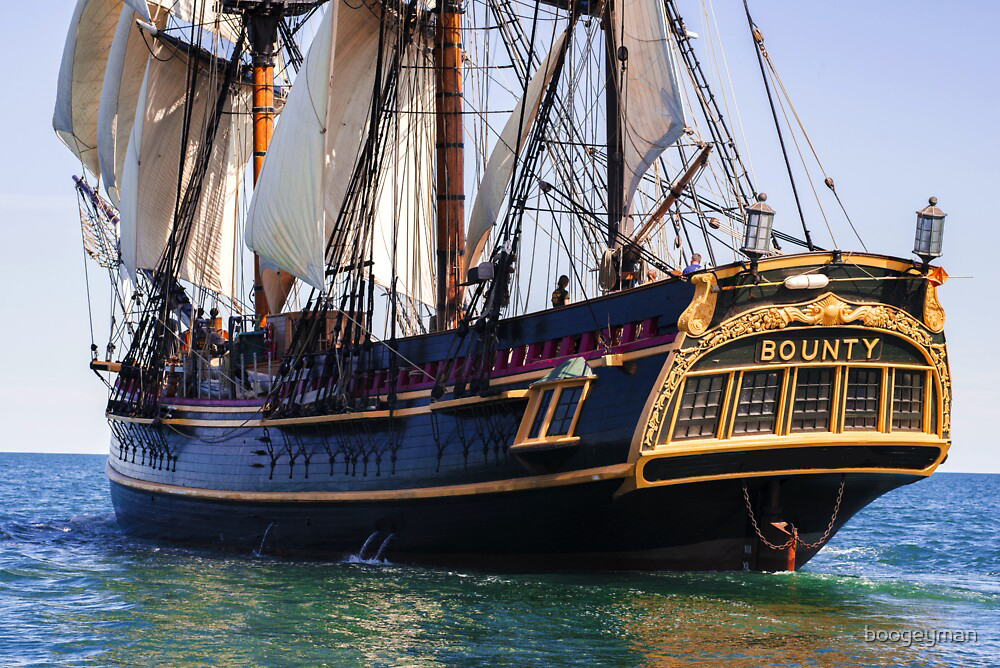
Papeete, Tahiti celebrates the Mutiny on the Bounty Festival each year in late October which usually offers an opportunity to hear lectures on history, buy T-Shirts, souvenirs and books. Papeete is the governmental center of The Society Islands with Jardin de l’Assemblée de la Polynésie Francé being the house of the assembly.

Notre Dame Cathedral

While Tahiti is short on historic sites there is the Notre Dame Cathedral, a historic building with a mix of Colonial and Gothic styles. It is a Catholic church opened in 1875 and is noted for housing three bells in its tower. The truth is that most people don’t visit these islands for history but for the beaches and clear azure waters and coral reefs. The islands are surrounded by coral reefs that act to protect these islands from storms and the diving is some of the best in the world. There are fewer resorts on Tahiti than the other islands with only three really highly rated hotels, the InterContinental Resort Tahiti being the top rated.

Bora Bora seems to offer the better selection of beaches with a dozen four star resort properties including the iconic Bora-Bora Pearl Beach Resort with its over water bungalows (in season rates start at US$600 a nite).

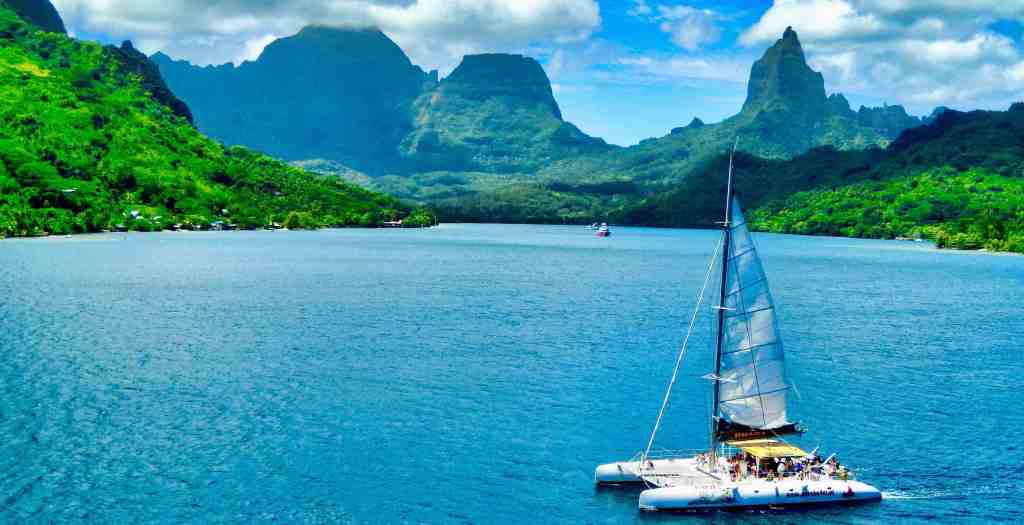
While Moorea is beautiful it’s Bora Bora that steals the show for scenery. It includes breathtaking towering peaks, natural lagoons and spectacular coral reefs circling the island. If you’d like to spend time in these islands this is the island to come back to.

Bora Bora

Avignon, France

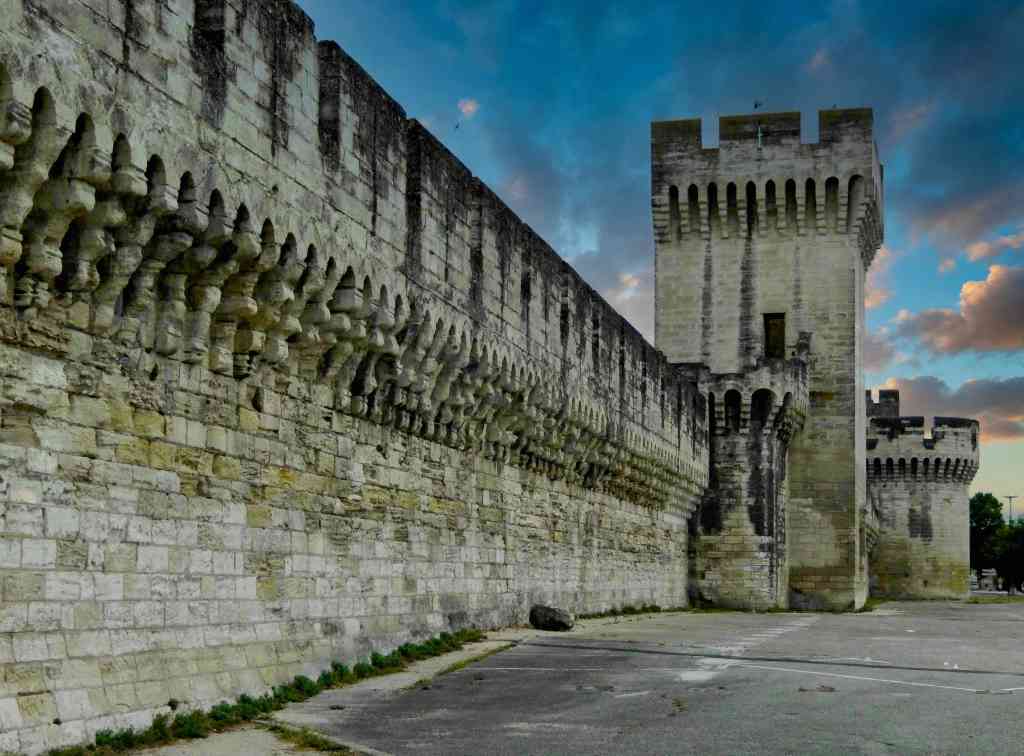
The defensive walls of old Avignon

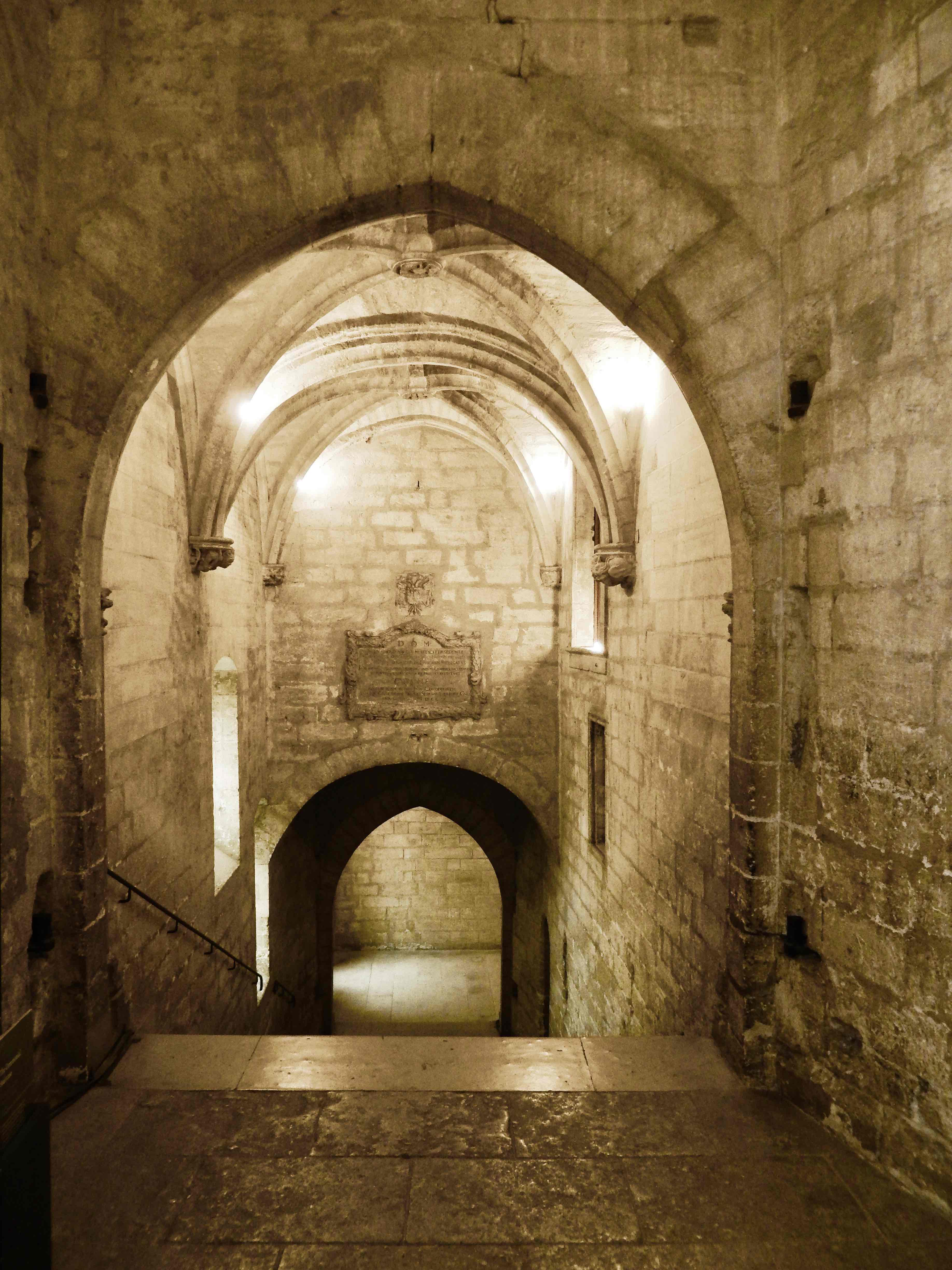
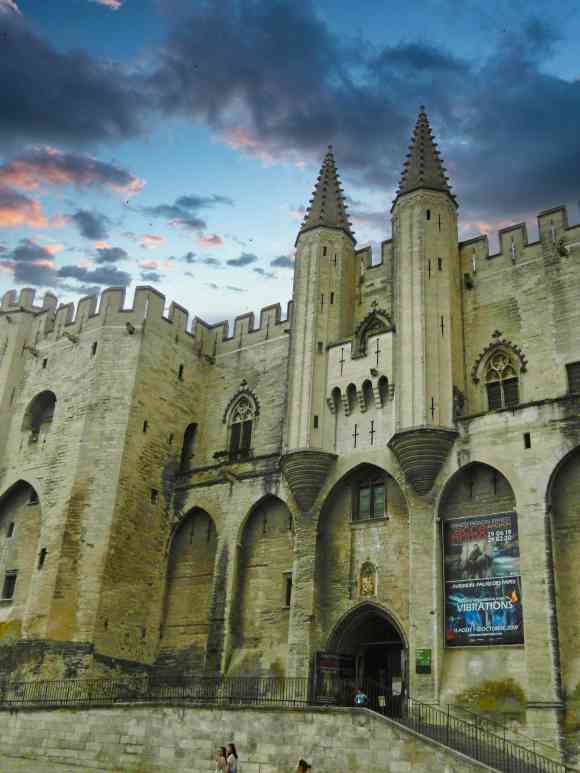
Avignon, a city with a remarkable history. Very few people, outside of Southern France or the historians at the Vatican know much about the French Papacy. You see the Papacy hasn’t always been in Rome but actually resided in Avignon for a time. The Avignon Papacy lasted from 1309 to 1376 during which seven successive popes resided in Avignon ( Kingdom of Arles at the time). The situation happened because of a conflict between the papacy and the French king, culminating in the death of Pope Boniface VIII after his arrest and imprisonment by Philip IV of France. Following the death of Pope Benedict XI, King Philip forced a deadlocked conclave to elect the French Cardinal Clement V as pope in 1305. Clement in 1309 moved his court to the papal enclave at Avignon, where it remained for the next 67 years. This period has been called the “Babylonian captivity of the Papacy”.

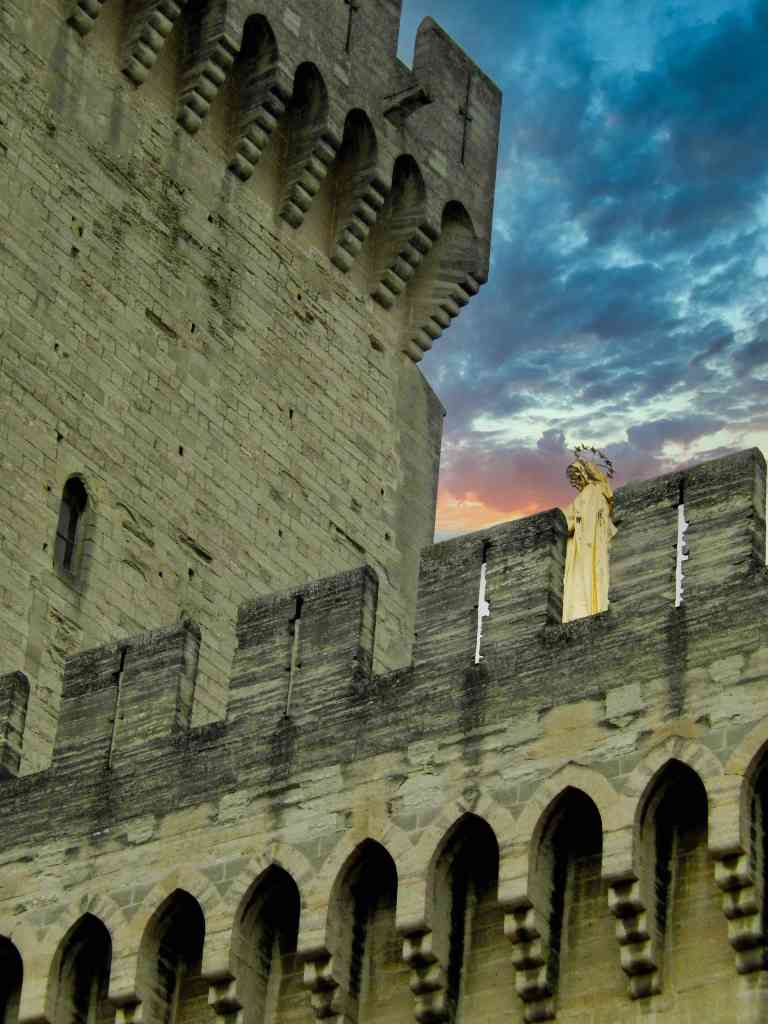
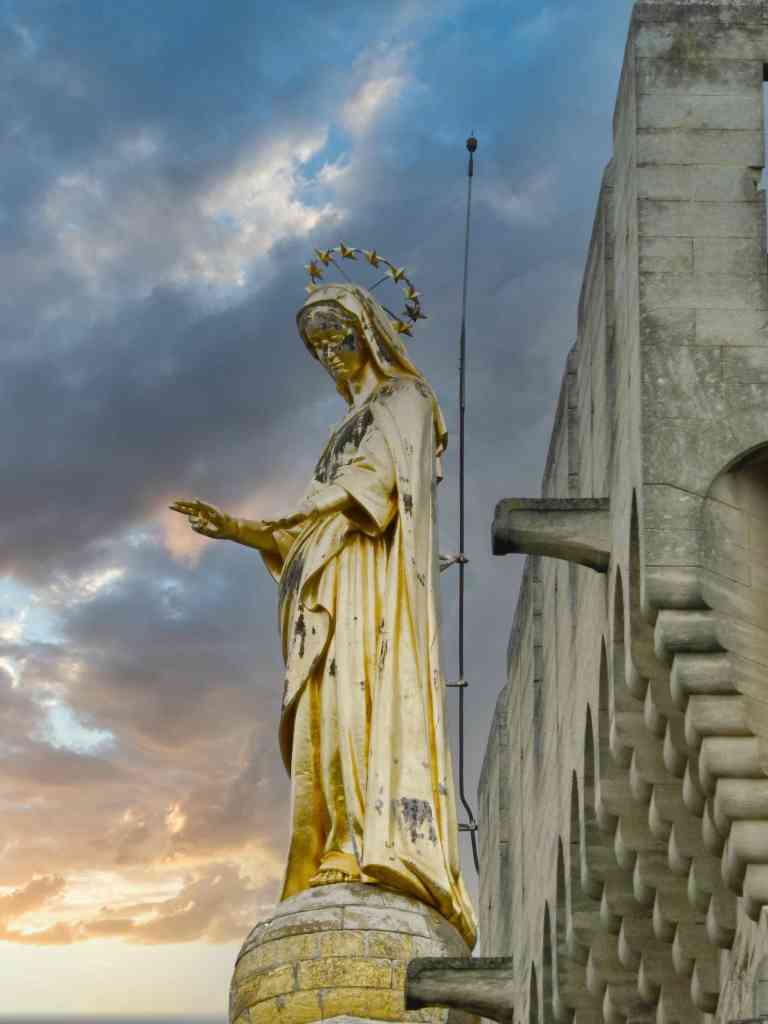
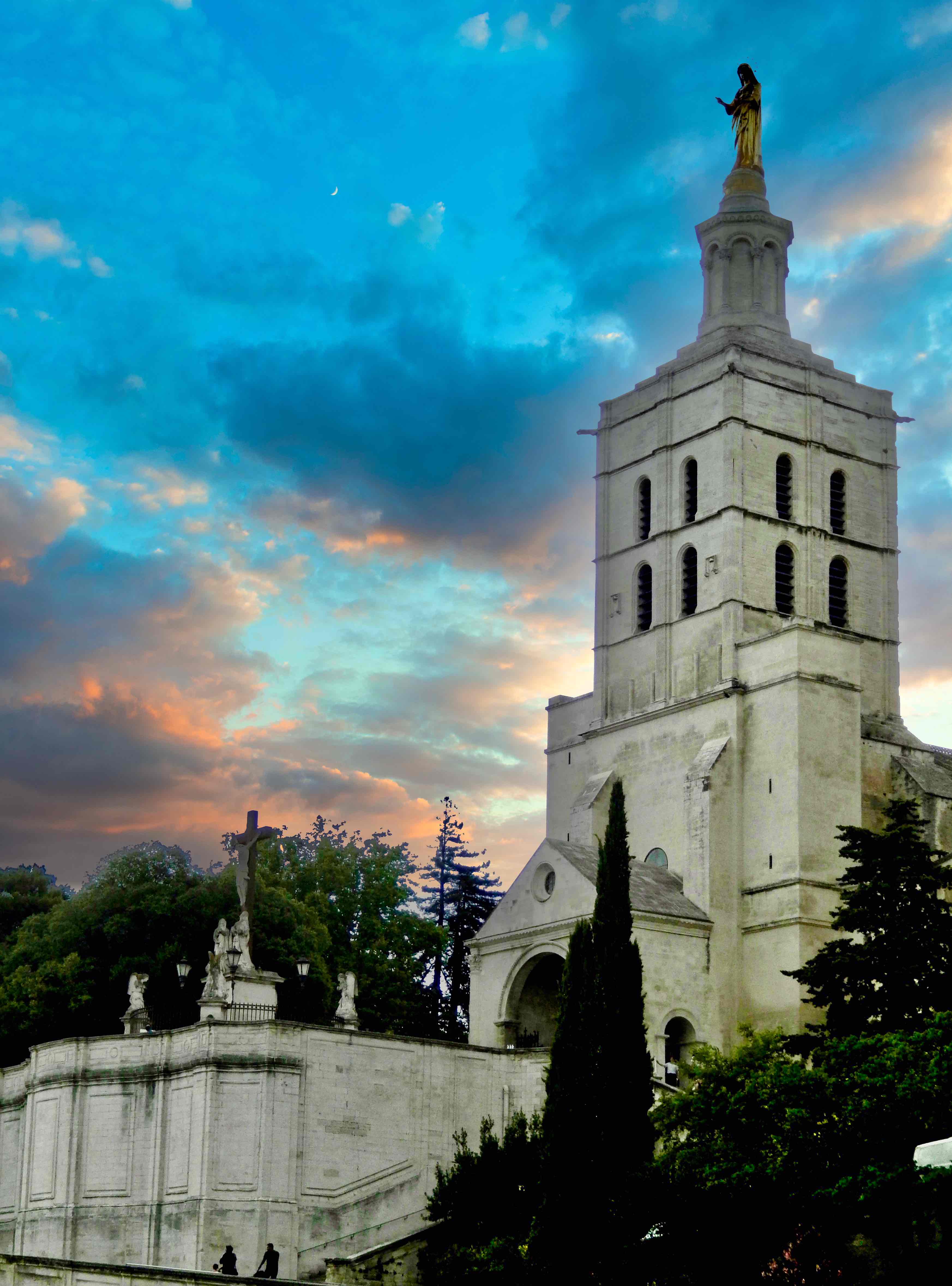
Scenes from around the Papal Palace

A total of seven popes reigned at Avignon, all French, and all under the protection of the French Crown. Avignon was a walled city and the Popes erected and expanded a Papal Palace and cathedral inside the fortified city. In 1376, Gregory XI abandoned Avignon and moved his court back to Rome. After Gregory’s death in 1378, deteriorating relations between his successor Urban VI and a faction of cardinals gave rise to the Western Schism. This produced a second line of Avignon popes, that were largely regarded as illegitimate. The last Avignon antipope, Benedict XIII, lost most of his support in 1398, including that of France.The schism ended in 1417 at the Council of Constance ending the Avignon Papacy.

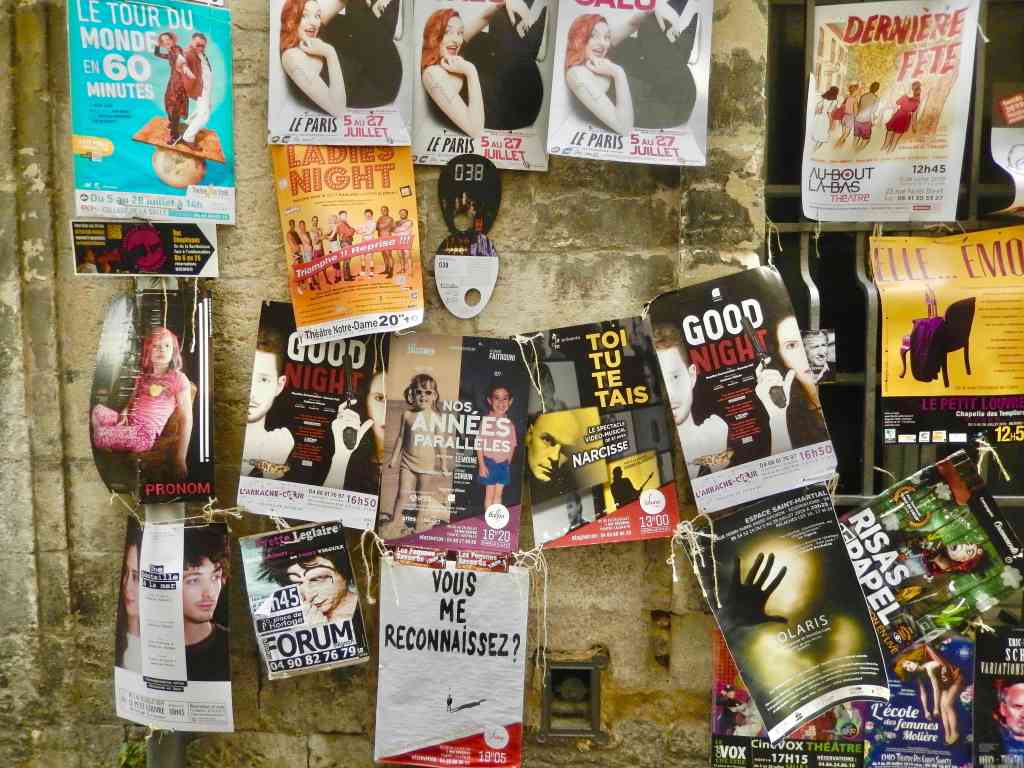
Today Avignon is a popular destination owing much to the Avignon Papacy and what it created.

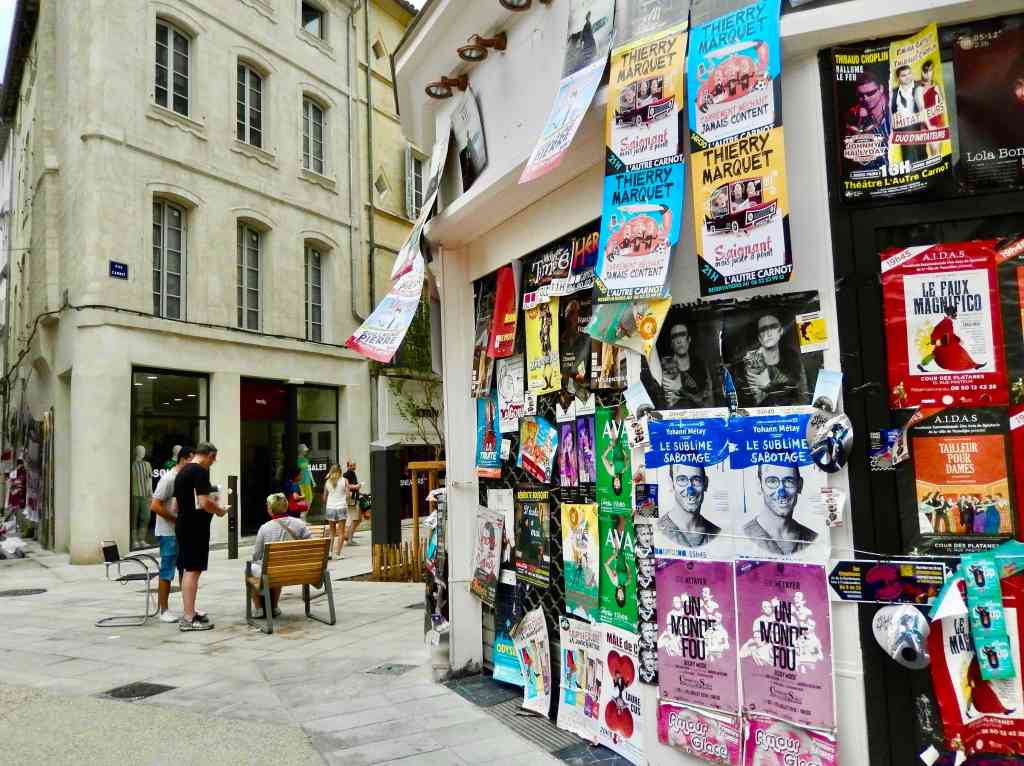
On the streets of Avignon…

Mississippi Highways In The Spring

A Short Story

Mississippi Odyssey

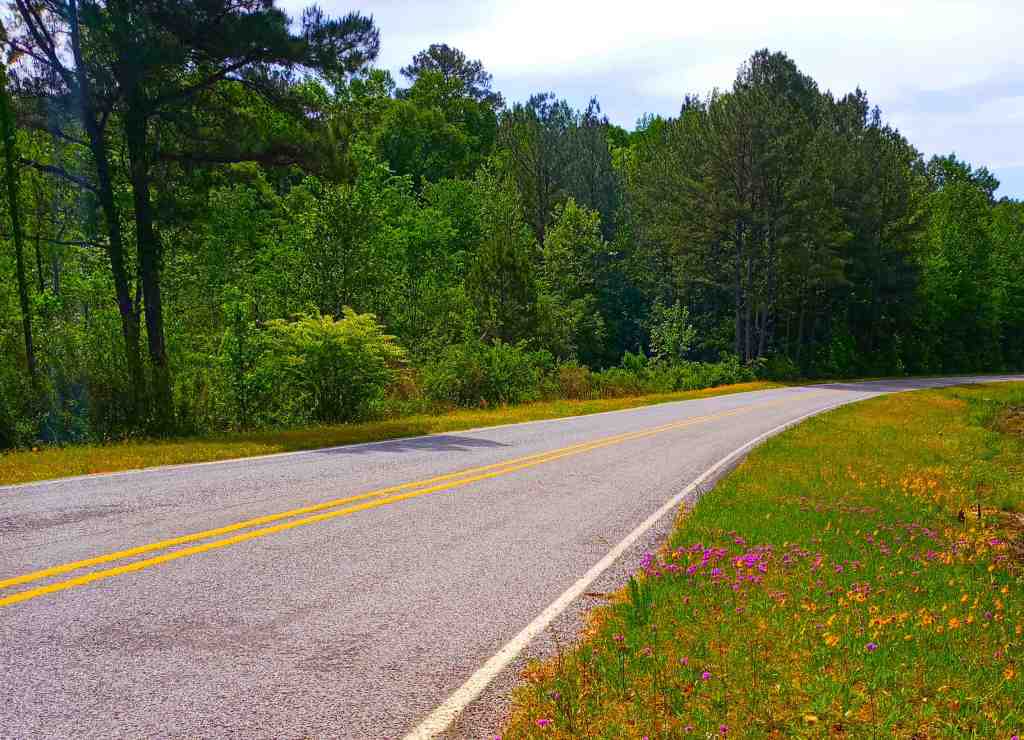
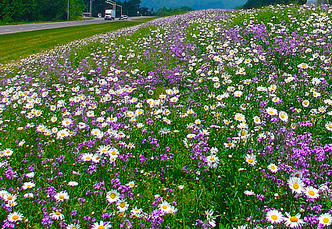
Driving across Mississippi this week I realized that one of the most amazing attractions of the trip was the sides of the highways. In places, the roadsides were literally carpeted in swaths of bright orange-yellow flowers mixed in with deep purple along with patches of bright reds, whites and pale blues. These wild flower displays went on mile after mile.

Doing some research it seems that seeding roadsides with wild flower seeds by highway departments is common and Mississippi is a particular stand out. Because the roads are regularly mowed it actually provides a better environment than even open wild fields for flowers to grow.

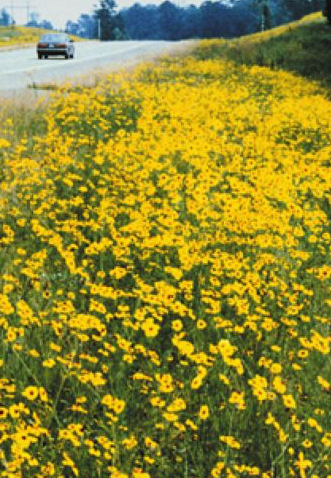
Some of the popular flowers in Mississippi include Lance-leaf Coreopsis known for its beauty and commonly planted along roadsides in Mississippi it boasts bright butter yellow flowers. Black-Eyed Susans are another of Mississippi’s familiar yellow flowers and a favorite of butterflies. Cardinal Flower or Scarlet Lobelia is the showiest of the North American Lobelia species with its bright red blossoms. A bright blue flower known as Bachelor’s Button, Bluebottle, Cornflower, or Garden Cornflower is another species common along Mississippi highways.

In Spring and Summer it is possible to see almost a hundred different wild flower species along the highways of America’s Southeast.

Visiting Dublin’s Gardens

It’s known as “The Emerald Isle” and it’s hard to deny that Ireland with its rolling hills and gardens isn’t living up to the name. This island has been called “The Emerald Isle” for well over two hundred years and the first time the words Emerald Isle appeared in print was in a poem by Belfast doctor William Drennan, titled “When Erin First Rose” published in the mid 18th century.

Spring in “The Emerald Isle” is simply magical and the gardens of Dublin are not to be missed on any visit to Ireland especially in the Spring.

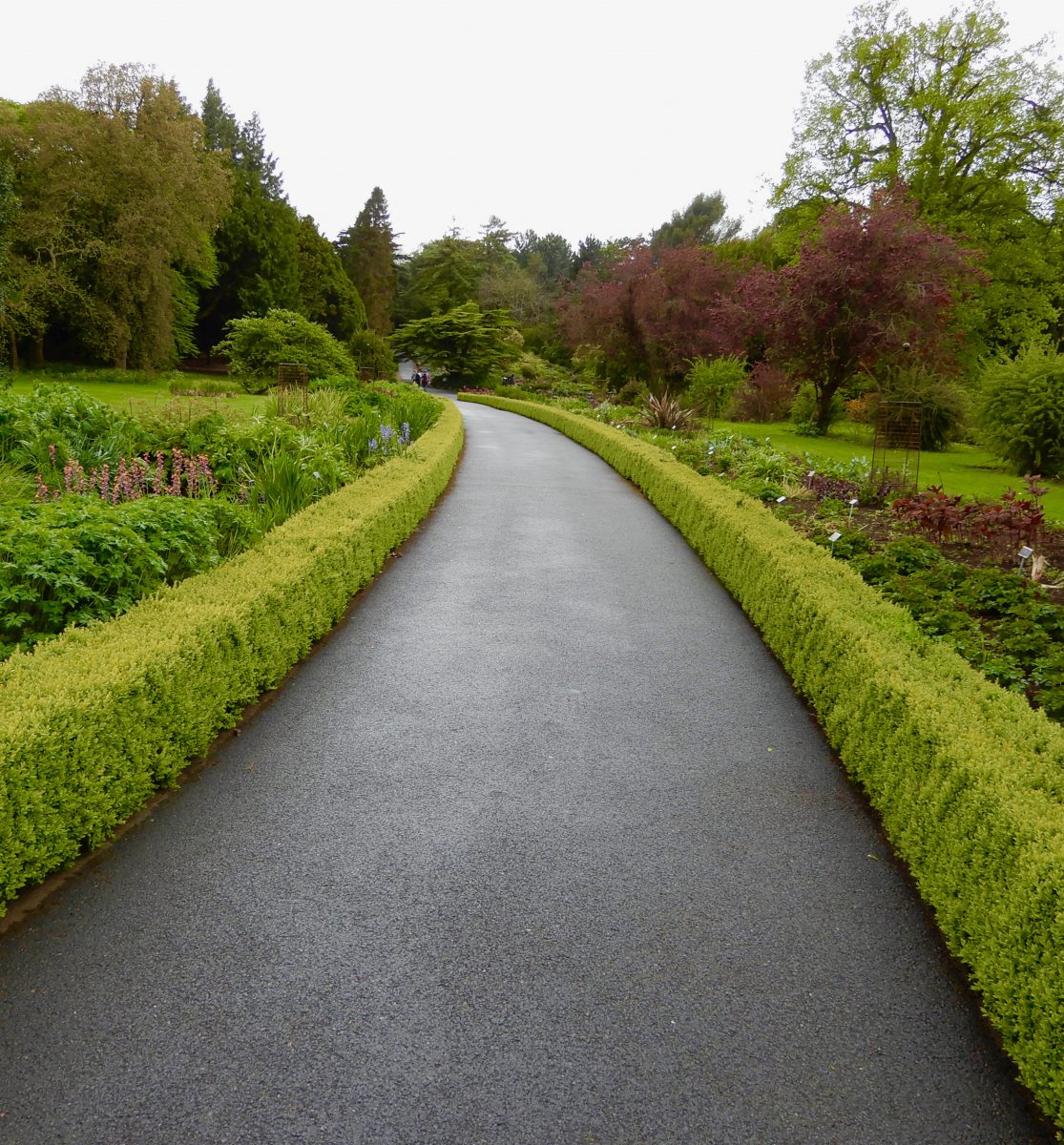
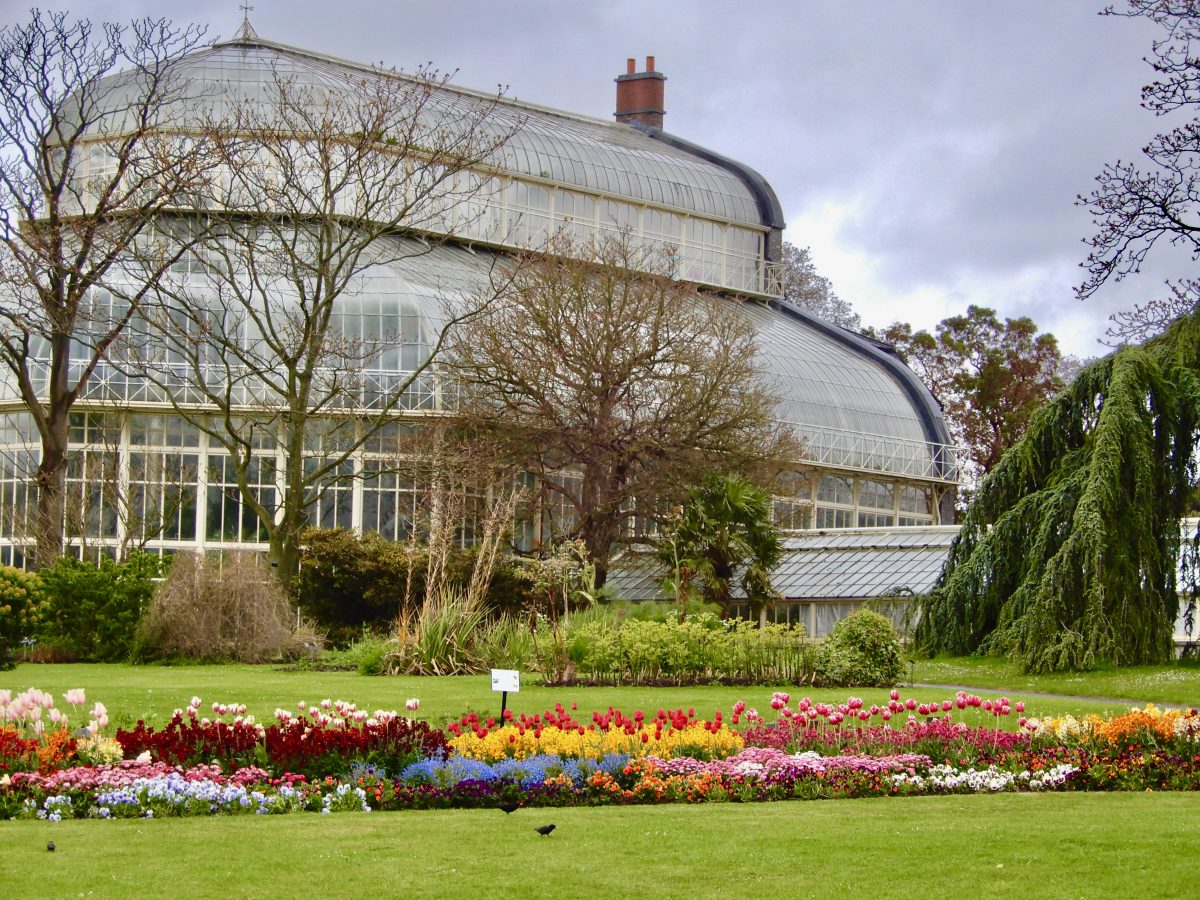
The National Botanic Gardens – This is a really beautiful garden with a number of greenhouses matching several environments. There were greenhouses dedicated to orchids, another to tropical plants and another to desert flora. The outside gardens cover a number of acres and feature several different styles. Admission is free, there is a restaurant and gift shop as well as a number of special programs including lectures and concerts. If you have time while in Dublin do yourself a favor and get out to see this garden.

National Botanic Gardens
Glasnevin Cemetery

Backed up to the Botanic Gardens is Glasnevin Cemetery and Glasnevin Cemetery Museum. The museum’s web site describes it as “the guardian and storyteller for over 1.5 million people. From the ordinary to the truly extraordinary, these people helped shape the Ireland of today. They want to share their stories and times with you through tours of the cemetery, a visit to the museum or through a genealogy search for your family history”. While in the neighborhood stop in at the well known Gravediggers Pub for a pint.

St. Stephen’s Green
St. Stephen’s Green
St. Stephen’s Green

St. Stephen’s Green is located in the heart of Dublin and is a focal point in the city, that provides an oasis of green in the middle of this busy metropolis. The Dublin Public Works web site describes this garden as “four centuries of history that are eventful and complex, involving such important figures as Arthur Guinness, 1st Baron Ardilaun, and Countess Constance Markievicz. The park itself hosts a large number of important sculptural monuments to Irish history. Many species of birds and plants also call the park home. Public facilities at St Stephen’s Green Park include a playground and a garden for the visually impaired”.

Blessington Street Park

Half way from the River Liffey to the National Botanic Gardens is the Blessington Street Park or “The Basin”. Located near the intersection of Royal Canal Bank and Primrose Avenue this is a beautiful and well kept pocket park surrounding a lake. After walking thru this park imagine how lucky the neighbors are to live next to this gem.

Blessington Street Park