
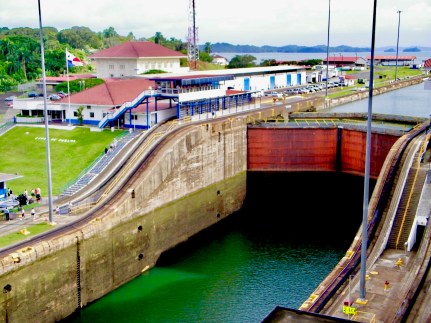
One very popular cruise itinerary is transiting the Panama Canal. Cruises generally cover three categories. West to east normally starting in a California port and ending in Florida. The reverse, east to west and Caribbean cruises that go part way through the canal and return to the Caribbean.
The best way to experience the canal is on a cruise ship. Generally these cruises start from major cruise ports of Miami, Ft. Lauderdale, San Diego, Los Angeles and San Francisco. They usually include a number of itinerary stops that can include Grand Cayman, Cartagena, Columbia, Colon in Panama, ports in Guatemala, Costa Rica, Honduras and Mexico but the star of the trip is the Canal.
In 1880 the French tackled what was to be one of the biggest engineering projects ever. The intent was to dig a canal from the Caribbean across Panama to the Pacific Ocean. They were defeated by some mountains but mostly by a mosquito and the single celled organism that causes malaria.
In 1903 President Theodore Roosevelt of the United States took on the responsibility of getting done a long-term United States goal, completing the trans-isthmian canal. In order to get the U.S. authority a number of treaties were attempted and finally the U.S. backed a revolutionary movement that gained Panama independence from Columbia and granted the U.S. ownership of the property.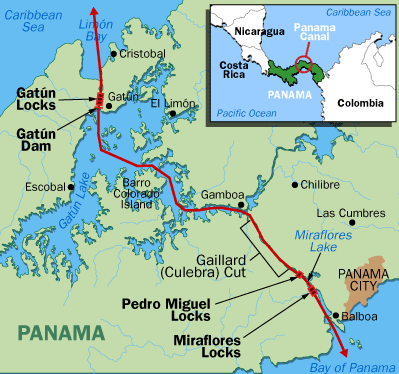
The new canal projects success was partly the result of healthcare advances made during the construction, led by William Gorgas, an expert in
controlling tropical diseases including yellow fever and malaria. Gorgas was one of the first to recognize the role of mosquitoes in the spread of these diseases, and by focusing on controlling the mosquitoes greatly improved worker safety and health.
The American engineers abandoned the French plan of a sea level cut and went to a design using locks to lift ships up to the level of Gatún Lake and back down again. One of the biggest projects was the Culebra Cut through the roughest terrain on the route and remains one of the largest earth –moving projects ever tackled.
Later in the construction it was decided there would not be enough water reserves to operate the locks. Several dams were built with one being a dam at Pedro Miguel which encloses the south end of the Culebra Cut (actually an arm of Gatún Lake). The Gatun Dam is the main dam blocking the original course of the Chagres River, and resulted in creating Gatún Lake. Additionally two dams were built at Miraflores that enlarged Miraflores Lake.


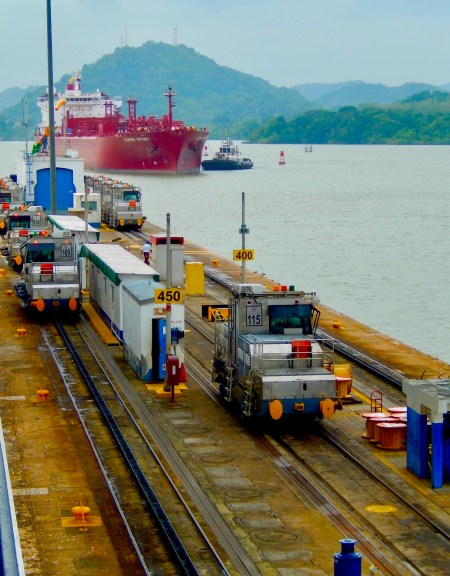
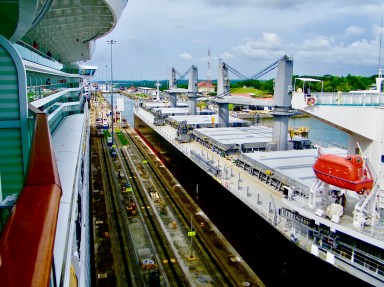
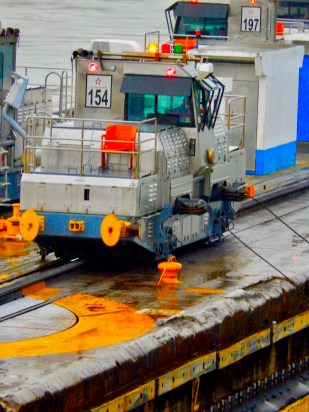
We have taken a couple of cruises that transit the canal and are always enthralled by the trip thru the locks and lakes of this remarkable place. Ships are pushed and pulled by tugs and canal rail engines called “mules” into locks with only inches of clearance. Water roars out of exhaust ports and massive ships rise and drop effortlessly within the locks.
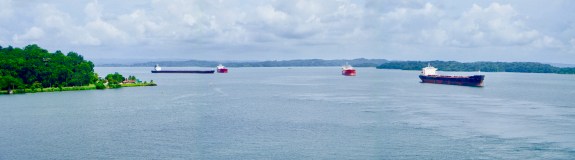
Cruising across Lake Gatún is like a journey thru a primitive and beautiful rain forest with numerous islets. Dozens of ships glide along near us as they line up to re-enter the locks. Transiting the Culebra Cut with its walls towering above leaves us overwhelmed by the shear tonnage of dirt that had to be excavated and hauled away.
Many cruises stop at Cristobal Pier near Colon where locals offer crafts and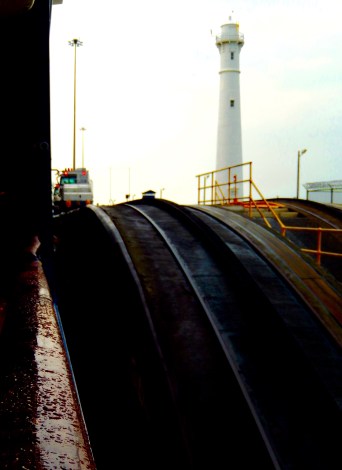 wares for sale with usually Kuna Indians from the San Blas Islands among the merchants. Many of the cruise ships require a quick paint touch-up at the exit dock to cover up numerous rubs and scrapes from the passage through the locks
Up until recently the canal could only accommodate ships designated Panamax. Those original locks are 1,050 ft (320.04 m) in length, 110 ft (33.53 m) in width, and 41.2 ft (12.56 m) in depth. These limits have influenced the ship building industry to build Panamax vessels for the past hundred plus years
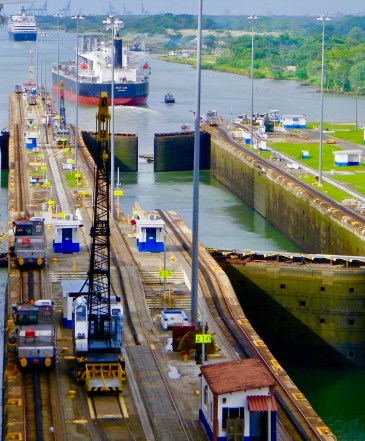 On September 7, 1977, President Jimmy Carter signed the Panama Canal Treaty and Neutrality Treaty promising to give control of the canal to the Panamanians in the year 2000. After Panama took control the Panama Canal Company started an expansion project. The expansion project started construction in 2007 and opened for commercial operation on 26 June 2016. The new locks allow transit of larger Post-Panamax and New Panamax ships, which have a greater cargo capacity than the original locks could accommodate. New Panamax ships will have a dimension of 1,200 ft (366 m) in length, 160.7 ft (49 m) in width and 49.9 ft (15.2 m) in depth. Unfortunately many of the cruise industries new mega-ships still cannot cruise the canal mainly because they are too tall to cruise under the bridge at the Pacific end of the canal.
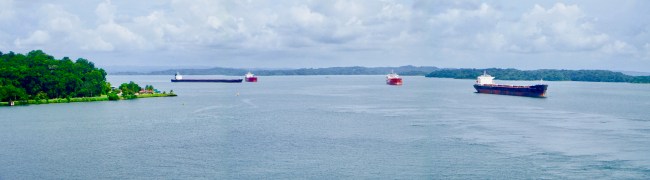 All-in-all this is a fascinating journey and one of the three or four best itineraries we’ve taken. The ports-of-call are an opportunity to visit a number of Central American countries and see some of this interesting region.
 hotel near Sydney’s Chinatown (the

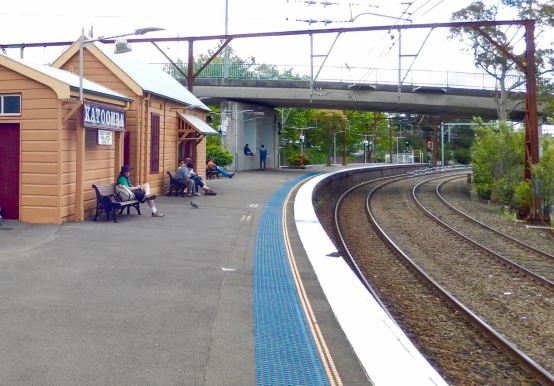
 The town of Katoomba is the center of the Blue Mountains with a number of attractions nearby. Once in the Blue Mountains we booked the
 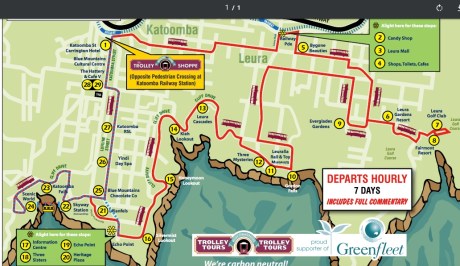 There are 29 stops which include Katoomba Falls, Echo Point, Three Sisters and Leura Cascades. There is a cable car ride (extra charge) and a complex at Scenic World with a café and a restaurant. There is also the


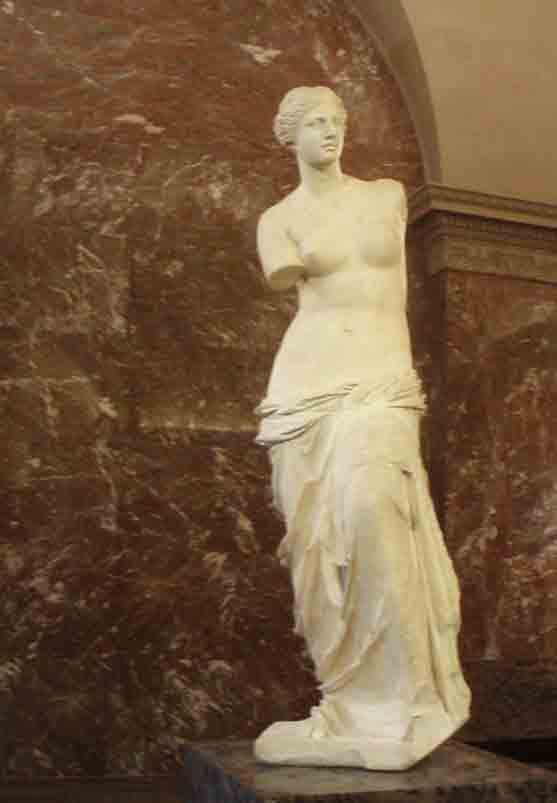
 Victory of Samothrace) and the Venus di Milo (an ancient Greek statue and one of the most famous works of ancient Greek sculpture). They were each in different galleries in the Louvre and Buchwald’s column claimed that nobody had yet entered the Louvre, looked at each piece and exited the museum in under four minutes, but the new record was near. It was a funny image offered up to American tourists visiting Paris but it had unintended consequences.


 middle of a Florida town. Not something you expect outside of Disney World. But on a recent drive through central Florida that is what we found in Ocala.
 park that includes an interesting museum. For the state of Florida this is almost ancient history. Early settlers, Seminole Wars, Andrew Jackson.
 Every state in America is noted for its tribes of American Indians that include Comanches, Blackfoot, Algonquin, Shaenee, Shoshone, Sioux and almost a hundred additional tribes. In Florida we recognize the Seminoles as our major Indian tribe, but who are they historically?
 Soon these new settlers were coming in conflict with the Seminoles and the government decided the situation needed a solution. In 1823 the Treaty of Moultrie Creek was signed between the United States and leaders of the Seminole Nation. That treaty had the Seminoles relocate to a large tract of land in what is now Central Florida. The treaty also prohibited white persons from entering or settling on those Seminole lands. The Ocala area was central to the Indian towns and the army built Fort King to assure that both sides kept the treaty.
 In a reversal of policy Congress passed The Indian Removal Act in 1830 at the urging of President Andrew Jackson who had fought the Seminoles in Florida and defeated the Creek Indians in 1814. This resulted in the forced negotiation of the controversial Treaty of Payne’s Landing requiring that the Seminoles be removed to new lands in what is now Oklahoma.

 Fort King was abandoned in May of 1836 in favor of Fort Drane built nearer the swamps where the Seminoles were hold up. Fort King was reoccupied in April of 1837. It served as a base for raids and in 1840 Captain Gabriel Rains of the 7th U.S. Infantry led 16 soldiers on a recon but were attacked by a Seminole war party. They managed to fight their way back to Fort King, with three men killed.










 The Intentional Travelers