Most people think pasta when it comes to Italian cooking but actually Italy has a number of regional cuisines. Tuscan and Florentine diets trend heavily toward cold sliced meats, grilled meats, lots of beans, soups and stews. With the exception of lasagna, pasta is usually done as a side dish or a casserole in Florence. Because Florence has become such an international city and a huge tourist destination many of the restaurants have put together menus that fit the visitors expectations. One small restaurant in the central city that doesn’t fit that description is Trattoria Mario.
If you are looking for a great value in good authentic food in Florence, Italy check out this gem. A local trattoria with an international clientele, owing its popularity somewhat to a bit of encouragement from Trip Advisor reviewers. It is located at Via Rosina, 2r, 50123 just a short walk from the Basilica di San Lorenzo.
The restaurant is cozy and if crowded you will probably be sharing a table if you are a small party, but that is part of the experience. While there we overheard several tables talking in several languages. The restaurant has the feel of a neighborhood place with a staff that is friendly and efficient. The dishes are prepared with skill and are mostly priced between €5 and €8. The menu is hand written and taped on the kitchen window and as the chef runs out of an item he comes out and strikes thru it. Inexpensive splits of local wines are also available.
Looking For Something Special? Search this site to find travel inspiration, tips and more.
Most people, when they talk about Singapore, speak in superlatives but, the simple truth is, mere words just aren’t enough. We flew to Singapore on United 1 from San Francisco, a seventeen plus hour flight
The hotel is halfway between the airport and the Marina Bay District and offered a free airport shuttle. The facility is
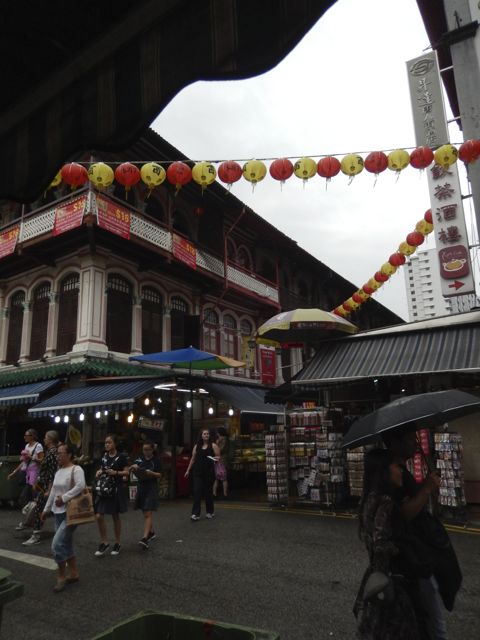
Chinatown
modern, the rooms are comfortable and the staff is friendly and helpful. A great buffet breakfast is offered and, depending on the category of stay, may be included in the rate. The location is near shopping malls (Parkway Parade Shopping Center is across the street) and restaurants and just a few blocks from East Coast Park.
After walking to the park, you are amazed by the view out to sea. It looks as if half the ships in the world are either anchored just off shore or are cruising by. Looking at a map you will notice that the South China Sea is blocked to the east by the Southeast Asia peninsula. The first opportunity that eastbound shipping has sailing from China, Hong Kong, Taiwan, Vietnam and all the other nations of the area is past Singapore and thru the Straights of Malacca (also sp. Melaka). That’s a lot of cargo bound for Europe, Africa, the Middle East and India all moving right past Singapore. That may also help explain why this city-state has become so rich and important.
The stories about the strict laws and their enforcement are mostly true. It seems that even chewing gum in Singapore is against the law because the government thinks it messes up the streets. When you arrive in country, your immigration form explains that selling drugs is punishable by death. While civil libertarians may be shocked, the obvious result is one of the most modern, safe and clean cities we have ever visited.
English is an official language taught in all schools along with Malay, Mandarin and Tamil but almost all signage is in English making it easy to get around and find things. The city boasts a world class rapid transit system, the MRT that is easy to access, purchase tickets for and understand. The system offers an all-day ticket but we found it cheaper to purchase roundtrip fares to specific destinations. The cleanliness is also striking. No graffiti anywhere and you could probably eat off the floors.
Singapore boasts dozens of world famous restaurants and clubs, a Universal Studios theme park, one of the world’s great zoos, a water park, aquarium and two botanical gardens, the newest and most spectacular being Gardens by the Bay. Almost everything can be reached via the MRT or an inexpensive taxi ride. The city also boasts a Chinatown and a Little India which offer inexpensive shopping and eating options.
Singapore is home to a number of Hindu Temples because of the Indian labor brought in by the British when they established a trading post in the early nineteenth century. The oldest, Sri Mariamman Temple dates back to 1827. The Sri Senpaga Vinayagar Temple is located on Ceylon Road, a few blocks from the Grand Mercure Roxy. It was built by the Sri Lankan Tamils for the Hindu God Ganesha.
While not a destination for bargain hunters because of the high cost of living, the city is home to a number of malls and department stores along with high-end specialty shops. Singapore shows off with a modern skyline and one of the newer additions is the triple towers of the Marina Bay Sands. This complex features a hotel, a casino and 170 plus premium brand stores capped by a connecting roof garden floating at the top. It is home to a number of restaurants operated by the likes of Wolfgang Puck, David Myers and Gordon Ramsay.
The popular symbol of Singapore is the Merlion, a lion with the body of a fish. While there are supposedly a number of local legends about the history of the Merlion the truth is it was created for the tourist board in the sixties as a marketing tool. The official symbol of Singapore is a red graphic of a lion’s head.
We spent a couple of years trying to plan a trip to Yellowstone. One of our primary goals was to spend some time at The Old Faithful Lodge. It turned out that getting reservations there is a very difficult thing to do. It is almost impossible to book directly with the lodge, because as soon as the booking season becomes available, it is virtually sold out. The Park Service suggested we book through a broker where you pay a non-refundable fee. We then found out that some travel friends of ours had booked a trip through Yellowstone with Caravan Tours the year before and really enjoyed it. After speaking with them, we decided to give this a try, our first land tour.
Crazy Horse Memorial
The tour we booked started in Rapid City, South Dakota, and visited Mt. Rushmore National Monument, Crazy Horse Memorial, Devils Tower National Monument, Little Big Horn Battlefield National Monument, Yellowstone National Park, the
Mount Rushmore
Grand Tetons and Jackson Hole and ended in Salt Lake City, Utah. After leaving the tour in Salt Lake we rented a car and spent a week on our own visiting Moab, the National Parks of Arches, Canyonlands, Capital Reef, Bryce Canyon and Zion. That gave us a good perspective to compare the two experiences.
Devil’s Tower
First, an overview of the tour. Caravan provided accommodations each night, a modern and comfortable motor coach that accommodated 48, a driver and tour guide, admission to all parks and attractions, breakfast each morning and occasionally other meals. Suitcases were tagged and placed inside our hotel room each evening and picked up outside our room in the morning.
The tour started with a meet and greet with our guide Greg on Wednesday at the hotel in Rapid City. The next day we boarded the bus and headed for Crazy Horse Memorial and after that stopped at Mt. Rushmore. Neither of these sites were on our bucket list but,
Little Big Horn Memorial
afterwards, we are glad we visited. Back in Rapid City that evening the town was hosting the first street concert of the season (Thursday evenings) which was a nice surprise.
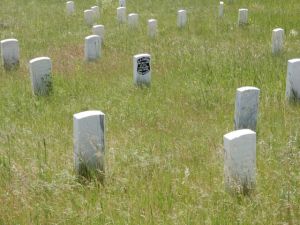
The next morning we headed west with stops at the Devils Tower and the Little Big Horn Battlefield. The Devils Tower is a natural wonder and truly an impressive formation (think Close Encounters of the Third Kind). The Little Big Horn site offered a historical perspective on the 1876 battle. The Custer National Cemetery was on the same property. Next stop was lunch at the historic Sheridan Inn and a talk on Buffalo Bill. We spent the night in Billings, Montana.
Yellowstone Canyon & Falls
Between stops, one of the interesting aspects of the tour was our guide playing historical or informative DVDs relating to the places we were visiting. Greg also shared his knowledge and thoughts in a running commentary throughout the trip.
Day four of our journey was dedicated to the main
Mammoth Warm Springs
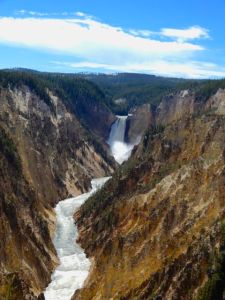
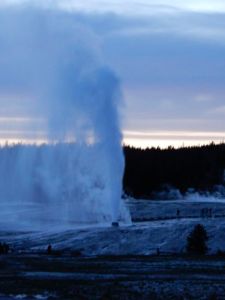
event, Yellowstone National Park. If you have not visited Yellowstone, no matter what you have heard cannot do it justice. Our first stop was Mammoth Hot Springs where we encountered some elk and walked trails around the hot springs where mineral deposits form terraces down a hillside. After a few brief stops, including iconic Yellowstone Gorge, called the Grand Canyon of Yellowstone with Yellowstone Falls we arrived at the Old Faithful Lodge for a two night stay. Shortly after checking in we got to watch our first Old Faithful eruption.
If you intend to visit Yellowstone, the first thing you need to recognize is that the park is larger than the state of Delaware with just nine hotels and a few campgrounds inside the park and reservations difficult to come by. Most Park visitors stay at motels in Jackson Hole or West Yellowstone so a lot of time is used up getting in and around the park. As summer advances so do the lines of cars so getting up early becomes a necessity. Also, if you get into the park late, the parking lots for a number of featured areas can be gridlocked.
Old Faithful Lodge
The Old Faithful Lodge is a historic site sitting in the middle of the largest concentration of geothermal features in the world. We were told that half of the world’s active geothermal features are located within one mile of the Lodge. The Lodge is an impressive building with a grand lobby standing five stories high. The guest rooms, however, are primitive by modern standards: no air-conditioning, television or wifi, with spotty cell service and a real 1950s look. Ours had one double bed with a small bathroom featuring a pedestal sink (not much room for toiletries). The real draw is simply the location.
The afternoon we arrived, just outside our window, was a bull bison and, looking down the hill past the general store, there was a steaming field of vents with various geysers going off frequently. Every evening in the main lobby there was live music and, weather permitting, a fire in the massive fireplace. Food is available in the main dining room (menu & buffet), the lobby bar which served light fare like bison burgers and chili, and a deli. Near the main lodge there is a country store with counter service until 5 o’clock and a large cafeteria a short walk away. Between the lodge’s front door and the cafeteria is the Old Faithful geyser, currently putting on a show about every ninety minutes.
Jackson Hole
After checking out of The Old Faithful lodge we stopped at Lake Yellowstone on our way to the Tetons National Park followed by a night in Jackson Hole Wyoming. The next day we headed off to Salt Lake City with a stop at the Oregon Trail Center.
The Tetons
We both felt as if we had gotten our moneys worth with this tour. We saw sights we may have never visited by ourselves, met some great people, traveled in comfort and spent time at all of our wished for destinations. We would highly recommend Caravan Tours and their Yellowstone trip.
Looking For Something Special? Search this site to find travel inspiration, tips and more.
After spending a week on an organized land tour in early June (Yellowstone, Grand Tetons, etc.), we picked up a rental car in Salt Lake City. With accommodations booked in Moab, Panguitch, Springdale and Los Vegas, Nevada we headed out taking US15 south from Salt Lake City and then picked up Route 6 toward Moab.
Nine Mile Canyon
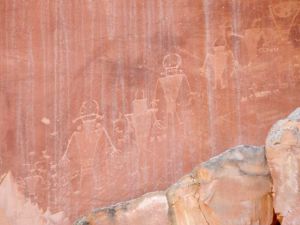
Petroglyphs, 9 Mile Canyon
On our way we took a side trip to Nine Mile Canyon (additional information). We had been told about the canyon and had also read an article about the locations of petroglyph sites in the area. The canyon is actually forty-eight miles long with the first petroglyph site about twenty-seven miles in. Unfortunately we seemed to have misplaced the article, which listed the location of each site and, once into this isolated area, we realized what a mistake that was. The two-lane road had virtually no traffic (except some free roaming cattle) and there was very little in the way of signage. We passed the first marker twice without seeing it – a green sign on a post about six inches tall and ten inches long that simply said “First Site” and an arrow. If you have the time, a visit to a few of these thousand year old sites is really interesting.
Getting into Moab late in the afternoon we checked into the motel and got something to eat with a plan to start in Arches National Park early the next morning.
Arches National Park
Arches National Park
We visited Arches National Park early in the morning and realized that no photograph or description can begin to express the massive size of its’ formations or the scale of the arches and balancing rock structures. This place just has to be experienced in person. The sandstone formations are massive and the colors are fantastic. If you are a hiker, there is a large number of very walkable trails in the park, temperature permitting, along with a number of scenic drives. On the subject of weather it is very important that you carry water in your car and with you if hiking. The high temperatures and dry conditions can be punishing.
Canyonlands National Park
Canyonlands
Only about twenty-five miles from Arches is the northern entrance to Canyonlands National Park and it is a wholly different experience as you enter on high bluffs and look down into the canyons. The landscape is similar to the Grand Canyon in character and color as you stand on the rim. In the western area of the park are the best hiking trails where an extinct volcano caldera formed an interesting bowl-like valley. Between Canyonlands and Arches is a state park named Dead Horse Canyon which is worth a visit as well. There is also an entrance to Canyonlands about sixty miles south of Moab that features the Needles District with a strikingly different look, featuring backbone formations of rows of sandstone spires.
Scenic Route 128
Just south of Arches National Park is scenic Route 128 North that runs up another canyon beside the Colorado River. As you drive the road along the river, you are surrounded by 500 to 1,000 foot sandstone cliffs with many completely vertical. On the river you see numerous rafting groups and as you drive deeper into the canyon the land opens up to dozens of spires and buttes.
In the canyon is a small town named Castle Valley and near the river is the Red Cliffs Lodge and the Castle Creek Winery. The winery offers tastings and features some good wines that are popular in the region’s restaurants. On the map you may notice a ghost town named Cisco and might be tempted to go take a look. Do not bother – the town is a junkyard of abandoned trailer homes and RV’s laced with obscene graffiti. Our suggestion is when you reach Dewey Bridge, turn around and drive back unless you are going on to US 70. While we didn’t visit, we were told that there is an interesting movie museum near the Castle Creek Winery and there are numerous raft operators on this stretch of the Colorado River.
Capital Reef National Park
Leaving Moab the next morning we headed north on 191 to US70 west. We exited 70 onto Route 24 south and headed to Capital Reef National Park. Capital Reef is home to another collection of petroglyphs and these are well marked with easy access from the road. This is also the location of Fruita which was established by Mormons as an agricultural area in 1880. A few structures from the original settlement still remain as do the orchards.
Petroglyphs, Capital Reef
Route 24 travels right thru Capital Reef with one scenic side road inside the park featuring a number of good hiking trails. After exiting Capital Reef on 24 west we picked up Route 12 heading south towards Bryce Canyon National Park.
Utah Route 12 is a scenic and interesting trip from Capital Reef to Bryce Canyon. It crosses some spectacular country with ridges, canyons and mountains at every turn. One stretch navigated a ridge with only two narrow lanes and steep drops on both sides. Along the way we stopped at the Anasazi State Park where we viewed a interesting museum and Indian village excavations.
Bryce Canyon National Park
Natural Bridge, Bryce Canyon
Bryce Canyon is a must visit. The park sits atop high country, looking down into the canyons which are packed with geological features called hoodoos. (Interconnected spires of colorful sandstone creating mazes and rising from the canyon floor.) While hoodoos are scattered throughout the parks in Utah, nowhere in the world are they as abundant as in the northern section of Bryce Canyon. Many of the hiking trails go down the canyon face and are steep and descend an average of 700 feet but there are a few walkways for those seeking less of a challenge.
There is a hotel with a restaurant inside the park but there are also a number of accommodations just a short drive away starting at Bryce Canyon City. The Park Service, in an effort to reduce traffic, operates free busses with pick-up stops in the “City”. The drive through the park is about nineteen miles to the end at Rainbow Point with an altitude of over nine-thousand feet. At the point, the morning we were there, the temperature dropped over twenty degrees from the Visitors Center and winds were howling.
Bryce Canyon
Red Canyon is between Bryce Canyon and Panguitch where our motel was located. The canyon road goes thru two short tunnels cut thru the sandstone and there are a couple of parking areas for the hiking trails. Our motel had a colony of prairie dogs right outside our door and they liked to come out and socialize around dusk. The second night we were visited by a pronghorn antelope. One cautionary note here is that Panguitch is mostly closed on Sundays and it became a challenge finding a place to eat.
Zion National Park
After two nights near Bryce Canyon in Panguitch we headed off early for Zion. We had read that Zion has a traffic problem and that by late morning parking is almost impossible to find. Like Bryce Canyon, Zion also has a free shuttle bus that picks up at stops in Springdale, the town just outside the southern entrance to the park. In season Zion Canyon Scenic Drive is only open to the parks buses, which can be picked up at the Visitors Center near the south entrance. Of the parks we visited, Zion had the largest number of hiking trails ranging from wheel chair accessible to strenuous. One of the park’s more popular hikes goes thru “the narrows” which is a narrow width passage with a stream running through it . Unfortunately this trail and a few others require a permit and there is usually a several days wait to get one.
Driving down from Panguitch we entered Zion around 9:00 am at the east entrance. There were maybe three or four cars ahead of us and we traveled down canyon walls thru numerous switchbacks and two tunnels. One tunnel was two lanes and almost a mile long with no lights, so be sure and test your headlights before entering. We got to the visitors center around 10:00 and had to search for parking. We took a couple of hikes on trails near the Visitors’ Center and by noon the line for the tour busses wound thru the complex and out into the parking lot. A few hours later when we exited to Springdale the line of cars to get in was backed up over a mile through town.
We spent the night at The Red Rock Inn and it was the highlight of the trip. Located in town and a couple of miles from the park it was comfortable, beautifully decorated and clean. The owners were helpful and friendly and the room came with a voucher for breakfast at Oscars a block away. Oscars was also great, offering a full breakfast and plenty of coffee. The whole town is nestled in a canyon with towering red sandstone cliffs above it and unbelievable traffic “in season.”
The next morning we headed for Los Vegas with a couple of nights on the strip and our flight home. During the trip we saw snow (Panguitch averages six inches in June), windy conditions and virtually no rain. In summary, it was the trip of a lifetime offering spectacular scenery and temperatures ranging from freezing to over one hundred. BACK TO TOP
For over twenty-five years the heart of our business was servicing customers in the Caribbean. It would be easier to list the places we haven’t been than were we have. As a result we like to think we know the neighborhood pretty well.
Back in the beginning, Eastern Airlines was the primary carrier from the U.S. to most islands and they sold an island hopper ticket that allowed us to travel around the islands for a discount price. We would usually go out for a couple of weeks at a time spending a day at each island and staying at local or discount accommodations. Fast forward a decade or more and Eastern is gone (mostly replaced by American) and, because we now have to book each flight in and out with between islands mostly being LIAT and seaplanes, the trips take in fewer stops at much higher prices. Fortunately our business is more successful but travel has gotten more complicated because we are hauling children with us.
The restaurants, hotels and resorts are more upscale and we tended to spend more time in each location, partly because of the airfare, but also because we are spending time with more customers. We also took a number of busman’s holidays because we liked skin diving and beach combing but also because we could include business and offset some of the costs.
There are some places that we haven’t been back to in a while but we can still talk about the character of the islands. There is one place we can’t go back to because a volcano buried it (Montserrat). There are a number of places we return to often and can offer current tips and suggestions. Keep an eye out as we add articles about our little corner of the world including:
We have also taken more than a dozen Caribbean cruises and we will offer some comments on these as well. Cruising the Caribbean I offers an overview of cruising the Caribbean. Cruising the Caribbean II talks about the short 3 and 4 day cruises out of South Florida and their destinations. Cruising the Caribbean III looks at the seven day and longer cruises.
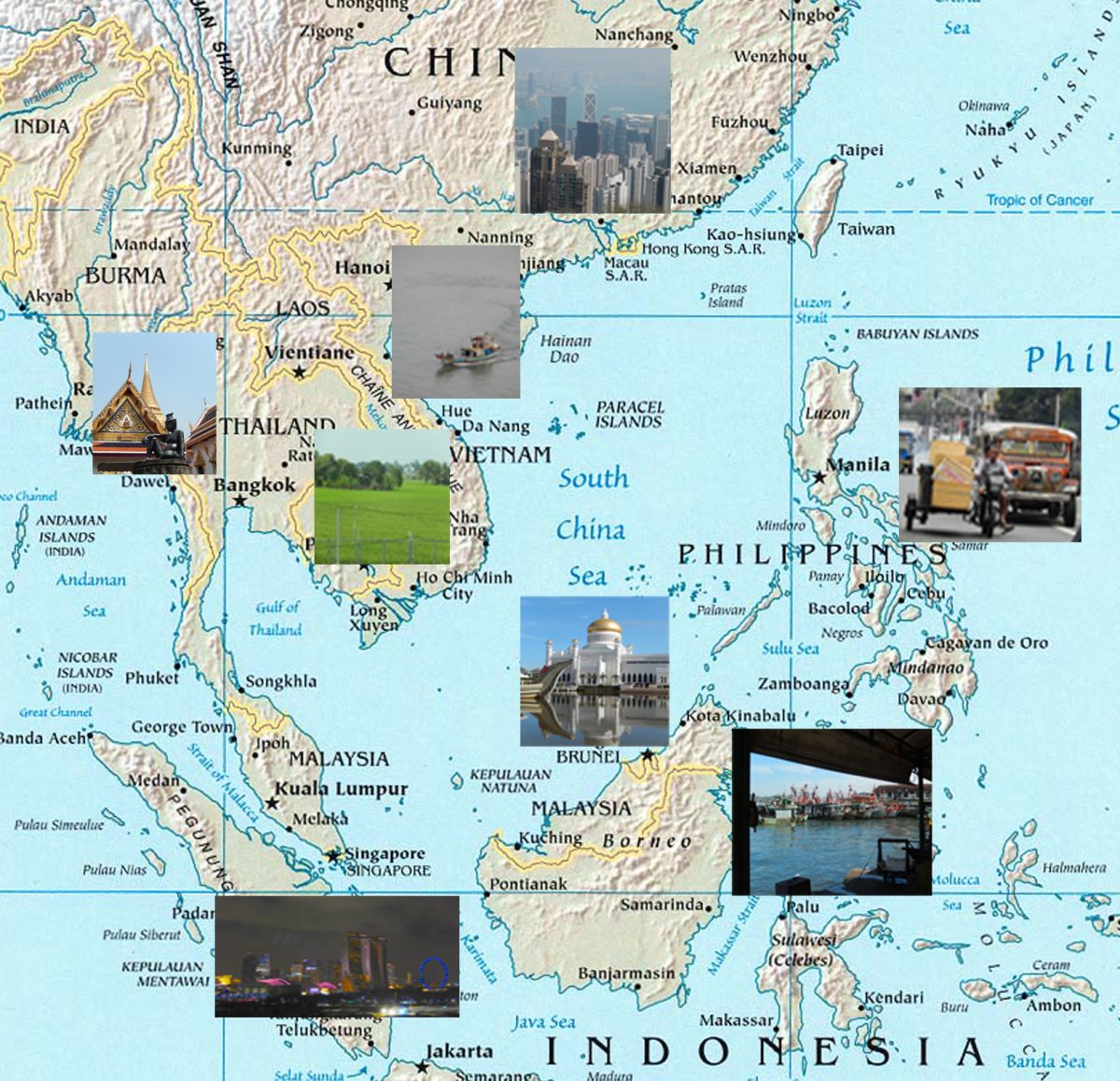
We spent all of a February cruising with Celebrity’s Constellation in the South China Sea on back-to-back itineraries. We visited twelve ports with only one repeat (Ho Chi Min City). If you are going to fly twelve thousand miles you probably should make the most of the trip. We flew into Singapore and with the return for the second cruise and the extra day in port at the end we had five days to explore this city and all we could say was wow! The ship also spent two days in the port for Bangkok and we spent one night in a Bangkok hotel and booked a private tour (more about that at another time ;-).
Beyond the usual reasons for cruising there was an additional advantage on this trip. If you are not into a diet of noodles with dried fish flakes or hot curries, the ship gives you the opportunity to return to a Western style menu. The ship also takes care of visas and immigration ahead of each port.
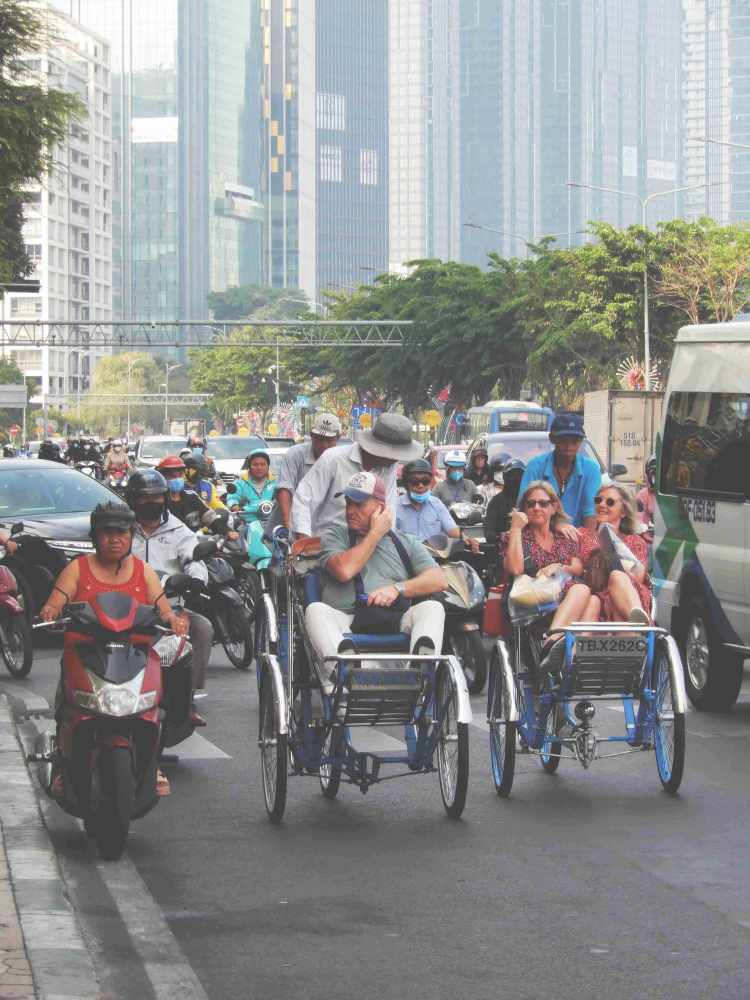
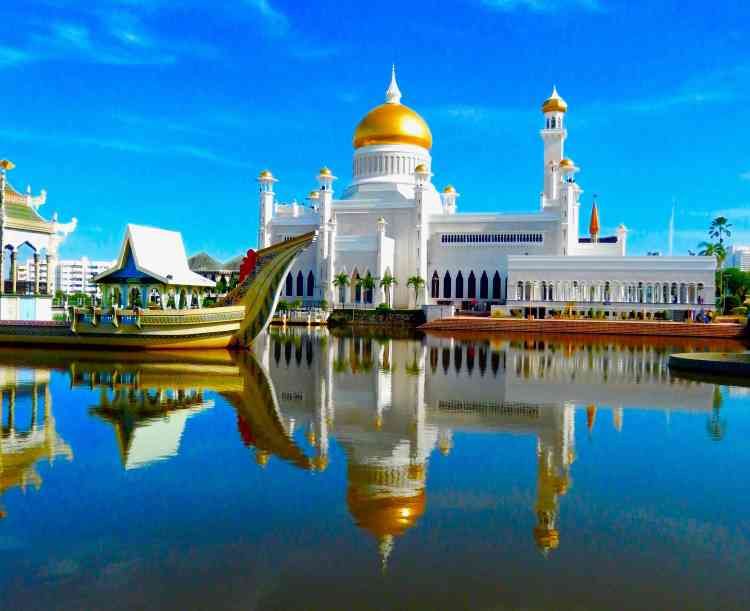
Besides our time in Singapore our trip included four stops in Vietnam, Hong Kong, two stops in the Philippines which included Manila, two stops in Borneo, Kota Kinabalu, Malaysia, Brunei and two stops in Thailand. We had an opportunity to see a lot as well as try a number of cuisines. Many of the destinations were studies in extreme contrasts but it was also obvious that things are greatly improving economically. It is also interesting to switch from Muslim to Buddhist to Western cultures as we went from one port to the next. On board there were a number of excellent in-depth lectures on the history and culture of the various countries which provided a good perspective on the ways the region developed.
Over the last number of years we have found cruising gives us an opportunity to sample a number of places and than we decide where we want to come back to for extended stays. Southeast Asia is no exception to this and we certainly have a few we will add to our return list.
Look for more posts covering each of these countries with pointers on must do things, food, transportation and hotels.
Planning A Cruise? Start With The Intentional Travelers Port Guides
 Most people think pasta when it comes to Italian cooking but actually Italy has a number of regional cuisines. Tuscan and Florentine diets trend heavily toward cold sliced meats, grilled meats, lots of beans, soups and stews. With the exception of lasagna, pasta is usually done as a side dish or a casserole in Florence. Because Florence has become such an international city and a huge tourist destination many of the restaurants have put together menus that fit the visitors expectations. One small restaurant in the central city that doesn’t fit that description is Trattoria Mario.
 If you are looking for a great value in good authentic food in Florence, Italy check out this gem. A local trattoria with an international clientele, owing its popularity somewhat to a bit of encouragement from Trip Advisor reviewers. It is located at Via Rosina, 2r, 50123 just a short walk from the Basilica di San Lorenzo.
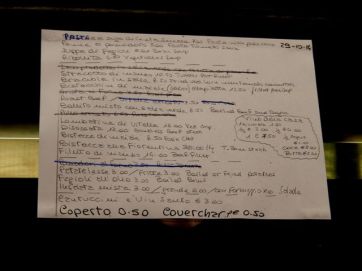 The restaurant is cozy and if crowded you will probably be sharing a table if you are a small party, but that is part of the experience. While there we overheard several tables talking in several languages. The restaurant has the feel of a neighborhood place with a staff that is friendly and efficient. The dishes are prepared with skill and are mostly priced between €5 and €8. The menu is hand written and taped on the kitchen window and as the chef runs out of an item he comes out and strikes thru it. Inexpensive splits of local wines are also available.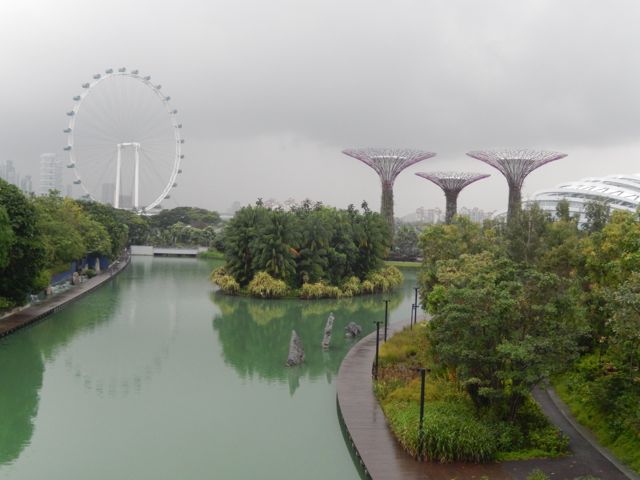
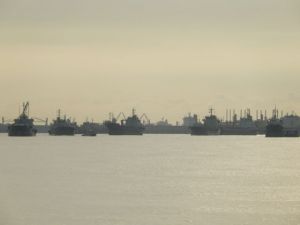 just off shore or are cruising by. Looking at a map you will notice that the South China Sea is blocked to the east by the Southeast Asia peninsula. The first opportunity that eastbound shipping has sailing from China, Hong Kong, Taiwan, Vietnam and all the other nations of the area is past Singapore and thru the Straights of Malacca (also sp. Melaka). That’s a lot of cargo bound for Europe, Africa, the Middle East and India all moving right past Singapore. That may also help explain why this city-state has become so rich and important.
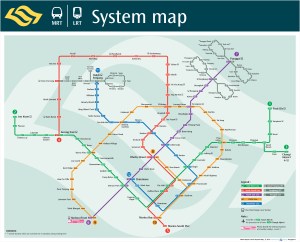 streets. When you arrive in country, your immigration form explains that selling drugs is punishable by death. While civil libertarians may be shocked, the obvious result is one of the most modern, safe and clean cities we have ever visited.
 Malay, Mandarin and Tamil but almost all signage is in English making it easy to get around and find things. The city boasts a world class rapid transit system, the
  newest and most spectacular being Gardens by the Bay. Almost everything can be reached via the MRT or an inexpensive taxi ride. The city also boasts a Chinatown and a Little India which offer inexpensive shopping and eating options.
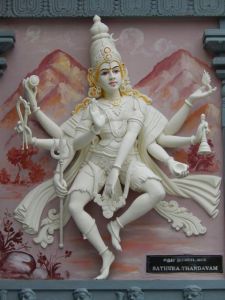 post in the early nineteenth century. The oldest, Sri Mariamman Temple dates back to 1827. The Sri Senpaga Vinayagar Temple is located on Ceylon Road, a few blocks from the Grand Mercure Roxy. It was built by the Sri Lankan Tamils for the Hindu God Ganesha.
 and 170 plus premium brand stores capped by a connecting roof garden floating at the top. It is home to a number of restaurants operated by the likes of Wolfgang Puck, David Myers and Gordon Ramsay.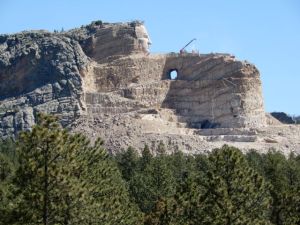




 hotels and a few campgrounds inside the park and reservations difficult to come by. Most Park visitors stay at motels in Jackson Hole or West Yellowstone so a lot of time is used up getting in and around the park. As summer advances so do the lines of cars so getting up early becomes a necessity. Also, if you get into the park late, the parking lots for a number of featured areas can be gridlocked.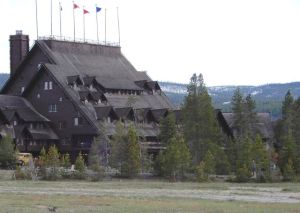
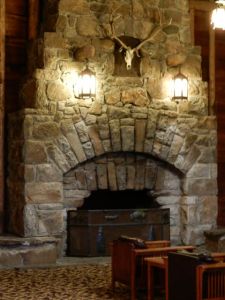
 grand lobby standing five stories high. The guest rooms, however, are primitive by modern standards: no air-conditioning, television or wifi, with spotty cell service and a real 1950s look. Ours had one double bed with a small bathroom featuring a pedestal sink (not much room for toiletries). The real draw is simply the location.
 permitting, a fire in the massive fireplace. Food is available in the main dining room (menu & buffet), the lobby bar which served light fare like bison burgers and chili, and a deli. Near the main lodge there is a country store with counter service until 5
 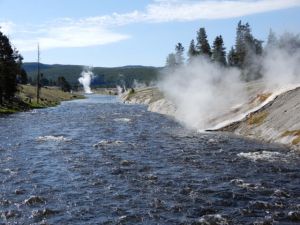 o’clock and a large cafeteria a short walk away. Between the lodge’s front door and the cafeteria is the Old Faithful geyser, currently putting on a show about every ninety minutes.


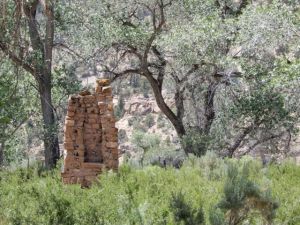 inches tall and ten inches long that simply said “First Site” and an arrow. If you have the time, a visit to a few of these thousand year old sites is really interesting.
 We visited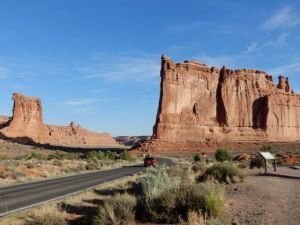

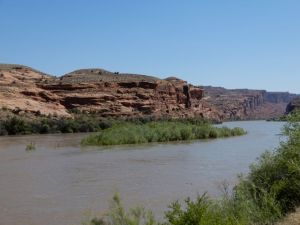
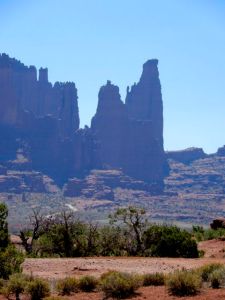 opens up to dozens of spires and buttes.
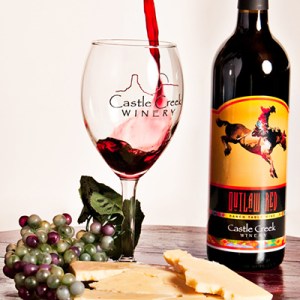 turn around and drive back unless you are going on to US 70. While we didn’t visit, we were told that there is an interesting movie museum near the Castle Creek Winery and there are numerous raft operators on this stretch of the Colorado River.
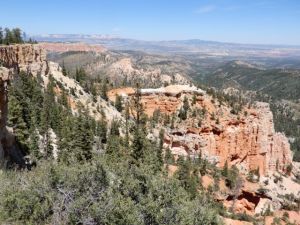
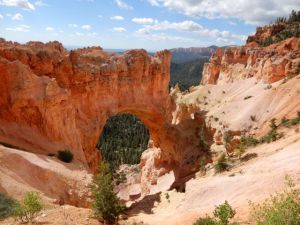
 looking down into the canyons which are packed with geological features called hoodoos. (Interconnected spires of colorful sandstone creating mazes and rising from the canyon floor.) While hoodoos are scattered throughout the parks in Utah, nowhere in the world are they as abundant as in the northern section of Bryce Canyon. Many of the hiking trails go down the canyon face and are steep and descend an average of 700 feet but there are a few walkways for those seeking less of a challenge.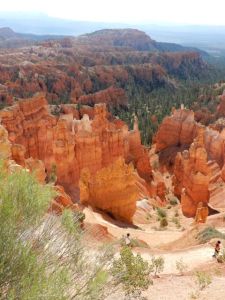
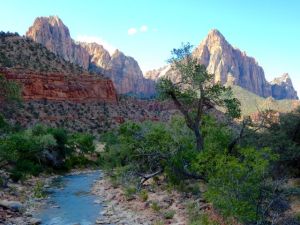
 wheel chair accessible to strenuous. One of the park’s more popular hikes goes thru “the narrows” which is a narrow width passage with a stream running through it . Unfortunately this trail and a few others require a permit and there is usually a several days wait to get one.
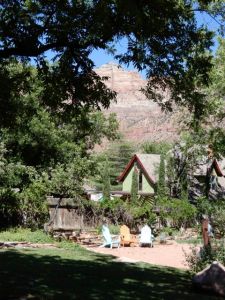 your headlights before entering. We got to the visitors center around 10:00 and had to search for parking. We took a couple of hikes on trails near the Visitors’ Center and by noon the line for the tour busses wound thru the complex and out into the parking lot. A few hours later when we exited to Springdale the line of cars to get in was backed up over a mile through town.
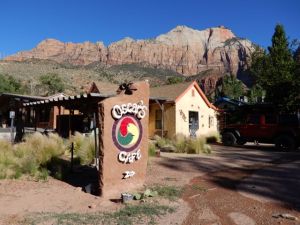 We spent the night at









 The Intentional Travelers